01. Quick Answer
The 2027 ALV outlook depends more on specific catalysts than on a fresh rediscovery of Allianz's quality
The 2027 question is narrower than the 2030 or 2035 debate. Investors are not asking whether Allianz is a good franchise. They are asking what could move ALV meaningfully over the next 12 to 18 months. The answer starts with the obvious: earnings delivery, cat-loss experience, pricing trends, Pimco and AGI flows, and whether management can keep capital return intact while confirming its full-year profit outlook (Allianz 1Q 2026).
| Catalyst | Why it matters |
|---|---|
| Operating-profit delivery | Near-term price action still depends on whether Allianz keeps proving that current profitability is durable. |
| Capital return | The buyback and dividend profile remain important support for the 2027 setup. |
| Catastrophe volatility | Short-horizon scenarios can change quickly if weather losses surprise to the upside. |
| Asset-management sentiment | Flow and fee trends can either reinforce or dilute the underwriting story. |
02. Historical Context
Near-term price behavior matters more than distant history for a 2027 call
Because the horizon is short, historical context should be practical rather than sprawling. Over the last 10 years Allianz compounded strongly, but the more relevant point for 2027 is that the shares reached about €390.50 in late 2025 and have since traded with more sensitivity to quarterly news flow and risk sentiment (Yahoo Finance history). That suggests 2027 is less about discovering Allianz and more about whether the stock deserves to hold or extend its premium after a strong run.
| Metric | Latest reading | 2027 implication |
|---|---|---|
| 1Q 2026 operating profit | €4.5 billion | A solid opening quarter reduces immediate downside pressure if the rest of the year remains orderly. |
| Solvency II ratio | 221% | Supports buybacks and reinforces balance-sheet confidence into 2027. |
| 2025 operating profit | €17.4 billion | A strong trailing base raises expectations but also gives management credibility. |
| Recent share range | Roughly €369 to €393 in early May 2026 daily closes | Shows the stock can still move materially around sentiment and results. |
The evidence is mixed in one important sense. Allianz's quality is widely recognized, which limits the surprise value of simply being solid. To outperform in 2027, the group probably needs either better-than-expected earnings conversion, more convincing fee-business momentum, or a meaningful market drawdown that makes its balance-sheet quality look especially attractive.
That is why 2027 should be framed as a catalyst map rather than a generic "good company, therefore good stock" argument. In a short horizon, even excellent businesses can stagnate if investors see no fresh reason to bid the multiple higher. Conversely, one or two quarters of stronger-than-expected underwriting, cash generation, or asset-management momentum can quickly reopen upside because the market already trusts the franchise.
03. Main Drivers
Five catalysts are most likely to decide whether ALV breaks higher or pauses into 2027
1. Full-year 2026 guidance credibility
If Allianz keeps confirming its annual outlook quarter after quarter, the market is more likely to reward consistency. If guidance starts to look stretched, the stock could pause even without a true deterioration in franchise quality.
2. Catastrophe losses during the 2026 and 2027 seasons
For a 2027 forecast, catastrophe experience matters more than for a 2035 one. A single bad season does not break Allianz, but it can change the near-term earnings narrative and valuation tone.
3. Pimco and Allianz Global Investors flow trends
Improving flows can make the group look more balanced and less dependent on pricing in P&C. Weak flows would remind the market that one of Allianz's important quality engines is not on autopilot.
4. European rate expectations and reinvestment yields
Insurers benefit from better reinvestment economics, but bond-market volatility can still affect sentiment and reported capital metrics. The 2027 path therefore remains partly macro-sensitive.
5. Buybacks and dividend signaling
Capital return is not a footnote in ALV. It is one of the clearest reasons long-only investors stay interested even when growth is not spectacular (full-year 2025 release; CMD 2024).
04. Institutional Forecasts and Analyst Views
Analyst debate is centered on catalysts, not on whether Allianz is fundamentally sound
Shorter-horizon institutional views are easier to frame than 2035 scenarios because management guidance and current industry conditions matter more than distant structural shifts. Even so, public 2027 price targets are less informative than the factors analysts actually debate: the pace of operating-profit growth, solvency durability, claims costs, and whether capital return remains steady.
| Input | Signal | Why it matters for 2027 |
|---|---|---|
| Allianz 1Q 2026 release | Management confirmed the annual outlook | Supports the idea that the near-term base case remains constructive. |
| Allianz CMD 2024 | EPS CAGR and payout targets remain in place | Keeps the market focused on execution rather than speculation. |
| Aon and Swiss Re market commentary | Pricing remains rational, though not uniformly hard | Explains why upside depends on discipline rather than a runaway market. |
| Ratings profile | High-quality balance-sheet support remains intact | Limits the probability of a disorderly downside scenario absent new shocks. |
Available data suggests that analysts are less divided on Allianz's quality than on its near-term upside from current levels. That is an important distinction. It means 2027 probably hinges on catalysts, not on a rediscovery of the business model.
For practical forecasting, investors should track four leading indicators: quarterly operating profit versus guidance, the Solvency II ratio, cat-loss experience against expectations, and whether asset-management businesses contribute positively to sentiment. If three of those four stay supportive, the base case can migrate toward the upper end of the range. If they deteriorate together, the downside case becomes far more credible.
05. Scenarios, Risks, and Invalidation
Bull, bear, and base cases for 2027 should be anchored to explicit triggers
Bullish 2027 scenario
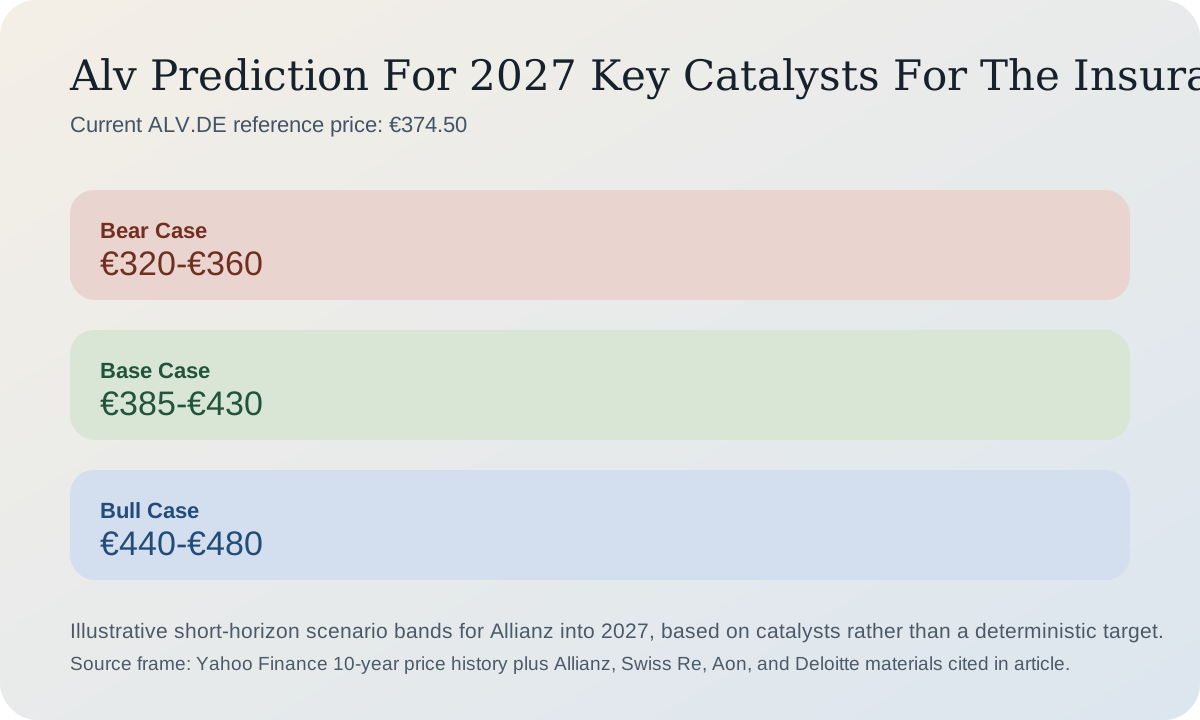
The bull case is €440 to €480. This likely needs clean earnings beats, manageable cat losses, supportive fixed-income markets, and capital return that feels reliably repeatable. In that setup, investors may treat Allianz as a rare combination of resilience and still-acceptable growth.
Bearish 2027 scenario
The bear case is €320 to €360. This does not require a deep crisis. It would likely follow from weaker pricing, heavier losses, poor flow momentum, or a macro wobble that makes investors question whether Allianz deserves its current valuation support.
Base-case 2027 scenario
The base case is €385 to €430. That range assumes more of the same: solid but not spectacular delivery, steady payouts, and a market that respects Allianz's quality without assigning a much richer multiple.
| Scenario | Range | Catalysts | Probability |
|---|---|---|---|
| Bull | €440-€480 | Clean earnings, light cat losses, good flows, durable buyback support | 25% |
| Base | €385-€430 | Steady guidance, disciplined underwriting, stable solvency | 50% |
| Bear | €320-€360 | Loss-heavy weather years, weaker pricing, asset-management softness | 25% |
| Path | Estimated probability | Why |
|---|---|---|
| Rising by 2027 | 45% | The quality base is strong, but the stock already reflects much of it. |
| Falling by 2027 | 25% | A pullback is plausible if catalysts disappoint in a mature valuation setup. |
| Moving sideways | 30% | A high-quality insurer can drift if near-term beats are incremental rather than decisive. |
Risks to watch
Watch the catastrophe season, commercial line pricing, solvency trajectory, and any evidence that asset-management fee businesses are losing traction. Those factors can change the 2027 setup quickly.
What could invalidate the forecast
The base range would be too low if Allianz meaningfully exceeded guidance and accelerated per-share capital return. It would be too high if the market started to treat 2025 as a cyclical earnings peak rather than a durable level.
Conclusion
The 2027 ALV setup is constructive but selective. Allianz remains a high-quality franchise, yet the near-term outcome depends on concrete catalysts rather than abstract admiration for its balance sheet.
That makes patience part of the strategy. Investors who want exposure still need to separate long-run respect for the business from the shorter-horizon question of what can actually move the shares over the next several reporting cycles.
Disclaimer: This article is for informational purposes only and does not constitute individualized financial advice. Near-term scenarios are conditional and not guaranteed.
06. Investor Positioning
Different time horizons require different ALV tactics
| Investor type | Prudent approach | Key monitor |
|---|---|---|
| Investor already in profit | Consider holding core exposure and trimming only if the name became oversized. | Quarterly guidance confirmation and cat-loss season. |
| Investor currently at a loss | Use stop-loss or thesis-based review rather than blind averaging. | Whether losses reflect fundamentals or only short-term market swings. |
| Investor with no position | Wait for pullbacks or scale in gradually. | Entry discipline matters more when upside is catalyst-dependent. |
| Trader | Trade around earnings and macro events with defined risk. | Volatility can compress quickly after catalysts pass. |
| Long-term investor | A gradual build can still make sense, but avoid chasing short-term strength. | Capital return and 2027 target delivery. |
| Risk-hedging investor | Do not confuse Allianz with a portfolio hedge. | Pair with actual hedges if downside protection is the primary goal. |
07. FAQ
Frequently asked questions about an ALV 2027 prediction
What is the single biggest catalyst for ALV into 2027?
The cleanest catalyst is continued evidence that operating profit and solvency remain strong enough to support sustained capital return.
Can Allianz rally in 2027 even if insurance pricing softens?
Yes, but it would need offsetting positives such as better investment income, stronger asset-management flows, or more aggressive per-share capital return.
Why is the sideways probability still meaningful?
Because mature, high-quality financials often consolidate after strong runs if new information is good but not dramatically better than what the market already expects.
References
Sources
- Yahoo Finance chart API for ALV.DE, 10-year monthly history and recent daily closes
- Allianz 1Q 2026 earnings release
- Allianz full-year 2025 earnings release
- Allianz Group Annual Report 2025
- Allianz Capital Markets Day 2024: 2027 targets and capital framework
- Allianz ratings page
- Swiss Re Institute insurance industry outlook and sigma research
- Aon Global Insurance Market Insights, Q1 2026 overview
- Deloitte insurance industry outlook
- Allianz Risk Barometer
- Allianz natural catastrophe resilience research
- Allianz Responsible AI principles