01. Quick Answer
A 2035 BAYN forecast has to separate operating potential from litigation drag, because the two can move in opposite directions for years
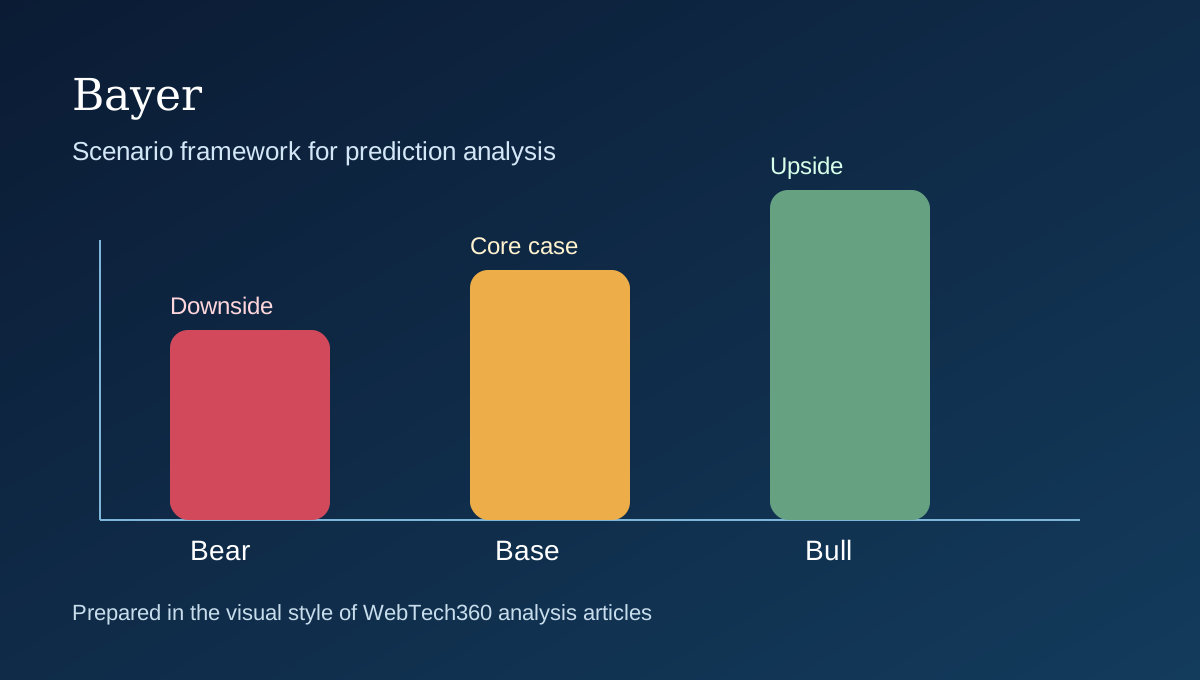
The long-range case for Bayer is not built on explosive growth. It is built on whether a global life-sciences platform with real drug, seed, and consumer assets can eventually trade closer to intrinsic value once legal and leverage overhangs ease. Available data suggests a reasonable 2035 base case is around €45 to €60, with a bull case up to €95 if Pharma execution compounds and litigation becomes genuinely finite. The bear case remains meaningful because the market has learned, repeatedly, that legal uncertainty can erase operational progress.
| Point | Why it matters |
|---|---|
| 2035 is long enough for real rerating | If the legal overhang fades, Bayer has enough time to compound from a depressed base. |
| The bull case is operational and legal | Strong Pharma alone is not enough; legal normalization must accompany it. |
| The bear case is not just about earnings misses | It is about capital being trapped by litigation and leverage for much longer than investors expect. |
| Scenario thinking is essential | A single target would overstate precision for a company with unresolved event risk. |
02. Historical Context
The last decade shows that Bayer's valuation can swing far more than its asset base
Bayer's 10-year chart is a reminder that market structure and legal confidence can dominate operational fundamentals for prolonged periods. The stock went from the high-€80s in 2017 to below €20 in late 2024 before recovering toward the high-€30s by mid-May 2026. Yet throughout that period Bayer still owned major global businesses. That history matters for 2035 because it implies the upside does not require Bayer to become a new company; it requires the market to stop pricing it like an unbounded legal problem.
At the same time, a 2035 framework has to be realistic about why the discount emerged. Roundup litigation has already cost Bayer tens of billions of dollars in settlements and provisions, while 2026 guidance still implied material free cash outflow due to legal payouts. Investors who ignore that history usually overestimate how quickly the stock can normalize.
| Metric | Latest data | 2035 relevance |
|---|---|---|
| Recent price | €37.84 | Still reflects a large litigation discount versus Bayer's historical range |
| 10-year CAGR | -5.7% | Shows why rebound math can be powerful if the thesis improves |
| 2026 EBITDA guidance | €9.6-€10.1 billion | Indicates the core operating base remains substantial |
| 2026 free cash outflow guidance | €1.5-€2.5 billion | Highlights that value realization is still constrained today |
| Area | Needed improvement | Why the market cares |
|---|---|---|
| Legal risk | Clearer containment of Roundup liabilities | Without this, investors keep applying a deep discount to every future cash flow. |
| Pharma mix | Sustained growth in Nubeqa, Kerendia, asundexian, and newer pipeline assets | Quality growth deserves a higher multiple. |
| Leverage | Steady debt reduction after litigation cash drag moderates | A cleaner balance sheet broadens the investor base. |
| Capital allocation | Disciplined M&A and internal investment | Shareholders need confidence that new spending will create value, not more complexity. |
03. Main Drivers
The 2035 story depends on how Bayer resolves six structural questions
1. Can Bayer turn legal uncertainty into legal drag?
There is a large difference between an open-ended liability story and a manageable payout story. The stock probably cannot sustain a full rerating until investors believe Bayer has crossed that line.
2. Can Pharma become the valuation leader?
Management's 2026 Pharma messaging was notably more ambitious than in prior years. Returning to mid-single-digit growth from 2027 and pushing margins toward 30% by 2030 would make Pharma the highest-quality part of the group by a wider margin.
3. Can Crop Science become less cyclical in investors' minds?
Crop Science will likely remain cyclical, but a stronger seed traits franchise, digital agriculture, and better cost discipline could reduce the perception that the segment is mainly a source of volatility.
4. Will AI improve productivity enough to matter financially?
Bayer's AI use cases in drug discovery, clinical trials, radiology, and agronomy are increasingly concrete. Over a 10-year horizon, these gains can shift R&D productivity and commercial efficiency even if the impact looks modest quarter to quarter.
5. Will balance-sheet repair expand strategic flexibility?
Bayer's debt is not merely an accounting issue. It shapes what management can do with dividends, acquisitions, and investor messaging. A healthier balance sheet is central to the bull case.
6. Can the conglomerate discount narrow without a breakup?
CEO Bill Anderson suspended a strategic review that might have led to a breakup. That means Bayer now needs to prove that better execution alone can unlock value. If it cannot, the discount may linger even after some operational progress.
04. Institutional Forecasts and Analyst Views
Current institutional signals support upside from today's level, but they do not justify complacency
Public analyst commentary in 2026 was constructive overall but conditional in tone. JPMorgan maintained an Overweight rating with a €50 target after Q1. UBS upgraded the stock to Buy with a €52 target, arguing that Bayer traded at a steep discount to European pharma peers and that litigation progress could unlock a 36.2% 12-month total return. On the other hand, Reuters reported that Bayer's 2026 guidance still came in below consensus at the midpoint, showing that the sell side is not ignoring execution risks.
| Institution / source | Published view | Long-range implication |
|---|---|---|
| JPMorgan | Overweight, €50 target | Suggests credible upside even before assuming full legal normalization. |
| UBS | Buy, €52 target; 4% Pharma sales CAGR 2025-2030 | Supports the idea that better Pharma mix can narrow Bayer's structural discount. |
| Barclays, via Reuters | Guidance midpoint 3.3% below consensus | Warns that poor operating delivery can still delay rerating. |
| Bayer management | Pharma growth from 2027; margin toward 30% by 2030 | Provides the core assumptions needed to extend a 2035 bull or base case. |
For a 2035 forecast, the cleanest approach is to treat these views as short-to-medium-term anchor points, then extend them through scenario analysis. The public record supports the idea that Bayer has operating upside from here. It does not support pretending that the path will be smooth.
05. Bull, Bear, and Base Case Scenarios
The 2035 range is wide because the company has both quality assets and unusual legal baggage
| Scenario | 2035 range | Conditions required |
|---|---|---|
| Bull | €70-€95 | Roundup moves from existential worry to manageable legacy issue, Pharma compounds as planned, debt falls substantially, and Bayer's peer discount narrows sharply. |
| Base | €45-€60 | Legal costs remain material but finite, Pharma grows modestly, Crop Science stays useful but cyclical, and the discount narrows only partially. |
| Bear | €20-€35 | Litigation remains stubborn, cash generation disappoints, acquisitions fail to offset patent erosion, and Bayer stays trapped as a discounted special situation. |
The base case assumes neither a heroic turnaround nor a fresh collapse. It assumes Bayer eventually earns a more normal valuation on still-imperfect fundamentals. The bull case is powerful because starting valuation is low enough that moderate business improvement could have an outsized stock impact. The bear case remains credible because a company can spend years generating respectable EBITDA without delivering much equity value if legal payouts and debt absorb the cash.
| Path | Probability | Comment |
|---|---|---|
| Probability of rising | 50% | Starting valuation and public bank targets support upside over a nine-year window. |
| Probability of falling | 25% | It would likely require legal disappointment plus operating under-delivery. |
| Probability of moving sideways | 25% | Possible if operational progress is offset by persistent discounting. |
This probability range is derived from current valuation versus history, visible sell-side targets, management's published divisional objectives, and the scale of cash-flow drag still tied to litigation. It is an interpretive framework, not a mechanical valuation model.
06. Investor Positioning, Risks, and Invalidation
Long-dated investors should think in tranches and scenarios, not in a single all-in call
| Investor type | Cautious approach | Key focus |
|---|---|---|
| Investor already in profit | Rebalance on strong rallies and keep a core position only if the legal thesis is improving | Do not let a recovery trade become an unexamined conviction holding. |
| Investor currently at a loss | Average only if your legal and cash-flow assumptions still hold | Being down is not itself a reason to add. |
| Investor with no position | Use staged entry points rather than chasing headline spikes | Bayer remains event-driven. |
| Trader | Trade around legal and earnings catalysts with strict stops | Volatility can be abrupt in both directions. |
| Long-term investor | Monitor debt reduction, not just EPS growth | Equity value creation depends on what cash flow is left after legal costs. |
| Risk-hedging investor | Keep position sizes modest or pair with less event-driven healthcare exposure | This remains a special-situation stock. |
Risks to watch: adverse litigation developments, slower launches in Pharma, patent erosion, crop-protection pricing weakness, acquisition integration risk, and policy shifts around drug pricing or trade.
What could invalidate this forecast: a decisive legal win or settlement structure that sharply caps long-tail liabilities would invalidate the conservative side of this forecast. Conversely, if new legal complexity or persistent free cash outflows delay balance-sheet repair into the 2030s, even the base case could prove too optimistic.
Disclaimer: This is a scenario analysis for informational purposes, not personalized financial advice. Long-range equity forecasts are highly sensitive to assumptions that can change materially.
07. FAQ
Frequently asked questions about Bayer's 2035 forecast
Why not use one precise 2035 price target?
Because the main drivers are scenario-dependent. Bayer's legal path can materially change fair value, so a range is more defensible than false precision.
What supports the bull case most?
The combination of depressed starting valuation, public bank targets in the low-€50s already, and management's plan for better Pharma growth and margins.
What keeps the bear case alive?
Litigation tail risk, debt, and the possibility that operational improvements do not convert into cash available for shareholders.
Is 2035 enough time for Bayer to fully recover?
Possibly, but only if legal drag becomes bounded. Time alone does not fix a structurally uncertain liability profile.
References
Sources
- Yahoo Finance chart API, BAYN.DE 10-year monthly history and recent share price
- Bayer Quarterly Statement Q1 2026, earnings performance
- Bayer investor relations hub for Q1 2026 results and presentation materials
- Bayer Annual Report 2025
- Bayer Pharma Media Day 2026: portfolio, pipeline, and 2030 margin ambition
- Bayer strategy page covering core life-science priorities
- Bayer, Delivering on the promise of artificial intelligence
- Bayer Crop Science, GenAI for Good and E.L.Y. productivity program
- Reuters, March 4, 2026: Bayer's 2026 profit guidance and litigation-driven free cash outflow
- Reuters, February 17, 2026: Roundup settlement and Supreme Court strategy
- Reuters, February 25, 2026: pushback against the proposed Roundup settlement
- Reuters, May 12, 2026: Q1 operating profit beat driven by soy licensing resolution
- Reuters, April 7, 2026: Bayer says U.S. pharma tariffs do not change 2026 guidance
- Reuters, May 6, 2026: Bayer to acquire Perfuse Therapeutics for up to $2.45 billion
- dpa-AFX via Investing.com, May 12, 2026: JPMorgan keeps Bayer at Overweight with a €50 target