01. Quick Answer
The most defensible 2027 Brent outlook is below today's spot price, but not necessarily back to the old glut era
The strongest public anchors for 2027 are the EIA global oil page and the IMF WEO database. Both point to oil assumptions in the mid-$70s, materially below today's Brent quote near $110.99/bbl. That matters because current prices still reflect live disruption risk. At the same time, the World Bank Commodity Markets Outlook and IEA Oil Market Report show that the market can stay above baseline longer if supply disruptions, freight risk, or OPEC discipline tighten the prompt balance.
| Category | Evidence-based read | Implication |
|---|---|---|
| Historical data | Brent moved from $16/bbl to $137/bbl within one decade Yahoo Finance | Near-term forecasts must allow for volatility. |
| Current market conditions | Spot Brent near $110.99/bbl is above the EIA and IMF 2027 anchors | The market is pricing more risk than official base cases. |
| Institutional signals | EIA global oil page and IMF WEO database both point to normalization, while the World Bank Commodity Markets Outlook keeps a high-price stress case alive | Analysts remain divided on how fast current tightness fades. |
| Most important watchpoints | OPEC supply decisions, non-OPEC growth, inventory draws, and shipping risk | These should shape 2027 more than broad commodity sentiment. |
02. Historical Context
Why the 2027 call is mostly about whether today's disruption premium fades
By 2027, Brent does not need a deep long-run philosophical debate. It needs a near-to-medium-term answer to a simpler question: does the market normalize toward the official forecasts, or does the current price shock expose a tighter system than baseline models allow? The ten-year tape from Yahoo Finance shows how quickly Brent can mean revert after a shock, but the IEA Oil Market Report and World Bank Commodity Markets Outlook show why this time could still stay tighter for longer.
| Metric | Latest read | Why it matters |
|---|---|---|
| Current Brent reference | $110.99/bbl | The spot price is still shaped by live geopolitical and shipping uncertainty. |
| EIA 2027 average | $76/b | This is the clearest official public anchor for 2027. |
| IMF oil assumption | About $75.97 in 2027 | The IMF baseline broadly reinforces EIA's normalization bias. |
| World Bank escalation band | $95-$115 in a 2026 stress case | Upside into 2027 becomes plausible if disruption persists. |
| Marker | Level | Interpretation |
|---|---|---|
| April 2020 low | $16/bbl | Useful reminder of how violently oil can overshoot in a demand shock. |
| March 2022 high | $137/bbl | Shows the upside when sanctions and war reprice physical security. |
| November 2024 close | $72.94/b | This is a helpful benchmark for a more balanced market. |
| December 2025 close | $60.85/b | The market was willing to price oversupply before 2026 disruptions returned. |
| May 2026 spot | $110.99/bbl | A large gap versus 2027 official assumptions implies downside if the shock fades. |
03. Main Drivers
The 2027 Brent forecast hinges on five practical drivers
1. Whether current disruptions prove temporary
The first driver is simple: if the current conflict premium fades, Brent can fall quickly toward the official baseline in the EIA global oil page. If it persists, 2027 averages can stay much higher.
2. OPEC+ discipline versus market-share pressure
If OPEC keeps defending price rather than volume, the downside to Brent narrows. If market-share pressure returns, the bear case gains credibility.
3. Non-OPEC barrels
The base case assumes U.S. and other non-OPEC producers still add enough supply to soften the market over time. That logic is embedded in the EIA global oil page.
4. Demand elasticity
The IEA Oil Market Report makes clear that high prices eventually hurt demand. The 2027 range therefore depends on how much consumers and industry adapt if oil stays expensive into 2026.
5. Macro growth and inventories
Oil rarely trades on demand forecasts alone. Inventory levels, freight disruption, and the health of manufacturing all matter. The evidence is mixed, which is why the 2027 call should stay conditional.
04. Institutional Forecasts and Analyst Views
For 2027, the public record is unusually clear: the official base case is lower than spot
The EIA global oil page is explicit that Brent should cool meaningfully if current disruptions ease, and the IMF WEO database broadly agrees with an oil assumption near the mid-$70s. The World Bank Commodity Markets Outlook and Reuters on Barclays show the opposing view: if the geopolitical risk premium lingers, analysts can re-mark forecasts higher quickly. That makes 2027 one of the cleaner scenario exercises in oil today.
| Source | Message | Interpretation |
|---|---|---|
| EIA | Average Brent around $76/b in 2027 | This is the central public baseline. |
| IMF | Oil assumption around $75.97 in 2027 | A second official source supporting normalization. |
| World Bank | Escalation can keep Brent above baseline for longer | Supports the bull scenario if disruption remains active. |
| IEA | Demand and supply are both sensitive to current high prices | Suggests the market can re-balance faster than narrative traders expect. |
| Barclays via Reuters | Raised 2026 Brent forecast to $100/b | Confirms that private forecasts can still chase geopolitical tightening higher. |
05. Bull, Bear, and Base Case
How the 2027 range and probabilities are built
The range starts with a simple spread: today's spot price versus the official 2027 baseline. The wider that spread, the more carefully investors should treat current conditions as temporary rather than permanent. The probabilities then ask how much of today's premium can survive another year of supply response and demand adaptation.
| Scenario | Price range | Conditions | Probability |
|---|---|---|---|
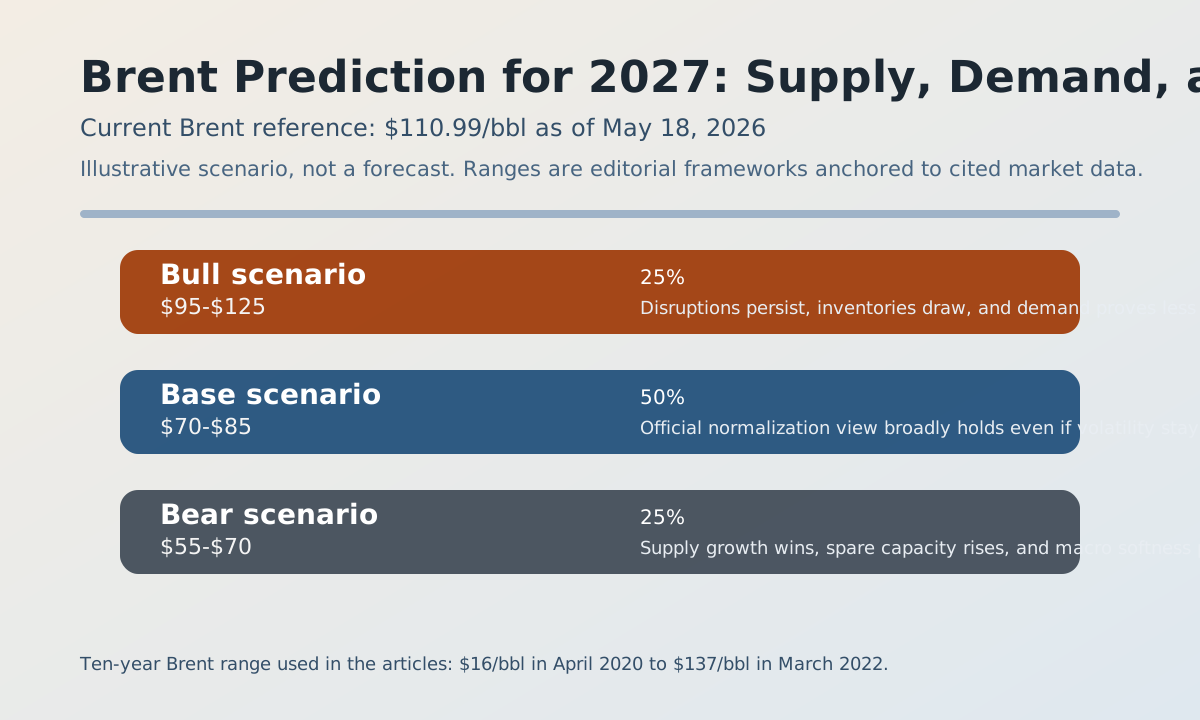
| Bull | $95-$125 | Disruptions persist, inventories draw, and demand proves less price-sensitive than expected | 25% |
| Base | $70-$85 | Official normalization view broadly holds even if volatility stays high | 50% |
| Bear | $55-$70 | Supply growth wins, spare capacity rises, and macro softness pulls prices down | 25% |
| Direction | Probability | Comment |
|---|---|---|
| Higher | 25% | The higher path requires disruptions and OPEC discipline to remain stronger than the market currently assumes. |
| Lower | 35% | The lower path becomes more likely if current conflict premium fades quickly. |
| Sideways to moderate decline | 40% | The base case is still some normalization, but not necessarily a collapse. |
Bullish scenario. Brent can still average $95-$125 in 2027 if the market carries conflict premium well beyond 2026, if shipping routes stay stressed, and if OPEC's spare capacity remains a strategic tool rather than a fast relief valve.
Bearish scenario. The $55-$70 outcome requires fading disruption, stronger-than-expected supply growth, and enough macro softness for inventories to rebuild. That scenario would look more like late 2025 than like the current tape.
Base case. The $70-$85 band sits above the weakest oversupply moments but still tracks closely to the EIA global oil page and IMF WEO database anchors. It is the most defensible range unless new evidence shows the 2026 shock is structural rather than temporary.
06. Positioning, Risks, and Conclusion
Investor positioning should reflect the gap between spot and official 2027 baselines
| Investor type | Prudent approach | Main watchpoints |
|---|---|---|
| Investor already in profit | Consider trimming into strength or hedging, because spot is already well above the official 2027 base case. | Curve backwardation and ceasefire headlines. |
| Investor currently at a loss | Do not automatically average down. Reassess whether the original thesis assumed a temporary disruption or a longer structural squeeze. | Producer response and inventories. |
| Investor with no position | Avoid chasing triple-digit oil after a shock. Wait for pullbacks or build exposure in stages. | Prompt spreads and OPEC communication. |
| Trader | Use stop-loss levels and event calendars. Near-term oil trades can reverse faster than conviction narratives. | Headlines, sanctions, and shipping data. |
| Long-term investor | Stay diversified and avoid using a 2027 commodity view as the only pillar of a portfolio thesis. | Demand elasticity and capex discipline. |
| Risk-hedging investor | Use Brent selectively as a macro hedge and rebalance if the position becomes too dependent on one geopolitical path. | Cross-asset hedging effectiveness. |
Risks to watch
Risks to watch include a sudden ceasefire, a surprise OPEC output increase, a deeper slowdown in manufacturing, or another supply shock that pushes the market further into scarcity. The most important distinction is between a correction, a cyclical bear market, and a structural collapse. Available data today supports the first two as plausible; the third still lacks strong evidence.
Conclusion
The 2027 Brent forecast is one of the few places where official baselines are materially lower than spot. That does not make the downside automatic, but it does mean investors should treat current prices as a stress-influenced condition rather than as the default equilibrium. A cautious base case remains around $70-$85, with upside only if disruption and discipline remain unusually persistent. Disclaimer: This article is for informational and research purposes only and does not constitute personalized financial advice.
07. FAQ
Frequently asked questions
What is the best public Brent forecast for 2027?
The clearest official public anchor is the EIA global oil page forecast near $76/b, reinforced by the IMF WEO database assumption around $75.97.
Why is the base case below today's price?
Because current spot still includes a geopolitical premium that may not survive intact into 2027.
Could Brent still be above $100 in 2027?
Yes, but that requires disruptions or OPEC discipline to persist longer than the official base cases assume.
What would invalidate the base case?
A structurally tighter supply system, repeated geopolitical shocks, or much weaker non-OPEC supply growth would all weaken the $70-$85 base case.
Methodology and Invalidation
How to interpret this framework and what would invalidate it
This framework puts the greatest weight on the EIA global oil page and IMF WEO database because the user asked for a 2027 call, and those are the strongest public medium-term anchors. The World Bank Commodity Markets Outlook and IEA Oil Market Report are then used to stress-test that baseline under escalation and physical-balance uncertainty.
The probability table is based on the gap between current spot and official medium-term assumptions, plus the historical tendency of Brent to normalize after geopolitical spikes unless the physical system remains genuinely constrained.
What would invalidate the framework? A deeper and longer disruption cycle, OPEC discipline that meaningfully restricts relief supply, or a weaker-than-expected non-OPEC response would all lift the upper tail. A sharper global slowdown or surprise producer competition would move the range down.
References
Sources
- Yahoo Finance, Brent Crude Oil Futures quote page and historical chart
- U.S. EIA, Short-Term Energy Outlook global oil section
- U.S. EIA, Short-Term Energy Outlook
- IMF, World Economic Outlook database, April 2026
- World Bank, Commodity Markets Outlook, April 2026
- World Bank, Commodity Markets Outlook release, April 28, 2026
- IEA, Oil Market Report, May 2026
- OPEC, Annual Statistical Bulletin
- Reuters via TradingView, Barclays raises 2026 Brent forecast
- Reuters via Investing.com, oil rises on Middle East supply fears