01. Quick Answer
A credible 2035 ETH forecast starts with market share, fee retention, and real-world utility rather than meme-cycle extrapolation
Very few credible institutions publish formal 2035 ETH targets, and that absence is healthy. It forces analysts to build from scenarios instead of pretending a single number can survive ten years of technology, regulation, and macro shocks. Available data suggests ETH could trade far above current levels by 2035 if Ethereum remains the default programmable settlement layer for tokenized assets, stablecoins, and onchain applications (Franklin Templeton) (Coinbase and EY-Parthenon). But the evidence is mixed on whether that implies a mid-four-figure, five-figure, or even higher path.
| Category | Evidence-based read | Implication |
|---|---|---|
| Historical data | ETH already moved from double-digit prices in the late-2018 trough to nearly $4,800 at the 2025 peak in available Yahoo history (Yahoo Finance) | Long-run upside is plausible, but not linear |
| Current market conditions | ETH is trading near $2,120.16, well below its 2025 peak (Yahoo Finance) | The 2035 base should not assume a straight-line climb from here |
| Institutional context | Spot ETF access, staking frameworks, and deeper derivatives markets all exist today (SEC) (CME Group) | The market is more mature than it was in earlier ETH cycles |
| Working base case | ETH has a reasonable path to materially higher prices by 2035 if adoption compounds | Magnitude depends on market share and value capture, not hype |
02. Historical Context
How high Ethereum can really go depends on whether the next decade looks more like infrastructure build-out or margin compression
The long-run bull case for ETH is strongest when framed as infrastructure logic rather than crypto tribalism. Ethereum.org's roadmap describes a chain designed to scale through cheaper rollups, account abstraction, and future security improvements (Ethereum.org). That is constructive for long-duration relevance. But a 2035 forecast must also respect Grayscale's warning that Ethereum can win on usage while still struggling on token valuation if too much economic value migrates above layer 1 (Grayscale).
| Metric | Latest reading | Why it matters |
|---|---|---|
| Recent ETH close | ~$2,120.16 | Sets the base for any realistic 2035 CAGR discussion |
| Institutional wrapper | Spot Ether ETFs are already part of the market structure | Reduces access friction for long-duration capital |
| Staking and security model | Ethereum's proof-of-stake system reduced energy consumption by about 99.95% after The Merge (Ethereum.org) | Helps the long-run sustainability and ESG narrative |
| Tokenization tailwind | Franklin Templeton and other incumbents are already building onchain financial products (Franklin Templeton) (Benji) | Suggests enterprise experimentation has moved beyond theory |
| Annualized growth assumption | Implied 2035 level | How demanding it looks |
|---|---|---|
| 5% CAGR | ~$3.3k | Very conservative; implies Ethereum remains useful but struggles to rerate |
| 10% CAGR | ~$5.5k | Reasonable if ETH behaves like a durable but cyclical digital infrastructure asset |
| 15% CAGR | ~$8.9k | Plausible if tokenization, settlement, and staking keep compounding |
| 20% CAGR | ~$14.4k | Requires stronger fee retention and broader asset-allocation adoption |
| 25% CAGR | ~$23.0k | Aggressive; assumes Ethereum captures far more economic activity without severe dilution of value capture |
03. Main Drivers
The long-run upside case rests on five structural questions
1. Does Ethereum remain the default settlement layer for tokenized finance?
Franklin Templeton's onchain fund work and broader RWA commentary indicate real institutions are still testing public-chain rails for settlement and record-keeping (Franklin Templeton) (Benji). If Ethereum-linked infrastructure stays central to that trend, the long-run addressable market for ETH remains large.
2. Can staking keep ETH investable to institutions?
Fidelity's thesis and the Ethereum Foundation's own treasury staking initiative both reinforce that staking is not a side narrative anymore (Fidelity) (Ethereum Foundation). A productive, yield-like asset often commands more durable strategic allocations than a purely inert one.
3. Will scaling strengthen the moat or dilute the token?
Rollups are core to Ethereum's roadmap, and Ethereum.org argues they are the path to cheaper user experiences (Ethereum.org). The upside is more activity. The risk is that the economics increasingly live elsewhere, leaving ETH under-monetized relative to the ecosystem it anchors.
4. Does regulation normalize enough to unlock broader portfolio inclusion?
SEC-approved spot Ether products matter because they move ETH from crypto-native custody rails into mainstream brokerage rails (SEC) (BlackRock). A decade-long forecast should assume regulation gets clearer, but not necessarily friendlier in every cycle.
5. How much competition emerges from other smart-contract ecosystems?
Coinbase's institutional survey shows broad interest in digital assets, not only in Ethereum (Coinbase and EY-Parthenon). That means Ethereum's long-run case is partly relative: it needs to remain the preferred place for the highest-value activity, not just one chain among many.
04. Institutional Forecasts and Analyst Views
There is no clean institutional consensus for 2035, so the responsible move is to bridge from 2030 frameworks with explicit assumptions
VanEck's 2030 model is still the most transparent public valuation map for ETH (VanEck). It is not a 2035 target, but it shows how sensitive outcomes are to market-share and revenue assumptions. If that framework is directionally right, then a five-figure ETH by 2035 is plausible under favorable conditions. If Grayscale is directionally right that fee retention remains the harder problem, outcomes can land much lower (Grayscale).
Fidelity's thesis helps fill the gap because it does not depend on a single exact price target. Instead, it describes the pillars that would matter over time: ETH as a store-of-value candidate, a staking asset, and the native asset powering computation and settlement (Fidelity). The more those use cases reinforce each other, the higher 2035 ceilings become.
| Source | Published horizon | Use in a 2035 framework | Caution |
|---|---|---|---|
| VanEck | 2030 | Best formal long-range public ETH valuation model | Extremely sensitive to assumptions about market share and cash flow |
| Fidelity Digital Assets | Long-run investment thesis | Supports the idea that ETH can matter as both a monetary and utility asset | Does not solve the exact 2035 price |
| Grayscale Research | 2025 network and fee analysis | Important check on value-capture optimism | Constructive on Ethereum, cautious on token monetization |
| CME and Glassnode | 2025 market-structure work | Useful for assessing institutional depth and ownership structure | Not a decade-long valuation model |
The practical conclusion is straightforward: analysts remain divided on magnitude, but the evidence supports a higher long-run range than today's price if Ethereum retains the premium end of onchain finance.
05. Bull, Bear, and Base Case
How high can Ethereum really go by 2035? Wide bands are more honest than false precision
| Scenario | 2035 range | Conditions | Probability |
|---|---|---|---|
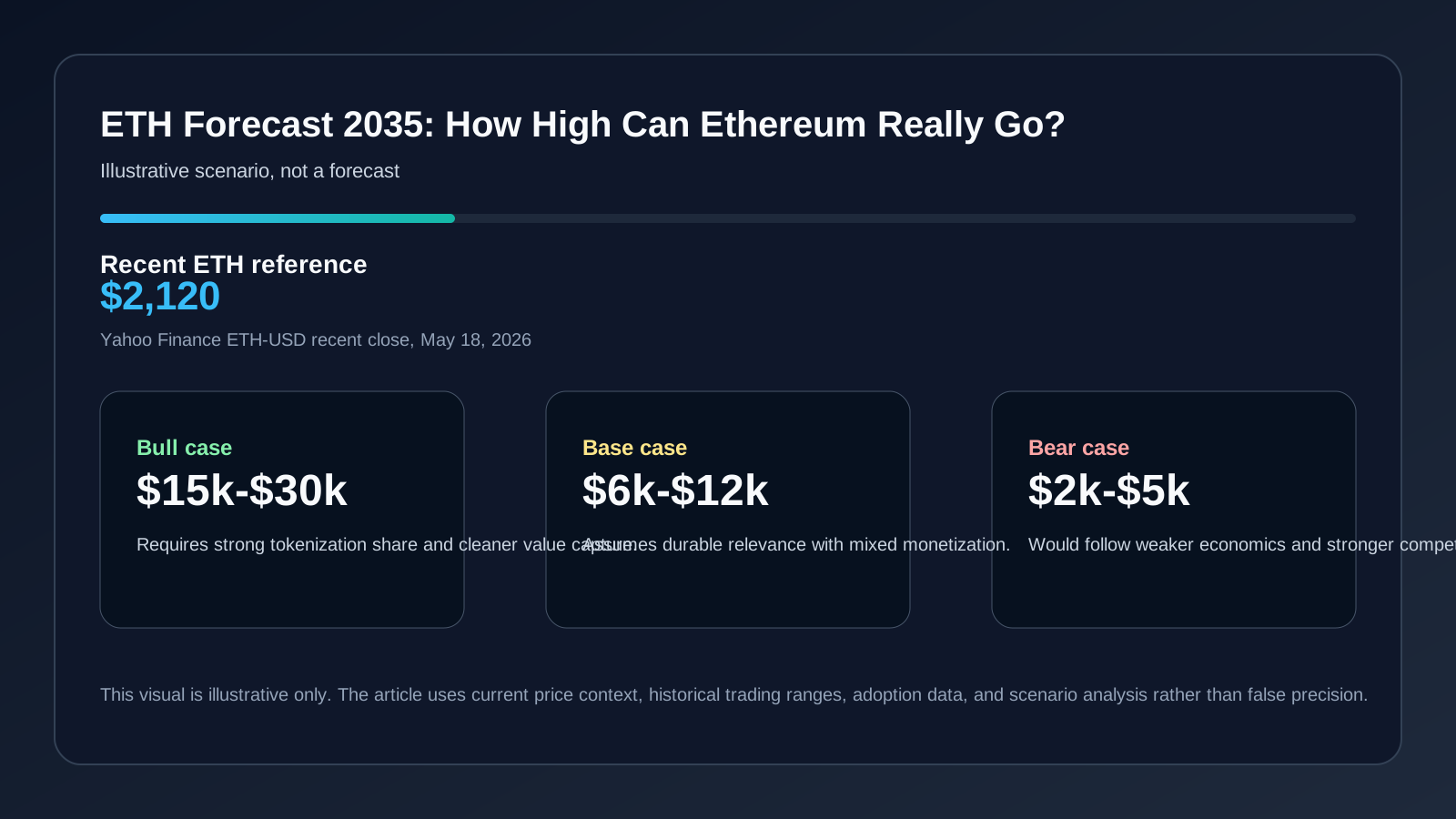
| Bull | $15k-$30k | Ethereum remains the default tokenization and settlement layer, staking stays investable, and ETH captures more of ecosystem value | 20% |
| Base | $6k-$12k | Ethereum stays central to digital finance and compounds usage, but value capture remains shared and cyclical | 50% |
| Bear | $2k-$5k | Ethereum survives and stays important, but competition, fee compression, and macro pressure cap rerating | 30% |
| Direction | Probability | Comment |
|---|---|---|
| Higher by 2035 | 55% | The long-run structure still favors a higher level than today's price if Ethereum remains institutionally relevant |
| Lower | 15% | A permanently lower path would likely require a deep thesis break, not just another correction |
| Sideways to moderate gains | 30% | Plausible if ETH behaves more like mature digital infrastructure than hyper-growth tech |
| Investor type | Prudent approach | Main watchpoints |
|---|---|---|
| Investor already in profit | Rebalance periodically so a winning ETH allocation does not become unmanaged chain-specific risk | Concentration, staking lockups, and taxes |
| Investor currently at a loss | Focus on thesis durability instead of trying to get even quickly | Liquidity needs, time horizon, and conviction quality |
| Investor with no position | Enter slowly and accept that long-run conviction still requires short-run drawdown tolerance | Entry discipline and macro conditions |
| Trader | Do not use a 2035 thesis to justify weak risk control over the next few weeks | ETH/BTC trend, options, and ETF flows |
| Long-term investor | Dollar-cost averaging is usually more robust than betting on one perfect entry point | Developer share, fee trends, and tokenization adoption |
| Risk-hedging investor | Use ETH as one piece of a digital-asset barbell rather than as a total substitute for cash or gold | Crisis correlations and liquidity conditions |
What would invalidate the high-end 2035 case? Slower tokenization adoption, persistent fee leakage to higher layers, harsh staking rules, or proof that Ethereum cannot protect pricing power would all matter. What would invalidate the cautious case? Broader use of Ethereum-linked rails in mainstream finance and a cleaner demonstration that network growth still accrues to ETH.
06. FAQ
Frequently asked questions
Is a five-figure ETH by 2035 realistic?
Yes, it is realistic in a scenario sense, but it is not a base-case certainty. That path depends heavily on adoption breadth and value capture.
Why is the 2035 range so wide?
Because no serious analyst can forecast a decade of competition, regulation, macro cycles, and protocol evolution with narrow precision.
Does ETH need another mania to go higher?
Not necessarily. A more mature path could involve slower compounding as institutional and enterprise use cases deepen.
What matters more for 2035: utility or monetary appeal?
Both matter. Utility attracts activity, while monetary appeal and staking help turn activity into a strategic asset case.
Methodology and Invalidation
How to interpret this Ethereum 2035 framework and what would change it
The forecast ranges in this article are scenario bands, not promises. They combine live ETH price data, official Ethereum documentation, and institutional or market-structure research from major asset managers, exchanges, research desks, and financial firms, plus editorial judgment about market structure. That mix matters because ether is not driven by one variable. It reacts to fee generation, staking, tokenization demand, rollup economics, derivatives positioning, regulation, and macro risk at the same time.
Probability tables in this article are editorial estimates rather than mathematical certainties. They are derived by weighing whether the evidence currently favors stronger usage and institutionalization, a mixed middle path with slower monetization, or a weaker path marked by fee compression, risk-off conditions, or renewed competition. Where the evidence is mixed, the range stays intentionally wide. False precision is usually a sign that the analyst is hiding uncertainty rather than measuring it honestly.
The most important invalidators would be evidence that Ethereum is growing in users but shrinking in economic capture, or that the broader financial system prefers alternative rails for tokenized finance. The most important discipline is to state what would invalidate the working view. Investors who are already in profit, investors sitting on losses, traders, hedgers, and long-term allocators do not need the same playbook, so the positioning table separates horizon and risk tolerance instead of pretending one answer fits everyone. Disclaimer: This article is for informational and research purposes only and does not constitute personalized financial advice.
References
Sources
- Yahoo Finance ETH-USD chart API, available weekly price history
- Yahoo Finance ETH-USD chart API, recent daily closes
- Fidelity Digital Assets, Ethereum Investment Thesis
- U.S. SEC, references to the Spot Ether ETP Approval Order and related approvals
- BlackRock, iShares Ethereum Trust ETF overview
- CME Group and Glassnode, Ethereum: Insights and Market Trends H1 2025
- Coinbase and EY-Parthenon, 2025 Institutional Investor Digital Assets Survey
- Ethereum.org, Scaling Ethereum
- Ethereum.org, Ethereum roadmap
- Ethereum.org, The Merge
- Ethereum Foundation, Treasury Staking Initiative, February 24, 2026
- Grayscale Research, Ethereum: The OG Smart Contract Blockchain
- VanEck, ETH 2030 Price Target and Optimal Portfolio Allocations
- Franklin Templeton, Revolution-Not Evolution: Detangling tokenization of RWAs
- Franklin Templeton, Benji platform overview