01. Quick Answer
The most likely AI outcome is that Allianz becomes more efficient before it becomes more visibly different
AI is unlikely to turn Allianz into a software company. It could, however, change the way a global insurer prices risk, triages claims, serves customers, detects fraud, and controls expenses. That matters because the next decade of value creation may come less from simple premium growth and more from how efficiently insurers turn data, capital, and workflow automation into better underwriting and lower friction (Responsible AI principles; Anthropic partnership; Insurance Copilot).
| Theme | Why it matters |
|---|---|
| AI is an operating story first | The near-term payoff is likely cost, speed, and quality improvements rather than a flashy revenue spike. |
| Claims and underwriting are the biggest opportunity areas | Those functions touch loss ratio, customer satisfaction, and cycle time. |
| Governance matters | AI in insurance carries regulatory, privacy, and fairness risks that can offset the upside if handled poorly. |
| Investors should expect gradual monetization | Available data suggests productivity gains come in layers, not all at once. |
02. Current Context
Allianz has the scale, data, and capital base to make enterprise AI credible
Allianz enters the AI decade from a relatively strong starting point. The company already has a large data footprint, a global operating base, and the capital to invest without endangering financial stability. That matters because many AI narratives fail at the implementation stage, not at the brainstorming stage. A business like Allianz can test, govern, and scale use cases more seriously than a weaker competitor can. The market backdrop also helps: insurers have a natural incentive to use AI where decision quality, fraud detection, and service productivity directly affect margins.
| Area | Current evidence | Why it matters |
|---|---|---|
| AllianzGPT | Internal generative AI tool announced in 2025 | Signals that AI is moving into day-to-day employee workflows. |
| Insurance Copilot | AI assistant for service and claims contexts | Customer and claims operations are prime areas for measurable efficiency gains. |
| BRIAN underwriting assistant | AI-enabled support for commercial underwriting | Underwriting quality can improve if AI helps surface better risk insight. |
| Anthropic partnership | Enterprise AI collaboration announced in 2026 | Shows Allianz is investing in scalable infrastructure rather than one-off pilots. |
The evidence is still mixed on timing. AI often produces quick demos and slow enterprise payoff. That is why the Allianz AI story should be framed as a decade-long operating-leverage thesis rather than a one-year revenue event.
There is also a strategic asymmetry here. If Allianz executes well, AI can improve productivity without requiring customers to change their behavior dramatically. If execution goes poorly, the downside may be more reputational or operational than transformational. That asymmetry is one reason insurers may ultimately extract real value from AI even if public excitement cools.
03. Main Drivers
Five ways AI could reshape Allianz over the next decade
1. Claims handling could become faster and less labor-intensive
Claims is one of the clearest AI use cases because large insurers process enormous volumes of documents, images, and communications. If AI reduces cycle time and leakage without harming fairness, the impact could show up in both cost ratios and customer satisfaction.
2. Underwriting could become more data-rich and more selective
The upside is not fully automated underwriting. It is better triage, better information extraction, and more consistent decision support. Allianz's BRIAN initiative suggests management sees this as a real operational lever, not a marketing line (BRIAN).
3. Fraud detection and compliance could improve meaningfully
Insurers face constant pressure from fraud, documentation errors, and regulatory complexity. AI can help detect anomalies and reduce manual review, but only if governance is robust.
4. Distribution and service productivity can lift retention
Allianz's AI copilot work matters because service quality in insurance is rarely glamorous but often decisive. Faster service, better answers, and lower operating friction can improve retention and cross-sell economics over time.
5. Governance, ethics, and explainability can define the ceiling
Allianz has already published responsible AI principles, which is a necessary signal in a regulated industry (Allianz Responsible AI). The investment implication is simple: insurers that scale AI without trust may invite regulatory friction that offsets the productivity benefit.
04. Institutional Forecasts and Analyst Views
Public AI evidence supports a measured productivity thesis rather than hype
Institutional AI forecasts for insurers remain more qualitative than numeric. Deloitte's insurance outlook highlights the industry's focus on modernization and productivity, while Allianz's own announcements suggest a measured enterprise-AI approach rather than speculative disruption (Deloitte; Anthropic partnership). Public evidence therefore supports a moderate conclusion: AI can widen Allianz's efficiency and decision-quality edge, but the payoff likely arrives gradually.
| Function | Potential upside | Main constraint |
|---|---|---|
| Claims | Faster resolution, lower operating cost, better fraud detection | Regulatory and fairness controls still matter. |
| Underwriting | Better risk selection and pricing consistency | Human oversight remains essential for complex risks. |
| Customer service | Higher productivity and possibly better retention | Poor implementation could damage trust. |
| Corporate functions | Document handling, legal, and workflow efficiency | Savings may be real but unevenly visible in reported numbers. |
Analysts remain divided mainly on speed, not direction. The evidence does not yet justify extreme claims that AI will transform Allianz overnight. It does justify taking productivity optionality more seriously than in the past.
05. AI Scenarios, Risks, and Invalidation
Bull, base, and bear AI cases should be tied to real business outcomes
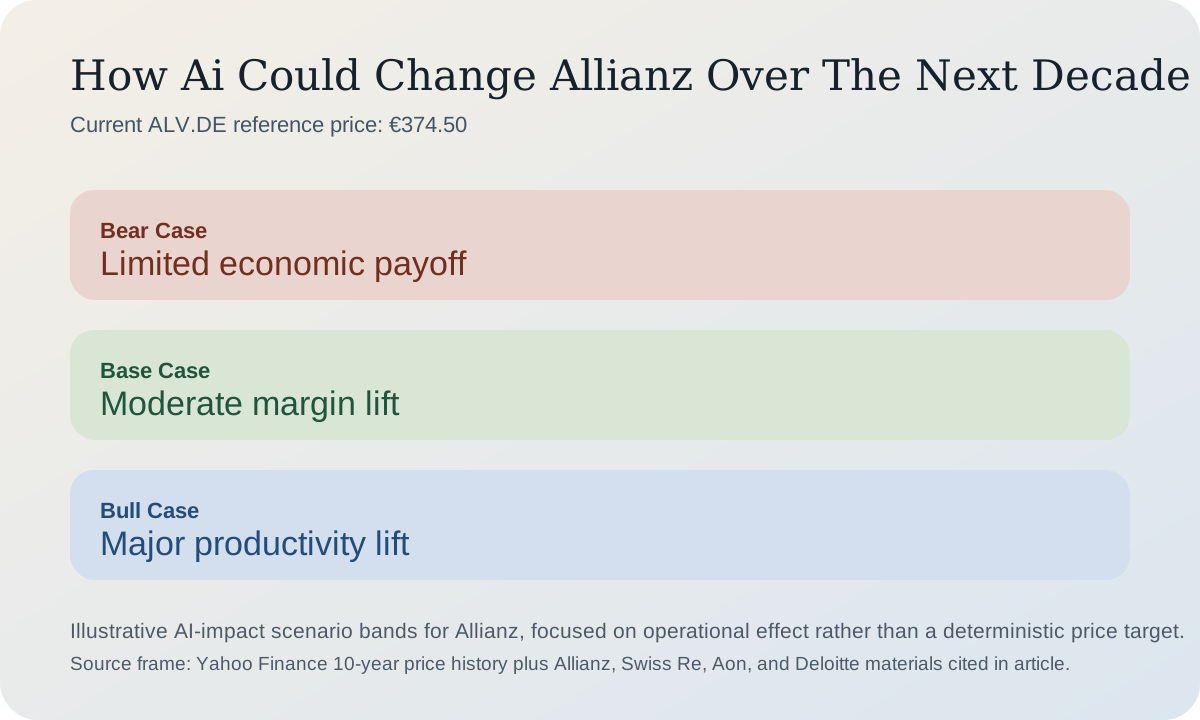
Bullish AI scenario
The bullish AI scenario is that Allianz uses AI to meaningfully lower expense friction, improve underwriting consistency, reduce fraud, and support customer retention. In equity terms, that could help justify a stronger premium multiple and a long-run share-price range around €600 to €750 by the mid-2030s if other fundamentals also cooperate.
Base-case AI scenario
The base case is more moderate: AI gradually improves service and workflow productivity, helping margins and scalability without radically changing the industry's economics. That still matters because even modest cost and leakage improvements can compound meaningfully in insurance.
Bearish AI scenario
The bearish AI scenario is not that AI disappears. It is that implementation costs, governance friction, fragmented data, or weak adoption keep the economic payoff small. In that case AI becomes an efficiency story with limited valuation impact rather than a strategic differentiator.
| Scenario | Business effect | Equity implication | Probability |
|---|---|---|---|
| Bull | Visible cost and quality gains across claims, underwriting, and service | Supports a stronger long-run valuation case | 25% |
| Base | Gradual efficiency gains with measured governance | Helpful but not revolutionary for the stock | 55% |
| Bear | Slow adoption or low realized payoff | Little valuation uplift beyond current expectations | 20% |
| Path | Estimated probability | Comment |
|---|---|---|
| AI improves Allianz meaningfully | 50% | The company has the scale and capital to execute, but enterprise payoff takes time. |
| AI disappoints relative to expectations | 20% | Execution and governance risks are real. |
| AI helps, but only incrementally | 30% | This is common in large regulated enterprises. |
Risks to watch
Data fragmentation, model explainability, employee adoption, regulatory scrutiny, and the risk of automating weak processes rather than improving them are the biggest variables. Investors should also watch whether AI savings are visible in expense discipline or only discussed abstractly.
What could invalidate the AI outlook
The optimistic AI view would be too strong if Allianz's pilots fail to scale, if governance constraints slow deployment materially, or if customers and regulators reject some use cases. It would be too cautious if the company shows measurable claim-cost or expense-ratio improvements directly linked to AI within a few reporting cycles.
Conclusion
AI could change Allianz materially over the next decade, but probably by making a strong insurer more efficient rather than by rewriting the insurance business from scratch. That is less dramatic than many headlines suggest, but for long-term investors it may be more valuable.
The practical investing question is therefore not whether AI will dominate headlines. It is whether AI can improve the economics of an already solid franchise. If the answer becomes visibly yes, Allianz may deserve a more durable quality premium over time.
Disclaimer: This article is for informational research only. Any long-run valuation implications from AI remain conditional and uncertain.
06. Investor Positioning
Investors should treat AI as optional upside, not as a substitute for valuation discipline
| Investor type | Prudent approach | What to track |
|---|---|---|
| Investor already in profit | Do not overpay for the AI narrative; keep position sizing disciplined. | Evidence of actual expense and claims improvements. |
| Investor currently at a loss | Avoid using AI as a story to justify any price. | Check whether the core Allianz thesis is still intact without AI hype. |
| Investor with no position | Build exposure only if the broader valuation also makes sense. | AI optionality is a bonus, not the whole case. |
| Trader | Trade around AI announcements carefully. | Enterprise-AI headlines can move sentiment more than fundamentals. |
| Long-term investor | Treat AI as a margin-enhancement thesis that compounds slowly. | Productivity, governance, and service quality over multiple years. |
| Risk-hedging investor | Do not rely on AI headlines as downside protection. | Portfolio hedges should remain separate from the AI thesis. |
07. FAQ
Frequently asked questions about AI and Allianz
Will AI make Allianz a much faster-growing company?
Probably not in a simple top-line sense. The more likely impact is better efficiency, claims handling, and risk selection.
What is Allianz doing in AI right now?
Publicly, the company has highlighted Responsible AI principles, AllianzGPT, Insurance Copilot, the BRIAN underwriting assistant, and an enterprise partnership with Anthropic.
What is the main risk to the AI thesis?
The main risk is that implementation remains fragmented or too constrained by governance and regulation to produce a meaningful financial payoff.
References
Sources
- Yahoo Finance chart API for ALV.DE, 10-year monthly history and recent daily closes
- Allianz 1Q 2026 earnings release
- Allianz full-year 2025 earnings release
- Allianz Group Annual Report 2025
- Allianz Capital Markets Day 2024: 2027 targets and capital framework
- Allianz ratings page
- Swiss Re Institute insurance industry outlook and sigma research
- Aon Global Insurance Market Insights, Q1 2026 overview
- Deloitte insurance industry outlook
- Allianz Risk Barometer
- Allianz natural catastrophe resilience research
- Allianz Responsible AI principles
- Anthropic and Allianz AI partnership
- AllianzGPT launch
- Insurance Copilot launch
- BRIAN underwriting assistant