01. Quick Answer
AI could reshape Meta more directly than many mega-caps because it influences content discovery, ad performance, assistants, chips, and wearables all at once
AI's impact on Meta is not theoretical. It is already visible in recommendation systems, ad ranking, creator tooling, infrastructure spending, and Meta's own description of how new models like Muse Spark and Meta AI will shape its products. Over the next decade, AI could change Meta through several channels at once: better ad economics, more engaging content ranking, more useful messaging and assistant surfaces, stronger custom-compute economics, and a larger hardware and wearables opportunity. It could also change the company by making capital-intensity and return-on-invested-capital debates more important than at any point in the prior decade.
| Category | Evidence-based read | Implication |
|---|---|---|
| Historical data | META moved from about $114.28 to about $618.43 over 10 years | Long-run upside is credible, but future ranges should reflect scale and capital intensity |
| Current market conditions | Ads remain very strong while AI spending is accelerating | The stock can keep working, but the multiple needs continuing proof |
| Institutional signals | Official reporting, Reuters, and S&P all point to strong fundamentals with visible capex debate | Analysts remain constructive, but not complacent |
| Most important watchpoints | Ad performance, AI ROI, capex guidance, user engagement, and Reality Labs losses | These factors will likely move the range more than generic social-media sentiment |
02. Historical Context
Meta is no longer just a social-media stock, but social engagement still funds the whole machine
Meta stock has climbed from roughly $114.28 to about $618.43 over the last 10 years based on Yahoo Finance monthly data, implying a 10-year CAGR of about 18.39%. That is a strong long-term compounding record for a company that has already absorbed privacy shocks, cyclical advertising swings, platform changes, regulatory scrutiny, and the market's repeated debates over whether Reality Labs is visionary or wasteful. The modern Meta thesis now sits on four pillars at once: large-scale digital advertising, engagement engines powered by recommendation AI, messaging and business surfaces, and a growing infrastructure push around Meta AI, custom silicon, and wearables.
| Metric | Latest official reading | Why it matters |
|---|---|---|
| Q1 2026 revenue | `$56.31 billion, up 33% | Shows ad demand and monetization remain very strong |
| Advertising revenue | `$55.02 billion | Meta is still overwhelmingly funded by ads, so ad quality remains the central driver |
| Family daily active people | 3.56 billion, up 4% | User scale still gives Meta one of the deepest data and distribution moats in global internet markets |
| Reality Labs operating loss | (`$4.03 billion) in Q1 2026 | Keeps the metaverse and hardware debate alive even while the core business performs |
03. Main Drivers
Five forces are most likely to shape Meta stock over the next several years
1. Advertising efficiency is still the economic center of gravity
Meta remains one of the most important digital advertising platforms in the world. The company said Q1 advertising revenue reached `$55.02 billion`, while its January 2026 AI update described measurable gains in ad clicks, conversions, and ad quality from ranking-model improvements. If those gains continue, Meta can keep monetizing AI faster than many investors expected.
2. AI infrastructure is now both a moat and a valuation risk
Reuters and Meta's own earnings release make the same point from opposite directions: the company is accelerating investment hard. The raised 2026 capex range of `$125-145 billion` can strengthen the moat if it lifts ad performance, AI assistants, creator tooling, and compute economics. It can also compress the multiple if return on capital looks slower than the spending ramp.
3. Reality Labs still matters even if the market focuses more on AI now
Reality Labs revenue remains small relative to the core business, while losses are still substantial. The bear case uses this as evidence that Meta keeps funding expensive option value. The bull case says that the same long-horizon ecosystem strategy could eventually matter across AI glasses, wearables, and the next interface layer.
4. Regulation and geopolitical friction remain structural risks
Meta's Q1 2026 release explicitly warned about legal and regulatory matters in both the U.S. and the EU. The same release also noted that March 2026 DAP was hurt by internet disruptions in Iran and restrictions on WhatsApp in Russia. That is a reminder that user scale and monetization are not detached from geopolitics.
5. The market is re-rating Meta as an AI platform, not just a social network
Official Meta posts on Muse Spark, custom silicon, and AI-driven product improvements suggest the company wants investors to treat it as a full-stack consumer AI platform. If that narrative holds, valuation can stay elevated. If the market decides Meta is still mostly an ad business with bigger capital needs, upside could narrow.
04. Institutional Forecasts and Analyst Views
The market likes Meta's earnings quality, but it is repricing what leadership in consumer AI will cost
That is why the long-run AI article on Meta has to stay balanced. Official results and product commentary show serious commercial traction, not just experimentation. Reuters and S&P also show that the market is not yet willing to ignore the cost side of the equation. The evidence is compelling, but not one-directional. AI can make Meta larger, more platform-like, and more valuable, while also making the stock more sensitive to any sign that spending discipline is slipping.
| Source | Message | Interpretation |
|---|---|---|
| Meta official reporting | Ads, operating income, and free cash flow remained strong in Q1 2026 | Operational quality remains strong |
| Reuters | Capex is rising sharply as Meta doubles down on AI infrastructure | Supports a constructive but valuation-aware base case |
| S&P Global | Ad strength beat expectations, but higher AI capex clouded near-term sentiment | Keeps both upside and execution risk visible |
| Meta product and infrastructure updates | Muse Spark, ranking AI, and custom silicon all point to a deeper platform strategy | Strengthens the long-run AI narrative if monetization follows |
05. Bull, Bear, and Base Case
How the forecast range and probability table are built
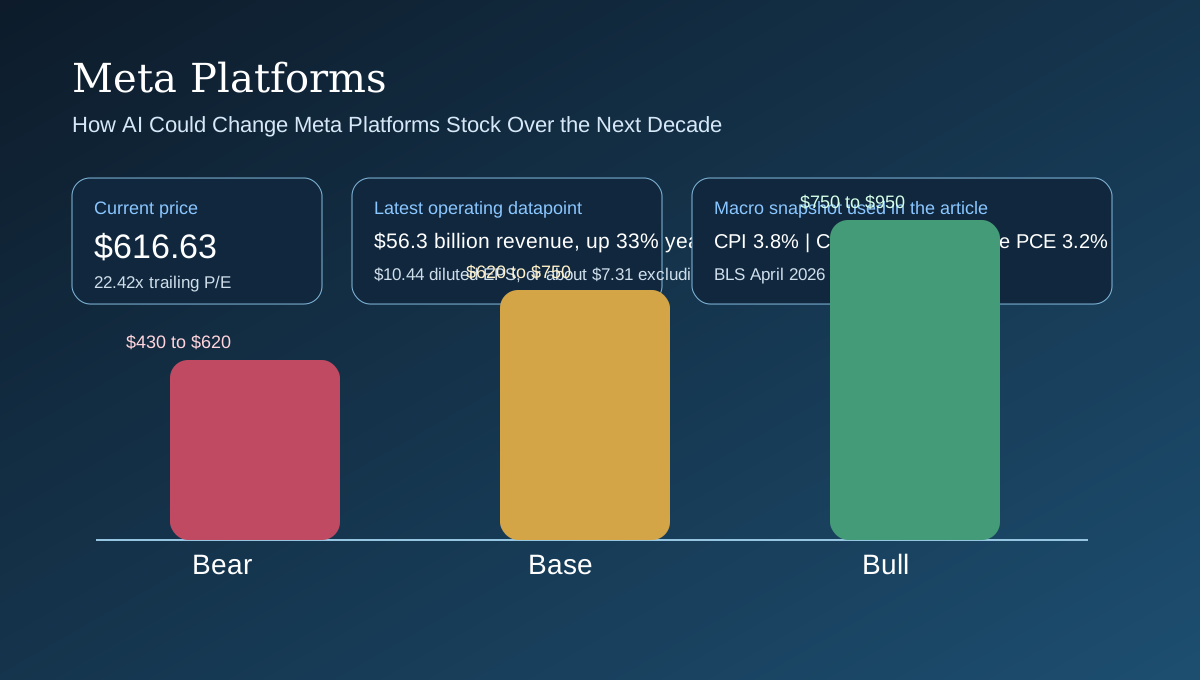
The ranges in this article are not institutional point targets. They are editorial scenario matrices built from current price, 10-year compounding history, advertising durability, AI monetization, capex intensity, regulation risk, and whether Meta can keep improving the quality of its revenue mix faster than its spending burden rises.
| Scenario | Likely effect | Conditions | Probability |
|---|---|---|---|
| Bull | AI deepens Meta's moat and improves the earnings mix substantially | Ranking AI, Meta AI, custom silicon, and wearables all generate durable monetization beyond the current capex cycle | 35% |
| Base | AI helps quality, but keeps capital-intensity debates alive | Monetization is real, though returns remain closely scrutinized | 45% |
| Bear | AI remains strategically important but financially less rewarding than the market expects | Spending stays high while product differentiation or monetization remains narrower than hoped | 20% |
| Directional outcome | Probability | Comment |
|---|---|---|
| AI lifts long-run stock quality | 55% | Most plausible if Meta keeps converting AI into structurally higher advertising and platform economics |
| AI has a mixed net effect | 25% | Possible if monetization and capital intensity broadly offset each other |
| AI becomes a valuation drag | 20% | Would require stronger evidence that spending quality is weaker than the market assumes |
| Investor type | Prudent approach | Main watchpoints |
|---|---|---|
| Investor already in profit | Hold a core stake, but trim if position size now depends on flawless ad and AI execution | Portfolio concentration, capex guidance, and regulatory headlines |
| Investor currently at a loss | Reassess whether the thesis is ad durability, AI monetization, or long-run wearables optionality before averaging down | Revenue quality, margin trend, and the size of the spending ramp |
| Investor with no position | Stage entries or wait for pullbacks instead of chasing AI enthusiasm after strong quarters | Valuation, ad checks, and Q2-Q4 capex commentary |
| Trader | Use stop-loss discipline and trade around earnings, policy developments, and AI product announcements | Volatility, options pricing, and fast-moving sentiment shifts |
| Long-term investor | Dollar-cost average only if convinced AI is improving monetization faster than it is increasing structural spend | Ad conversion gains, cash flow, and infrastructure returns |
| Risk-hedging investor | Rebalance if Meta has become an oversized exposure to one ad-and-AI thesis | Correlation with other mega-cap AI holdings and policy risk |
Conclusion: over the next decade, AI could change Meta more directly than many investors expect by strengthening advertising, assistants, and the wider compute stack, but the stock's ultimate payoff still depends on whether those gains outrun the cost of building them. Disclaimer: This article is for informational and research purposes only and does not constitute personalized financial advice.
06. FAQ
Frequently asked questions
Is Meta still mainly an advertising stock?
Yes, in economic terms advertising still funds almost everything. But investors increasingly value the company through the lens of AI-driven ad efficiency, consumer assistants, and infrastructure scale.
What matters most for the next forecast revision?
Ad conversion quality, capex guidance, engagement, Reality Labs losses, and evidence that AI products are improving monetization are the most important inputs.
Is Reality Labs still the biggest risk?
It remains an important risk, but right now the market is arguably more focused on whether Meta's AI capex trajectory earns adequate returns.
What would invalidate the bullish case?
Slower advertising growth, weaker engagement, major regulatory setbacks, or several years of infrastructure spending without visible payoff would all weaken the bullish case.
Methodology and Invalidation
How to interpret this Meta framework and what would change it
Meta should not be analyzed as a simple social-media company anymore, but it also should not be treated as a pure AI infrastructure story. The business is still overwhelmingly funded by advertising on Facebook, Instagram, WhatsApp, Messenger, and Threads. Yet the variables that increasingly shape valuation are AI ranking quality, infrastructure intensity, creator and business tooling, wearables, custom silicon, and whether Meta AI can become a durable consumer layer rather than an engagement feature. That is why single-point targets are usually less useful than scenario ranges.
These articles anchor their ranges to three things: current price, 10-year market history, and the present operating mix. Yahoo Finance chart data place META around `$618.43` in mid-May 2026, versus roughly `$114.28` at the start of the 10-year comparison window. That implies a 10-year CAGR of about 18.39%. The range logic here does not assume Meta simply repeats that exact annualized growth rate into 2035. Instead, it asks whether the next decade will feature a better or worse mix of ad monetization, engagement quality, AI returns, and capital intensity than the last one.
Primary documents matter most. Meta's Q1 2026 earnings release showed revenue of `$56.31 billion`, advertising revenue of `$55.02 billion`, Family of Apps revenue of `$55.91 billion`, Reality Labs revenue of `$402 million`, and Reality Labs operating loss of about `$4.03 billion`. The 2025 Form 10-K adds deeper context around full-year revenue of `$200.97 billion`, advertising revenue of `$196.18 billion`, Reality Labs revenue of `$2.21 billion`, and Reality Labs operating loss of `$19.19 billion`. Those figures are important because they show that the core engine is extremely profitable, while the optionality engine remains expensive.
External reporting explains what the market is debating now. Reuters emphasized that Meta raised its 2026 capex forecast to `$125-145 billion`, while S&P Global argued that strong ad performance and margin expansion were partially clouded by the accelerated AI spending path. Reuters also reported that Meta may surpass Google in global digital ad revenue by the end of 2026 according to eMarketer, which supports the bull case for ad-market leadership. At the same time, other Reuters reports on layoffs, CoreWeave, and Nebius show how serious Meta is about buying and building AI capacity. Available data suggests the company is simultaneously strengthening its moat and increasing the burden of proof on spending returns.
Investor positioning should therefore depend on time horizon. A trader may care most about ad checks, capex headlines, and policy risk. A long-term allocator should focus more on whether Meta can keep turning AI into measurable ad performance, whether wearables and assistants become material products, and whether capital intensity eventually stabilizes. Someone already in profit may trim if portfolio concentration now assumes flawless execution. Someone with no position may prefer staggered entries rather than chasing post-earnings momentum. What would invalidate a constructive Meta view? Ad demand softening, weaker user engagement, major regulatory hits, or several years of capex without commensurate monetization would matter. What would invalidate a more bearish Meta view? Continued strong ad conversion gains, AI product adoption, and evidence that custom infrastructure improves economics faster than expected would weaken the downside thesis.
Inline evidence anchors the framework (Yahoo META chart API; Meta Q1 2026 results; Meta 2025 Form 10-K; S&P Global post-quarter snapshot; Reuters on capex; Meta on custom silicon). That combination is why the forecast ranges here are scenario tools rather than certainty theater.
References
Sources
- Yahoo Finance chart API, META 10-year monthly history and current price
- Meta, Q1 2026 earnings release
- Meta, Q1 2026 earnings call
- Meta Platforms, Form 10-K for fiscal year ended December 31, 2025
- Meta, 2026: AI Drives Performance
- Meta, Introducing Muse Spark
- Meta, Broadcom custom AI silicon partnership
- S&P Global, Meta post-quarter snapshot, May 2026
- Reuters, Meta lifts capital expenditure forecast, April 29, 2026
- Reuters, Meta planning sweeping layoffs as AI costs mount, March 13, 2026
- Reuters, Meta poised to surpass Google in digital ad revenue, April 13, 2026
- Reuters, CoreWeave signs additional AI cloud deal with Meta, April 9, 2026
- Reuters, Nebius signs AI infrastructure deals with Meta, March 16, 2026
- Reuters, investors gauge AI payoff as spending surges, April 28, 2026