01. Quick Answer
How AI Could Influence WTI Oil Prices in the Coming Years
The quick answer is that AI is more likely to change WTI's probability distribution than to guarantee a one-way rally. The strongest near-term effect is indirect: AI raises electricity demand, and the systems built to serve that demand often rely on natural gas, grid expansion, and in some regions onsite diesel generation. The IEA's AI work and the IMF's commodity special feature both argue that AI can materially increase power-system stress and energy prices if supply is slow to respond (IEA, Energy and AI; IEA, Energy supply for AI; IMF, Commodity Special Feature: market developments and the impact of AI on energy demand).
But AI also works on the supply side. ExxonMobil, SLB, ADNOC, and related operators are using AI to monitor assets, optimize production, and automate subsurface decisions. Over time, better field management and lower operating friction could make supply more efficient and more responsive. That means AI can be bullish for oil via demand and bearish for oil via productivity, which is why the evidence is mixed rather than one-directional (ExxonMobil, how AI is being used to improve operations and boost production; SLB and AIQ on deploying agentic AI across ADNOC's subsurface operations; ADNOC and SLB on AI-powered production system optimization).
| Category | Evidence-based read | Implication |
|---|---|---|
| AI matters indirectly first | Its strongest current oil effect runs through power demand, gas balancing, and backup generation rather than direct oil consumption in servers. | WTI impact is real but second-order. |
| AI can support demand | Slow grid build-outs can increase use of gas and liquid-fuel backups in some regions. | This can keep energy complexes tighter than expected. |
| AI can improve supply | Upstream operators are already using AI for monitoring, optimization, and decision support. | That can eventually reduce cost and improve response time. |
| Net effect | AI probably raises volatility and complexity more reliably than it guarantees higher oil prices. | Scenario thinking is more useful than simple extrapolation. |
02. Historical Context
Current market snapshot and historical context
WTI's 10-year range of $18.84 to $105.76 per barrel is the first reason any forecast has to be scenario-based rather than point-based. Oil is not a stable compounder. It is a clearing price for a system shaped by geology, OPEC+ policy, inventories, freight constraints, war risk, and global growth. The same benchmark that collapsed in 2020 recovered above $100 in both 2022 and 2026, which means investors should distinguish between a correction, a cyclical bear market, and a structurally lower oil regime (Yahoo Finance chart API, CL=F 10-year monthly data; IEA, Global Energy Review 2026: Oil).
Historically, WTI has responded to macro growth, war, inventories, and OPEC far more than to computing themes. AI is different because it affects the energy system itself. If electricity demand rises faster than grids can cope, the knock-on effects can spread into natural gas, diesel, and eventually oil-market sentiment. That is why AI should be viewed as an energy-complex variable, not a narrow tech curiosity (IEA, Energy and AI; EIA press release on U.S. electricity demand growth fueled by data centers, January 13, 2026).
| Metric | Latest read | Why it matters |
|---|---|---|
| Power-demand channel | Data centers are now a visible energy-system force | AI can affect oil without becoming a direct oil consumer |
| Price channel | Electricity constraints can spill into broader energy pricing | WTI can feel AI through cross-commodity substitution and fuel balancing |
| Supply channel | Major operators are deploying AI in production workflows | Efficiency gains may cap part of the upside over time |
| Most likely effect | Higher volatility and a firmer floor | AI complicates oil-market analysis rather than simplifying it |
| Period marker | Approximate price | Interpretation |
|---|---|---|
| June 2016 monthly close | $48.33/bbl | WTI started the visible 10-year band in the high $40s as shale was still absorbing the 2014-2016 crash. |
| April 2020 monthly close | $18.84/bbl | The pandemic collapse shows how violently oil can break when storage, mobility, and sentiment all fail at once. |
| March 2022 monthly close | $100.28/bbl | Russia's invasion of Ukraine pushed crude back into a geopolitical scarcity regime. |
| December 2025 monthly close | $57.42/bbl | Before the 2026 supply shock, the market had already repriced toward oversupply and weaker demand expectations. |
| May 18, 2026 close | $103.37/bbl | Current scenarios start from an elevated, disruption-driven base rather than a neutral equilibrium. |
03. Main Drivers
Main drivers of price movement
1. AI can raise power demand enough to affect fuel markets
IEA's 2025 and 2026 AI work shows data-center electricity demand rising rapidly, while the IMF notes that AI expansion alone could raise U.S. electricity prices by up to 9 percent if supply is sluggish. That matters for oil because higher power costs and tighter fuel systems can spill into broader energy pricing and backup-fuel usage (IEA, Energy supply for AI; IEA, Key Questions on Energy and AI, executive summary; IMF, Commodity Special Feature: market developments and the impact of AI on energy demand).
2. Natural gas is likely the first fuel to feel AI, but oil can still participate at the margin
IEA says renewables and natural gas are among the main sources meeting new data-center demand, while its April 2026 update notes many developers are advancing onsite gas-based generation because of grid bottlenecks. That does not automatically make WTI the primary winner, but it can tighten the broader hydrocarbon complex and raise oil's floor in stress periods (IEA, Energy supply for AI; IEA news release on data center electricity use and AI, April 16, 2026).
3. AI can support diesel and liquid fuels in backup, transport, and build-out phases
Many AI facilities require backup power, construction activity, logistics, and generators before permanent grid connections are available. Those uses do not dominate world oil demand, but they can still matter at the margin when the system is already tight. This is best treated as a supportive layer, not the primary bull thesis (IEA news release on data center electricity use and AI, April 16, 2026; EIA press release on U.S. electricity demand growth fueled by data centers, January 13, 2026).
4. Upstream AI can lower costs and improve production efficiency
ExxonMobil says AI is helping track and monitor sensor data to improve operations and boost production. SLB and ADNOC are rolling out AI-driven production optimization and agentic subsurface workflows across major upstream assets. Over time, that could make oil supply more responsive and partially offset AI's demand-side support (ExxonMobil, how AI is being used to improve operations and boost production; SLB and AIQ on deploying agentic AI across ADNOC's subsurface operations; ADNOC and SLB on AI-powered production system optimization).
5. AI could amplify market volatility before it fully changes physical balances
The IMF's commodity feature and the IEA's AI analysis both point to a world where electricity demand and energy-system constraints become more important macro variables. Markets often price such transitions ahead of full physical evidence. That means AI may influence WTI first through expectations, sector rotation, and cross-energy sentiment, and only later through clear balance data (IMF, Commodity Special Feature: market developments and the impact of AI on energy demand; IEA, Energy and AI).
04. Institutional Forecasts and Analyst Views
Institutional forecasts and analyst views
No major institution is publishing a clean 'AI-adjusted WTI target,' which is exactly the point. AI is a force that changes the distribution of outcomes rather than a simple input into one price model. The best source set comes from IEA's AI reports, IMF work on electricity-price effects, EIA's data-center demand framing, and operator evidence from the upstream sector (IEA, Energy and AI; IEA, Key Questions on Energy and AI, executive summary; IMF, Commodity Special Feature: market developments and the impact of AI on energy demand; EIA press release on U.S. electricity demand growth fueled by data centers, January 13, 2026).
Those sources suggest a modestly bullish tilt for the broader energy complex in the near to medium term, but not a straightforward call that AI alone will send WTI structurally higher. The evidence is strongest for a firmer floor and more complicated cross-commodity interactions.
| Source | Forecast / signal | Interpretation |
|---|---|---|
| IEA Energy and AI | AI sharply increases data-center electricity demand | Power-system stress can support the wider energy complex |
| IMF commodity feature | AI-driven electricity demand can lift prices materially if supply is sluggish | Explains one indirect inflationary channel for energy markets |
| EIA | Data centers are a major driver of U.S. electricity demand growth | Confirms the macro relevance of AI infrastructure |
| IEA 2026 AI update | Developers are advancing onsite gas-based power generation | Hydrocarbon demand can benefit if grids lag |
| ExxonMobil | AI improves operations and can boost production | Supply-side efficiency may offset some demand-side support |
| SLB / ADNOC | AI is being deployed at scale in upstream optimization | The oil sector itself is becoming more AI-enabled |
05. Bull, Bear, and Base Case
How the forecast range and probability table are built
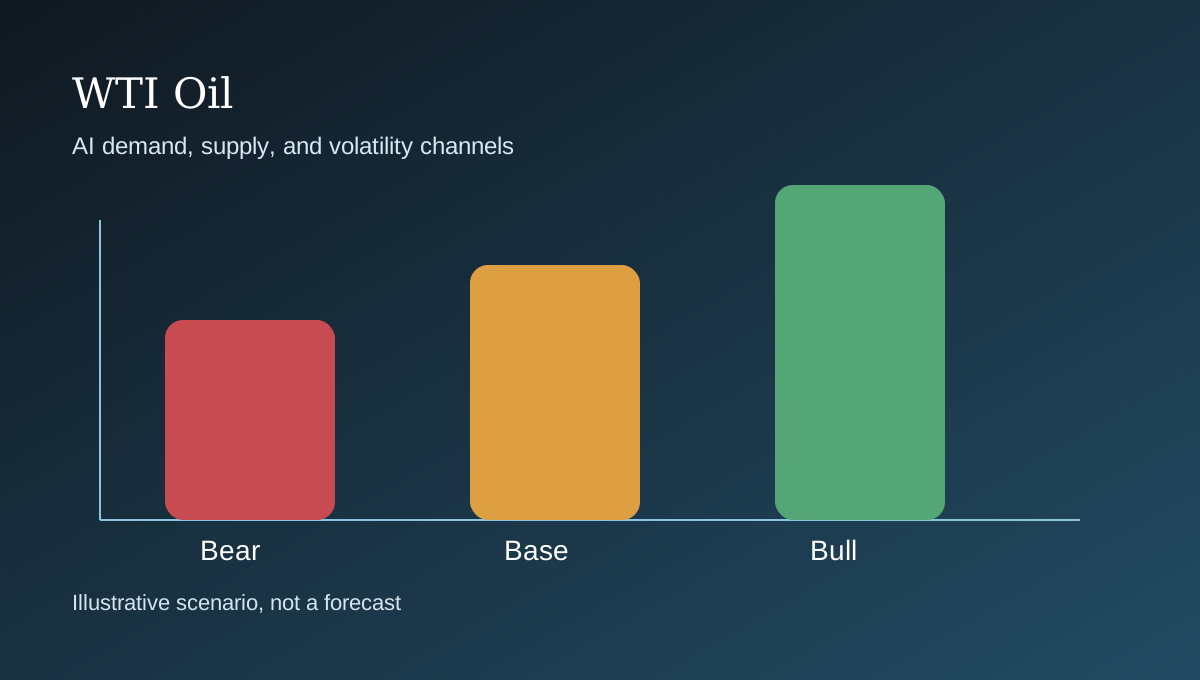
The scenario matrix below is about AI's influence on WTI over the coming years, not about AI replacing OPEC or geopolitics as the dominant crude driver. AI is better understood as an amplifier and modifier.
Probability is based on which channel dominates first. If power demand and fuel-system tightness outrun efficiency gains, AI is net supportive. If upstream productivity and lower oil intensity improve faster, AI's net impact on WTI becomes smaller or even modestly bearish.
| Scenario | Price range | Conditions | Probability |
|---|---|---|---|
| Bull | $90-$110/bbl | AI-driven power build-out tightens the hydrocarbon complex faster than upstream efficiency can offset it | 25% |
| Base | $70-$90/bbl | AI modestly raises oil's floor through energy-system spillovers while supply efficiency offsets part of the demand effect | 50% |
| Bear | $55-$70/bbl | Grid build-outs lag, direct oil demand effects stay small, and AI mainly lowers costs for producers | 25% |
| Direction | Probability | Comment |
|---|---|---|
| AI pushes WTI higher | 35% | More plausible if electricity bottlenecks keep hydrocarbons in the marginal generation mix |
| AI is mostly neutral for WTI | 40% | Still the most realistic outcome because many effects are indirect |
| AI ultimately lowers WTI | 25% | Possible if upstream productivity gains dominate and oil intensity falls faster than expected |
| Investor type | Prudent approach | Main watchpoints |
|---|---|---|
| Investor already in profit | Consider holding a core allocation but trim into sharp spikes, especially when spot prices outrun medium-term fundamentals. | Watch whether prompt risk premium is fading faster than the narrative. |
| Investor currently at a loss | Reassess position size and thesis rather than averaging automatically. A cyclical commodity can stay volatile longer than expected. | Separate the long-term oil thesis from an entry-price mistake. |
| Investor with no position | Avoid chasing parabolic moves. Wait for pullbacks, stagger entries, or stay patient if the risk-reward no longer compensates for volatility. | High spot prices often compress future returns. |
| Trader | Use stop-loss discipline, monitor inventory data, OPEC+ signaling, and time spreads, and treat headlines as catalysts rather than investment theses. | WTI can overshoot both up and down when positioning becomes crowded. |
| Long-term investor | Dollar-cost averaging can make sense only if you accept long drawdowns and use a horizon long enough to absorb policy and macro cycles. | Long-run oil exposure should be sized as a cyclical asset, not a bond substitute. |
| Risk-hedging investor | Use crude as part of a broader inflation or geopolitical hedge basket, and rebalance when one shock turns a hedge into an outsized directional bet. | Oil can hedge some macro risks while creating others. |
AI is unlikely to become the single biggest driver of WTI in the near term, but it can reshape how oil interacts with the wider energy system. The clearest conclusion is not that AI guarantees higher oil prices. It is that AI makes crude-market analysis more interconnected, with demand, electricity, gas, and upstream productivity feeding back into each other more than before. Disclaimer: This article is for informational and research purposes only and does not constitute personalized financial advice.
06. FAQ
Frequently asked questions
Does AI directly consume enough oil to move WTI by itself?
Not directly. The more important channels run through electricity demand, backup generation, construction, logistics, and broader hydrocarbon-market tightening.
Why would AI affect oil if natural gas is the main fuel for new power?
Because energy systems are linked. Tight gas and power markets can spill into diesel use, inflation expectations, and broader oil-market sentiment.
Can AI also reduce oil prices?
Yes. If AI improves field productivity, lowers costs, and makes supply more responsive, that can offset part of the demand-side support.
What would invalidate the AI-supportive WTI view?
If grid supply scales cleanly, direct liquid-fuel demand stays limited, and producer productivity gains dominate, AI's net oil impact would be smaller than bulls expect.
Methodology and Invalidation
How to interpret this framework and what would change it
This article relies more on cross-energy-system analysis than on standard oil-only forecasting. The core inputs come from IEA's Energy and AI work, IMF analysis of AI-led electricity demand, EIA's data-center demand framing, and operator evidence from ExxonMobil, SLB, and ADNOC (IEA, Energy and AI; IEA, Energy supply for AI; IMF, Commodity Special Feature: market developments and the impact of AI on energy demand; EIA press release on U.S. electricity demand growth fueled by data centers, January 13, 2026; ExxonMobil, how AI is being used to improve operations and boost production; SLB and AIQ on deploying agentic AI across ADNOC's subsurface operations).
The scenario ranges then tie those AI channels back to actual WTI history and current price context so the theme does not float free of the market's observed volatility.
Invalidation would come from either clean electricity supply expansion that reduces the hydrocarbon spillover or from AI improving upstream productivity faster than it boosts energy demand.
References
Sources
- Yahoo Finance chart API, CL=F recent daily data
- Yahoo Finance chart API, CL=F 10-year monthly data
- IEA, Energy and AI
- IEA, Energy supply for AI
- IEA, Key Questions on Energy and AI, executive summary
- IEA news release on data center electricity use and AI, April 16, 2026
- IMF, Commodity Special Feature: market developments and the impact of AI on energy demand
- EIA press release on U.S. electricity demand growth fueled by data centers, January 13, 2026
- ExxonMobil, how AI is being used to improve operations and boost production
- SLB and AIQ on deploying agentic AI across ADNOC's subsurface operations
- ADNOC and SLB on AI-powered production system optimization