01. Quick Answer
AI could reshape the Nikkei by changing who leads, not just by lifting the index mechanically
The Nikkei closed at 61,409.29 on 2026-05-15 after a decade-long price CAGR of roughly 14.78% (Yahoo Finance chart API for ^N225, 10-year monthly history; Yahoo Finance chart API for ^N225, recent daily closes). The next decade's AI effect is unlikely to be a single-line story where one or two chip names drag the whole index upward forever. More likely, AI changes index leadership, capital-spending patterns, telecom infrastructure, testing demand, automation, and disclosure quality across the benchmark.
That makes Japan especially interesting. GENIAC, METI semiconductor strategy, SoftBank Telco AI Cloud vision, and JPX AI initiative all show that AI is now being treated as infrastructure, not just software fashion. That is the right lens for a Nikkei article.
| Point | Why it matters |
|---|---|
| Japan's AI exposure is industrial | Semiconductor tools, testing, cloud, sensors, and automation matter more than app-layer narratives alone. |
| AI can broaden leadership | Banks, exchanges, telecom, and manufacturers can all benefit if adoption diffuses. |
| Policy support is visible | METI and SoftBank initiatives make AI a capital-allocation topic, not only a concept. |
| Concentration risk remains high | If benefits stay narrow, the AI thesis becomes more fragile for the index. |
02. Historical Context
The Nikkei's AI exposure sits on top of an already powerful decade-long rerating
The Nikkei's move from 15,575.92 to 61,409.29 over the last decade (Yahoo Finance chart API for ^N225, 10-year monthly history) means AI is arriving in a market that already has momentum and strategic relevance. That is important because AI will likely amplify some existing strengths rather than create a brand-new Japan story from scratch.
The index's price-weighted construction (Nikkei Stock Average guidebook, July 2025 edition) makes AI leadership especially visible. Expensive names linked to semiconductor tools or testing can shape the headline benchmark faster than in capitalization-weighted indices. But the deeper point is that AI can also change the composition of winners over time through index reviews and shifting sector balance.
| Metric | Reading | AI relevance |
|---|---|---|
| Current index level | 61,409.29 | AI optimism is arriving in an already elevated market. |
| 10-year price CAGR | 14.78% | Future AI upside should be judged against an already strong base. |
| 52-week range | 36,855.83 to 63,799.32 | Shows the market can still be volatile even with strategic AI enthusiasm. |
| Editorial AI base range | 80,000-95,000 | Assumes AI benefits broaden across tools, telecom, automation, and capital discipline. |
| Area | Mechanism | Likely beneficiaries |
|---|---|---|
| Semiconductor equipment | Training and inference drive fab and packaging demand | Tokyo Electron and suppliers. |
| Semiconductor testing | Higher complexity raises test intensity | Advantest and related ecosystem players. |
| Telecom and sovereign cloud | AI computing and inference need local infrastructure | SoftBank and digital infrastructure enablers. |
| Industrial automation | Labor shortages make AI adoption economically attractive | Robotics, factory automation, sensors, and precision manufacturers. |
03. Main Drivers
Six AI channels could reshape the Nikkei over the next decade
1. Semiconductor equipment and testing. Advantest already tied fiscal 2026 conditions to AI-related investment, and Tokyo Electron remains one of the clearest ways to express capex demand. This is the most obvious AI channel into the Nikkei.
2. Sovereign cloud and telecom infrastructure. SoftBank Telco AI Cloud vision and its Sarashina deployment show AI is becoming a domestic infrastructure story in Japan, not only a hyperscaler import story.
3. Government support and ecosystem building. GENIAC and METI policy indicate that policymakers want AI and semiconductors to function as national industrial priorities. That raises the chance of sustained capex and talent investment.
4. Exchange and market plumbing. JPX says it is using AI in market surveillance and investor-information workflows. That matters because AI can improve the investability of Japan through better information access and lower friction for overseas capital.
5. Sensors, electronics, and imaging. Sony remains relevant because AI growth increases demand for high-performance sensors, imaging systems, and content-linked ecosystems, even if Sony is not usually treated as a pure AI stock.
6. Labor scarcity and automation. AI is unusually relevant in Japan because demographics create a clear economic need for productivity tools. That gives AI adoption a stronger structural rationale than simple hype.
04. Institutional Forecasts and Analyst Views
The institutional case for AI in Japan is stronger when framed as infrastructure and productivity
Official and institutional sources rarely publish neat Nikkei targets based solely on AI, and they should not. But the evidence base is clear. METI is funding ecosystem development, SoftBank and OpenAI are building commercial channels, and JPX is already using AI operationally.
The more interesting question is not whether AI exists, but whether it broadens index earnings. That is where analysts remain divided. If AI stays concentrated in semiconductor capex, the index benefits but also becomes more cyclical. If AI diffuses into telecom, industrial automation, financials, exchanges, and corporate productivity, the Nikkei's decade-long earnings base gets much healthier.
| Source | What it shows | Implication for the Nikkei |
|---|---|---|
| METI | AI and semiconductors are now strategic policy priorities | Raises the odds of sustained investment and ecosystem support. |
| SoftBank | Domestic AI cloud and sovereign-AI infrastructure are being commercialized | Broadens AI relevance beyond hardware exporters. |
| JPX | AI is improving market operations and information access | Can make Japan more investable over time. |
| Advantest / Tokyo Electron / Sony | Multiple listed channels link AI to earnings and capital spending | Supports the idea that AI can reshape index leadership. |
05. Scenarios, Risks, and Invalidation
AI reshapes the Nikkei most effectively if the benefits spread beyond a few names
Bullish scenario
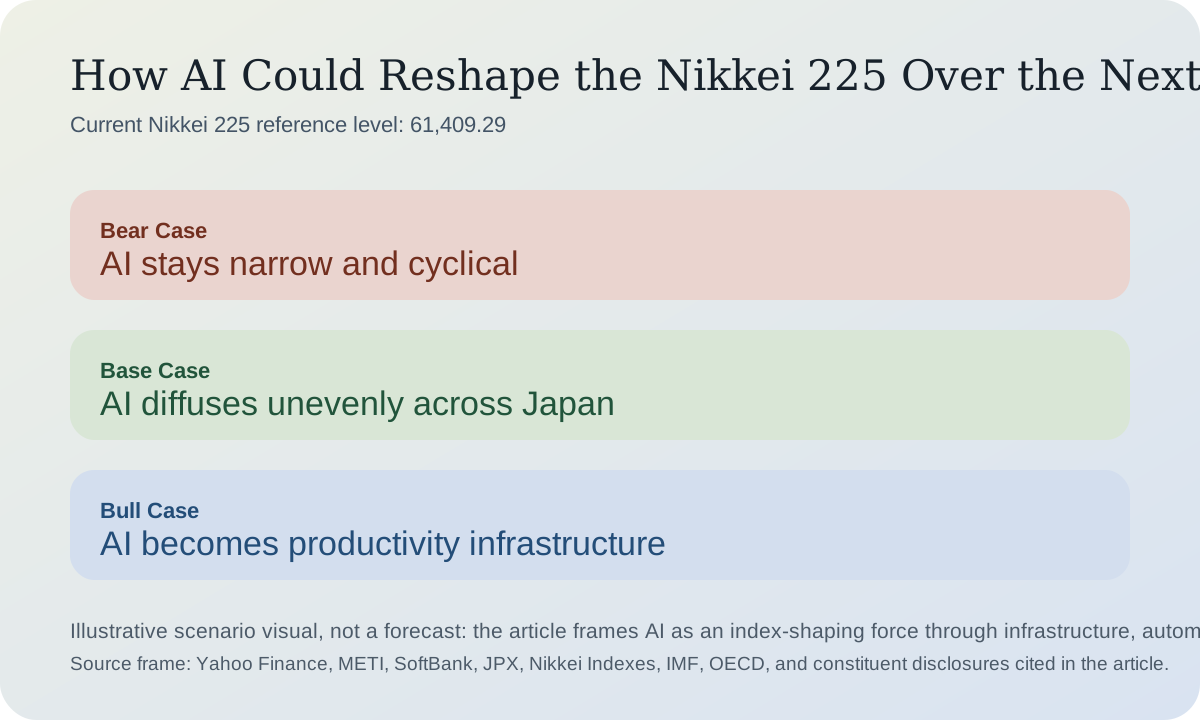
The AI bull case is 95,000 to 115,000 by 2035. This requires sustained semiconductor and testing demand, telecom-cloud buildout, wider enterprise adoption, and productivity gains that offset labor scarcity.
Bearish scenario
The AI bear case is 55,000 to 70,000. That would likely happen if AI enthusiasm remains concentrated in a few high-multiple stocks while the rest of corporate Japan sees limited earnings uplift.
Base-case scenario
The base case is 80,000 to 95,000. It assumes AI benefits spread unevenly but meaningfully across semiconductors, telecom infrastructure, industrial automation, and market plumbing.
Risks to watch
Watch whether AI investment remains commercially productive, whether power and data-center constraints slow deployment, whether policy support persists, and whether valuations get too far ahead of realized earnings.
What could invalidate the forecast
This framework would be too optimistic if AI remains mostly a capex hype cycle with little productivity payoff outside a few suppliers. It would be too conservative if Japan's industrial and telecom AI stack proves more scalable and more profitable than skeptics expect.
Conclusion
AI could reshape the Nikkei materially, but the strongest case is not just a bigger semiconductor trade. It is a broader Japanese productivity and infrastructure story that changes which sectors lead the benchmark over time.
Disclaimer: This article is for research and informational purposes only. AI-related scenario ranges are conditional, illustrative estimates based on public information, not guarantees.
| Scenario | Range | Conditions | Probability |
|---|---|---|---|
| Bull | 95,000-115,000 | AI demand broadens across tools, cloud, automation, and productivity | 25% |
| Base | 80,000-95,000 | Meaningful but uneven AI diffusion | 50% |
| Bear | 55,000-70,000 | AI gains stay narrow and valuations compress | 25% |
| Path | Estimated probability | Comment |
|---|---|---|
| Rising | 55% | Japan has multiple AI-adjacent industrial channels, not only one. |
| Falling | 15% | A lower outcome likely needs AI hype without productivity delivery. |
| Sideways | 30% | Possible if strong capex is offset by valuation digestion and uneven adoption. |
06. Investor Positioning
AI enthusiasm still needs disciplined portfolio behavior
| Investor type | Cautious approach | What to watch |
|---|---|---|
| Investor already in profit | Hold leaders, but trim if the portfolio has become a pure semiconductor bet. | The strongest AI thesis still fails if concentration gets excessive. |
| Investor currently at a loss | Check whether the position was an AI thesis or a momentum chase. | Re-enter only if the fundamental AI channel is still visible. |
| Investor with no position | Build exposure in stages across multiple AI-adjacent sectors. | Avoid chasing one headline stock as if it captures the entire Japan AI story. |
| Trader | Use stop-losses and trade around earnings, capex updates, and policy news. | AI narratives can reverse fast when guidance disappoints. |
| Long-term investor | Favor diversified exposure to AI infrastructure, automation, and broader Japan reform. | The durable thesis is broader than one quarter's capex print. |
| Risk-hedging investor | Hedge concentration and valuation risk, not just macro risk. | AI beneficiaries can be the first to de-rate when sentiment shifts. |
07. FAQ
Frequently asked questions about AI and the Nikkei
Is the Nikkei basically an AI semiconductor trade now?
Not entirely. Semiconductors are central, but the deeper AI story also includes testing, telecom cloud, industrial automation, sensors, and market infrastructure.
Why does AI matter so much for Japan specifically?
Because Japan combines strategic semiconductor relevance with a labor-scarcity problem that makes automation and productivity tools economically valuable.
What is the biggest risk to the AI-driven Nikkei thesis?
The biggest risk is that AI remains a narrow valuation story rather than becoming a broader earnings and productivity story across the index.
References
Sources
- Yahoo Finance chart API for ^N225, 10-year monthly history
- Yahoo Finance chart API for ^N225, recent daily closes
- Nikkei Stock Average guidebook, July 2025 edition
- METI GENIAC program overview
- METI outline of semiconductor revitalization
- SoftBank Telco AI Cloud vision, March 2 2026
- SoftBank generative AI services using Sarashina, April 16 2026
- OpenAI and SoftBank Group partnership announcement
- JPX progress of AI utilization under Medium-Term Management Plan 2027
- Advantest financial review for fiscal year ended March 2026
- Tokyo Electron investor relations and FY2026 earnings release
- Sony investor relations and FY2026 strategy materials
- OECD economic snapshot for Japan
- IMF 2026 staff concluding statement for Japan