01. Quick Answer
The 2027 call is more about catalysts and risk control than about heroic upside
The clearest conclusion comes first: the most defensible 2027 outlook for the IBEX 35 is a scenario range anchored to hard data, not a heroic one-number promise. The index closed at 17,622.70 on 2026-05-15, after trading between 17,356.10 and 18,484.50 over the last month and compounding at roughly 8.04% a year over the past decade according to recent daily data and 10-year monthly history.
Spain's macro backdrop is still supportive, but less carefree than the 2025 rally implied. INE's Q1 2026 GDP estimate showed growth of 0.6% quarter over quarter and 2.7% year over year, while April 2026 CPI data showed headline CPI at 3.2%, core inflation at 2.8%, and HICP at 3.5%. That mix still favors earnings growth, but it also leaves the market exposed to rates, oil, and any wobble in bank or utility leadership.
| Point | Why it matters |
|---|---|
| The market already sits near an elevated zone | That makes catalyst quality more important than simple valuation expansion. |
| Banks and utilities still dominate | Shorter-horizon outcomes can change quickly with rates, oil, and sovereign sentiment. |
| Spain's economy is still expanding | Current GDP and labor data do not support a recession base case. |
| The next 18 months are event-heavy | Inflation, bond yields, and earnings revisions matter more for 2027 than abstract long-run themes. |
The working base case in this article is 18,500-20,500 by year-end 2027. That is not a price target in the sell-side sense. It is a disciplined range that assumes Spain keeps growing faster than the euro area, banks and utilities remain central, and the market does not repeat the full multiple expansion of 2025.
02. Historical Context
The best 2027 forecast starts with what the market has already priced in
The IBEX 35 is Spain's flagship equity benchmark and tracks the 35 most liquid listed stocks on the Spanish market, weighted by free-float market capitalization, according to BME's own description and the latest factsheet. The composition makes one fact impossible to ignore: this is not a broad proxy for every Spanish business. It is a concentrated index dominated by banks, utilities, energy, and a handful of internationally exposed franchises such as Inditex, Iberdrola, Amadeus, Ferrovial, and Aena.
| Metric | Latest reading | Why it matters |
|---|---|---|
| Recent close | 17,622.70 | Forecast ranges should be anchored to the current market, not to an old high or a vague memory of the 2020 low. |
| 10-year starting point | 8,163.30 | The price-only series starts around 2016-05-31, which matters when estimating long-run compounding. |
| 10-year price CAGR | 8.04% | This is the strongest factual baseline for any long-range scenario work. |
| 10-year range | 6,452.20-18,360.80 | The index has already moved through deep drawdowns and fresh highs within the same decade. |
| Public index-level forward P/E | Not consistently disclosed by BME | Different vendors publish different snapshots, so this article avoids forcing a consensus number without a primary-source index vendor table. |
| Feature | Latest public evidence | Interpretation |
|---|---|---|
| Top sector | Financial services at 36.34% of index weight | Banks remain the single biggest driver of index beta. |
| Second-largest sector | Oil and energy at 20.04% | Utilities and energy still give the benchmark a different profile from the DAX or Nasdaq. |
| Top four weights | Santander 16.99%, Iberdrola 13.93%, BBVA 13.05%, Inditex 11.91% | A narrow leadership group can dominate outcomes in both bull and bear phases. |
| Income profile | BME said listed companies paid EUR37.7 billion in dividends in 2025 | Total return matters more in Spain than headline price return alone. |
The historical context is more constructive than Spain skeptics often admit. BME's December 17, 2025 market report said the IBEX gained roughly 41% through November and had climbed close to 46% by the prior close after breaking historical highs and touching 17,000. That move did not come from speculative technology alone. It came from banks, dividends, and a better-than-feared macro path. The history matters because it shows the index can rerate sharply when domestic growth, bank profitability, and capital returns line up.
For a 2027 article, the most relevant historical fact is not the full decade by itself. It is the speed of the recent rerating after 2024. The index has already proven it can move from skepticism to record territory quickly when banks, dividends, and macro resilience align. That means a 2027 upside case still exists, but it now requires fresh catalysts rather than just relief that Spain avoided recession.
03. Main Drivers
The 2027 path depends on five near-to-medium-term catalysts
1. Spain is still growing faster than many European peers
The OECD's Spain snapshot expects GDP growth to ease from 2.9% in 2025 to 2.2% in 2026 and 1.8% in 2027. The IMF's March 20, 2026 mission statement is slightly more cautious, pointing to around 2.1% growth in 2026 and 1.8% in 2027. Either way, the common message is that Spain is not in a recessionary baseline. That matters because the IBEX usually struggles most when growth and bank profitability roll over at the same time.
2. Inflation and rates still shape the multiple
INE's April release showed that inflation had cooled from the March spike but was still not fully tamed. Headline CPI came in at 3.2%, core inflation at 2.8%, and HICP at 3.5%. That means the market still has to respect bond yields, even if the growth story remains better than in much of the euro area.
3. Banks are still the hinge of the whole benchmark
The BME factsheet puts financial services at 36.34% of the IBEX 35. Santander, BBVA, CaixaBank, Sabadell, Bankinter, and Unicaja are not just constituents. They are the central reason the index can outperform when rates stay high enough to protect margins and the economy avoids a credit shock. They are also the main reason the index can stumble if growth disappoints or sovereign stress rises.
4. Utilities and energy make the market more defensive, but more oil-sensitive
Iberdrola, Repsol, Endesa, Naturgy, Enagas, Redeia, and Acciona Energia give the index a larger power-and-infrastructure footprint than many global investors expect. That supports downside resilience in some phases, but it also means higher oil prices or a policy shock can cut both ways for the benchmark.
5. Global exposure still matters more than many domestic narratives admit
Inditex, Ferrovial, Amadeus, Aena, IAG, and Telefonica all depend on cross-border demand, tourism, capex, or enterprise spending. The IBEX is Spanish, but it is not purely local. That is why macro signals from the euro area, the United States, oil markets, and AI spending can all move a market that many people still frame as a domestic trade.
| Factor | Current evidence | Current assessment | Bias |
|---|---|---|---|
| Spanish growth | Q1 2026 GDP was +0.6% qoq and +2.7% yoy | Still expansionary, but slower than the strongest 2024 pace | Bullish to neutral |
| Inflation | April 2026 CPI 3.2%; core 2.8%; HICP 3.5% | Still sticky enough to matter for rates and multiples | Neutral |
| Labor market | Q1 2026 unemployment rate 10.83%; employment 22.293 million | Resilient labor demand supports consumption and banks | Bullish |
| Fiscal path | OECD, IMF, and EC all see deficit narrowing but still above balance | Improving, though not fully repaired | Neutral |
| Sector concentration | Banks and energy remain dominant | Helpful in a reflationary backdrop, risky if oil or rates reverse | Two-sided |
6. Earnings revision breadth will matter more than narrative
Public company reporting and market coverage already show a more selective phase. If earnings strength stays confined to a few banks and utilities, the index can still climb, but the risk of a choppier range increases. That is why 2027 should be treated as a catalyst-driven year, not as a straight-line continuation trade.
04. Institutional Forecasts and Analyst Views
The public macro base case still leans positive for 2027, but with less room for error
The institutional lens is constructive, but not one-directional. The OECD says Spain should keep growing faster than many peers, supported by jobs, real wage gains, and investment, even as growth moderates. The IMF says domestic demand is still the main engine, but it also warns that geopolitical conflict, oil prices, and political fragmentation could complicate the fiscal path. The European Commission expects the deficit to keep narrowing from 2.5% of GDP in 2025 to 2.1% in 2026 and 2027, with the debt ratio moving below 100% in 2026. Banco de Espana's March 2026 projection round likewise points to slower but still positive growth and a still-manageable inflation path.
| Source | Latest public message | Why it matters for the IBEX |
|---|---|---|
| OECD | Growth should moderate to 2.2% in 2026 and 1.8% in 2027; inflation to 2.3% in 2026 | Constructive for earnings, but not euphoric for multiples. |
| IMF | 2026 growth around 2.1%; end-2026 headline inflation about 3.0% | Supports the soft-landing case, but keeps macro risk alive. |
| European Commission | Deficit seen at 2.1% of GDP in 2026 and 2027, debt below 100% next year | Helps the sovereign-risk narrative, which matters for Spanish banks. |
| Banco de Espana | Quarterly report and macro projections highlight slower growth and ongoing external risk | Confirms that the base case is resilience, not acceleration without friction. |
For 2027 specifically, the OECD and IMF growth baselines matter because they frame the next 12 to 18 months. They do not imply a recession. But they do imply slower growth than the strongest recent phase, which means the benchmark likely needs cleaner earnings breadth to beat expectations again.
05. Bull, Bear, and Base Cases
The 2027 call should be actively managed and frequently reviewed
Bullish scenario
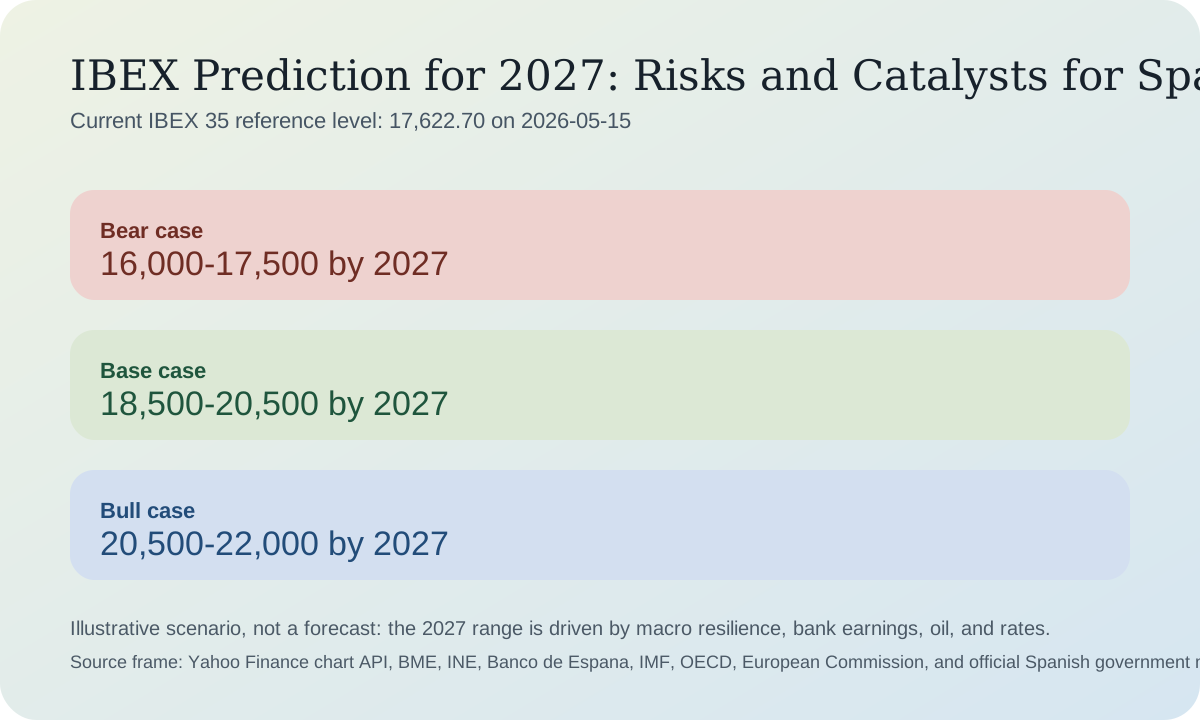
The bull case is 20,500 to 22,000 by the end of 2027, with a 30% probability. It needs continued macro resilience, lower inflation, and enough rate stability to keep Spanish banks attractive without triggering a credit slowdown. Review this thesis after each major CPI print and each bank earnings season.
Base-case scenario
The base case is 18,500 to 20,500, with a 45% probability. It assumes growth decelerates but stays positive, the deficit path remains manageable, and the benchmark keeps deriving support from dividends and regulated earnings.
Bearish scenario
The bear case is 16,000 to 17,500, with a 25% probability. It becomes more plausible if inflation stays sticky, oil remains a tax on the economy, and the bank-led portion of the benchmark gives back some of its rerating.
| Scenario | Range | Probability | Measurable trigger | Review timing |
|---|---|---|---|---|
| Bull | 20,500-22,000 | 30% | Inflation cools and GDP stays positive while banks maintain strong operating trends | Quarterly after CPI and earnings |
| Base | 18,500-20,500 | 45% | Growth slows but does not break, and policy risk stays contained | Recheck after each IMF, OECD, and Banco de Espana update |
| Bear | 16,000-17,500 | 25% | Oil shock, weaker bank margins, or higher yields drive a de-rating | Immediate review during energy or bond-market stress |
| Path into 2027 | Estimated probability | Why |
|---|---|---|
| Rising from current levels | 50% | The macro baseline is still positive and the benchmark retains strong income support. |
| Falling from current levels | 25% | The downside is real, but it likely needs a macro or energy shock rather than a mild slowdown. |
| Sideways and volatile | 25% | A more range-bound outcome is plausible after the strong move already achieved. |
Risks to watch
Three data points matter most right now: 3.2% CPI, 10.83% unemployment, and a market where banks and energy-heavy sectors dominate the factor mix. Add bond yields and geopolitics, and the 2027 path remains event-sensitive.
What could invalidate the forecast
The framework would be too cautious if earnings breadth improves sharply beyond banks and utilities. It would be too optimistic if the 2025-2026 rerating proved to be mostly multiple expansion with too little underlying earnings support.
Conclusion
The most realistic IBEX 2027 outlook is moderately constructive, but tactical. The market still has upside, yet the next leg probably depends on cleaner catalysts than the last one did.
Disclaimer: This article is for research and informational purposes only. The scenarios are based on cited public data and are not personal investment advice.
06. Investor Positioning
2027 is short enough that positioning discipline matters
| Investor profile | Cautious approach | What to monitor |
|---|---|---|
| Investor already in profit | Hold core exposure, trim if bank concentration has become too large, and rebalance rather than chasing new highs. | Bond yields, bank guidance, and whether leadership is broadening beyond the top financials. |
| Investor currently at a loss | Revisit the entry thesis before averaging down; a Spain thesis is only valid if growth and bank profitability still hold. | Macro slowdown, oil shocks, and any deterioration in sovereign spread narratives. |
| Investor with no position | Wait for either a pullback or clearer evidence that earnings breadth is improving, then scale in gradually. | Valuation discipline, support levels, and macro releases from INE, OECD, and Banco de Espana. |
| Trader | Respect volatility, avoid oversized directional bets, and use stop-loss discipline around central-bank, oil, and bank-news windows. | Short-term momentum, sector rotation, and headline risk from geopolitics. |
| Long-term investor | Dollar-cost averaging is more defensible than trying to time every macro wiggle, but only if the role of banks and utilities fits the portfolio. | Dividend sustainability, real GDP trend, and whether Spain's structural competitiveness keeps improving. |
| Risk-hedging investor | Use the IBEX more as a diversifier than as a pure growth engine, and pair it with assets that behave differently when oil or Europe rates jump. | Correlation shifts during stress and any spike in energy-linked inflation. |
07. FAQ
Answers to common 2027 search questions
What is the biggest catalyst for the IBEX into 2027?
Bank earnings quality is still the most immediate catalyst because financials are the largest sector weight in the benchmark.
What is the biggest near-term risk?
Sticky inflation combined with oil strength and higher yields. That mix can hurt both valuation and domestic activity.
Why is the 2027 upside smaller than some long-range 2030 or 2035 ranges imply?
Because the market has already done a lot of rerating work, so the next 12 to 18 months are more likely to depend on execution than on pure sentiment recovery.
08. Sources
Primary and high-credibility references used in this article
- Yahoo Finance chart API for ^IBEX, 10-year monthly history
- Yahoo Finance chart API for ^IBEX, recent daily closes
- BME IBEX 35 factsheet
- BME explainer on what the IBEX 35 is
- BME December 17, 2025 market report on the record IBEX year
- INE Q1 2026 GDP flash estimate
- INE April 2026 CPI and HICP release
- INE labor force survey latest data
- Banco de Espana March 2026 macroeconomic projections page
- Banco de Espana Financial Stability Report Spring 2026
- OECD Spain economic snapshot
- IMF March 20, 2026 Spain Article IV mission statement
- European Commission economic forecast for Spain
- Reuters-linked market note on IBEX gains and Middle East focus
- Reuters-linked market note on IBEX weakness, oil, and yields