01. Quick Answer
A serious 2035 platinum forecast has to balance lasting scarcity against the risk that high prices solve part of the shortage
NYMEX platinum futures (PL=F on Yahoo Finance) were trading around $1,983.5/oz on 2026-05-18. The same 10-year monthly series started near $1,021.5/oz on 2016-06-01 and most recently showed $1,983.5/oz, with a 10-year monthly range of roughly $785.9 to $2,102.8 and a price-only CAGR near 8.04% (10-year monthly data).
WPIC's January 2026 five-year outlook is one of the few public frameworks that already extends platinum balances toward 2030, and it still sees average deficits of roughly 348 koz a year from 2027 through 2030. That matters because 2035 prices will be heavily influenced by whether those deficits merely persist or trigger supply and substitution responses that change the market before the next decade is halfway through.
The long-horizon forecast also has to respect macro uncertainty. The World Bank expects platinum prices to cool after the 2026 spike, while the IMF still assumes a moderate global growth path rather than a deep industrial recession. The evidence is mixed, so scenario analysis is the only defensible approach.
| Point | Why it matters |
|---|---|
| Long horizon | 2035 forecasting is less about next quarter's sentiment and more about whether deficits remain chronic even after higher prices. |
| Supply constraints | Modest mine growth and geographically concentrated production can support a higher long-run floor. |
| Demand transition | Automotive erosion is real, but the pace of erosion is still slower than many zero-carbon narratives assume. |
| Probability logic | The highest 2035 targets should be treated as conditional bull cases, not as base expectations. |
02. Historical Context
Platinum's long-term setup only makes sense when current tightness is compared with a decade of false starts, sharp drawdowns, and renewed scarcity
Platinum's 2035 setup cannot be understood only through the 2026 lens. The last decade taught investors that a metal can be strategically important and still underperform for years if the market believes supply is adequate and autocatalyst demand is in secular decline. That legacy is why platinum was cheap for so long and why the latest rerating matters.
The new regime looks different because deficits are now documented rather than merely theorized. WPIC described the 2025 shortfall as the largest in its published history, while the May 2026 update still shows a deficit and very limited inventory cover. A market with that starting point deserves higher long-run ranges than a market swimming in surplus stock.
But 2035 is also far enough away that price itself becomes part of the forecast. If platinum stays expensive, recycling improves, demand gets thrifted, and substitution works against the bulls. That is why the 2035 base case cannot simply extend the 2025-2026 momentum indefinitely.
| Metric | Latest reading | Why it matters |
|---|---|---|
| Current platinum price | $1,983.5/oz | Every forecast range needs a live anchor because platinum already repriced sharply in 2025 and early 2026. |
| 52-week range | $1,004.5 to $2,852.4 | This range shows how quickly platinum can move when physical tightness meets speculative demand. |
| 10-year monthly range | $785.9 to $2,102.8 | Useful for separating a normal correction from a full regime shift. |
| 10-year price CAGR | 8.04% | Long-run compounding has been positive, but still uneven enough to punish lazy extrapolation. |
| Latest WPIC 2026 deficit | 297 koz | The latest published WPIC update still points to undersupply despite softer investment demand than in 2025. |
| Editorial base range | $2.3k-$3.2k | Scenario ranges are more honest than pretending platinum has one inevitable destination. |
| Line item | Latest official reading | Interpretation |
|---|---|---|
| Medium-term balance path | Deficits through 2030 | A deficit runway into 2030 raises the odds that 2035 starts from a tighter inventory base than the 2010s. |
| Automotive demand by 2030 | Around 2.6 Moz in WPIC's framework | Auto demand should decline, but not disappear, which is critical for the mid-2030s floor. |
| Hydrogen and new industry | Supportive but still emerging | Long-term upside improves if these channels become material rather than merely promotional. |
| Jewellery sensitivity | High | High platinum prices can help prestige positioning but can also suppress volume growth. |
| Recycling response | Meaningful but incomplete | More scrap helps, yet current projections do not suggest recycling alone fixes the deficit. |
| Macro overlay | Still powerful | Platinum can remain structurally tight and still go through long cyclical drawdowns. |
03. Main Drivers
Five structural forces matter most when projecting platinum into 2035
1. Deficits have to survive their own success
A long-run bull thesis is strongest when higher prices fail to cure the shortage. If mine output remains sluggish and recycling only partly responds, platinum can keep a premium scarcity component well into the 2030s.
2. The automotive decline is real, but timing still matters
Battery-electric growth caps autocatalyst demand, but hybrids, heavy-duty vehicles, and slower fleet turnover can keep platinum relevant longer than headline EV adoption charts imply.
3. Industrial diversification can matter more by 2035 than it does today
Johnson Matthey and WPIC both point to industrial support from electronics, glass, chemicals, and hydrogen. If even some of those uses scale, platinum's demand mix becomes more resilient.
4. South African supply discipline remains central
Platinum's geography still matters. USGS and industry reports both reinforce how dependent the market is on a narrow producer base, which limits how fast the supply side can rebalance.
5. Macro regime changes can overwhelm elegant models
The World Bank explicitly expects some moderation after the current surge, while Deutsche Bank highlights tariff and inventory outcomes as major swing variables. A 2035 range therefore needs to respect both structural scarcity and cyclical mean reversion.
04. Institutional Forecasts and Analyst Views
Institutional evidence supports a tighter platinum market, but the range of fair-value assumptions is still unusually wide
Direct 2035 platinum targets from major institutions are rare, so the best approach is to combine published 2026 price anchors with multi-year balance frameworks. LBMA analysts broadly cluster around elevated 2026 averages, but their ranges remain very wide, which implies limited confidence in precise pathing.
Bank views are also far from uniform. The Reuters poll still looks restrained versus the current market, while BofA moved much higher after platinum surged beyond prior assumptions. The gap between those numbers is not noise; it is evidence that different houses are still debating whether platinum's rerating is mostly cyclical or mostly structural.
For 2035, the most credible institutional input remains WPIC's own 2027-2030 deficit path. If that balance picture proves roughly right, then platinum should be worth materially more in the mid-2030s than it was across most of the last decade, even if the market also experiences multi-year corrections on the way there.
| Source | Published view | Why it matters |
|---|---|---|
| WPIC Q1 2026 update | 2026 deficit revised to 297 koz | The latest fundamental update still says the market is undersupplied despite price volatility. |
| WPIC January 2026 five-year outlook | Average deficits of about 348 koz a year from 2027 to 2030 | This is one of the few published medium-term platinum balance frameworks. |
| LBMA 2026 analyst panel | Analyst averages shown around $2.1k-$2.3k with wide ranges | The range matters because platinum is still a small market where flows can overwhelm smooth modeling. |
| Reuters poll | $1,550 average for 2026 | Useful as a conservative institutional baseline captured before the latest rerating ran further. |
| BofA | $2,450 average for 2026 | Represents one of the stronger bank views tied to deficits, tariff risk, and Chinese demand. |
| Johnson Matthey 2026 PGM report | Platinum demand should again exceed supply in 2026 | Adds an industry operator's view, not just a macro strategist's opinion. |
| World Bank April 2026 outlook | Platinum prices projected up about 53% in 2026, then down 13% in 2027 | A macro commodity house case that explicitly assumes moderation after the spike. |
| Deutsche Bank | Tariff outcomes could either trigger a rally or soften prices via inventory unwind | Useful because it frames policy uncertainty as a genuine swing factor rather than background noise. |
05. Bull, Bear, and Base Case
A 2035 platinum forecast is mostly a debate about how persistent the deficit era really is
Bullish scenario
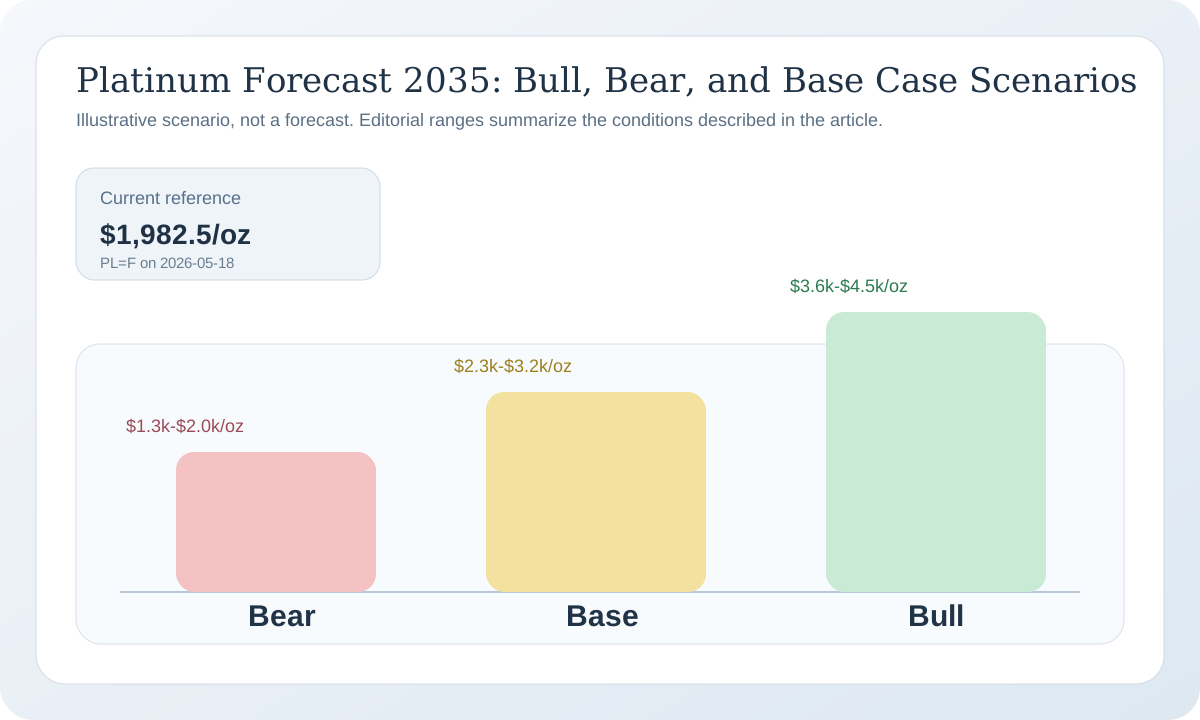
The 2035 bull case is $3,600 to $4,500. It requires deficits to remain normal rather than exceptional, industrial diversification to deepen, and the market to continue treating platinum as a strategic scarce metal rather than as a fading auto by-product.
Base-case scenario
The 2035 base case is $2,300 to $3,200. That range assumes the rerating sticks, but also assumes price-sensitive demand, modest recycling growth, and some substitution prevent platinum from living permanently in squeeze conditions.
Bearish scenario
The 2035 bear case is $1,300 to $2,000. This path would likely require either much faster automotive decline, much stronger recycling, or enough mine recovery that scarcity stops dominating the narrative.
Risks to watch
Long-run risks include policy-driven EV acceleration, a stronger palladium substitution cycle, new low-cost supply, slower-than-hoped hydrogen demand, and a decade defined more by industrial recession than by scarcity.
What could invalidate the forecast
The base case would be too bullish if the deficit cycle ends before 2030 and above-ground stocks rebuild materially. It would be too bearish if deficits remain entrenched and the market discovers durable non-auto demand faster than most models currently assume.
Conclusion
For 2035, platinum still looks more attractive as a range story than as a single-target trade. Available data suggests the floor should be higher than it was in the 2016-2023 period, but the evidence is mixed on whether new demand channels become large enough to justify a permanently explosive premium.
The probability table below is an editorial framework built from the live price anchor, the latest WPIC balance data, the World Bank macro path, and the dispersion in LBMA and bank forecasts. It is not a statistical guarantee.
| Scenario | Illustrative range | Conditions | Probability |
|---|---|---|---|
| Bull | $3,600-$4,500 | Entrenched deficits, strategic re-rating, and broader industrial adoption. | 25% |
| Base | $2,300-$3,200 | Higher floor persists, but scarcity is partly offset by adaptation. | 50% |
| Bear | $1,300-$2,000 | Supply and substitution improve more than expected. | 25% |
| Path | Estimated probability | Comment |
|---|---|---|
| Probability of rising | 50% | The longer-term floor looks better than it did in the last decade, but explosive upside is not the default path. |
| Probability of falling | 20% | A lower 2035 price still needs meaningful demand disappointment or easier supply. |
| Probability of moving sideways | 30% | A high but range-bound market is plausible if structural support remains while demand adjusts. |
06. Investor Implications
A platinum forecast is only useful if it changes how different investors manage risk, timing, and position size
A 2035 forecast is most useful for readers deciding whether platinum belongs in a long-horizon allocation at all. That decision should be based less on the next six months of noise and more on whether the portfolio can tolerate a volatile industrial precious metal.
Because the market is thin, even long-term believers should think in bands and rebalance rules rather than in all-in conviction. Platinum can be structurally attractive and still produce nasty multi-quarter drawdowns.
| Investor type | Cautious approach | What to watch |
|---|---|---|
| Investor already in profit | Hold part of the core position if the deficit thesis still fits, but trim or rebalance if platinum has become too large a portfolio weight. | Lease-rate tightness, exchange inventories, and whether the market keeps rejecting rallies above the current zone. |
| Investor currently at a loss | Separate a broken thesis from a poor entry. Add only gradually if deficits, stock depletion, and industrial demand still support the long-run case. | Whether downside comes from looser physical balances or only from macro de-risking. |
| Investor with no position | Avoid chasing vertical rebounds. Prefer staged buying, wait-for-pullback plans, or dollar-cost averaging. | Chinese jewellery substitution, ETF flows, and whether recycled supply starts responding more aggressively. |
| Trader | Use stop-losses and respect headline risk. Platinum is too thin a market for oversized conviction when tariffs and positioning can move price quickly. | Dollar moves, exchange-for-physical stress, South African supply headlines, and auto-sector news. |
| Long-term investor | Focus on scenario ranges, rebalance bands, and the structural supply story instead of one exact price target. | Whether 2027-2030 deficits persist and whether hydrogen and industrial uses become material rather than symbolic. |
| Reader seeking a hedge | Treat platinum as a specialist hedge with industrial sensitivity, not as a pure crisis hedge like gold. | Correlation behavior during equity selloffs and whether platinum trades as a precious metal or an industrial metal in the next shock. |
Disclaimer: This article is for informational and research purposes only. It is not a recommendation to buy, sell, or hold platinum or platinum-linked products.
07. FAQ
Frequently asked questions about the platinum 2035 forecast
Why is the 2035 range wider than the 2030 range?
Because the farther out the forecast goes, the more uncertainty matters around automotive demand, recycling, supply response, and new industrial uses.
What would most improve the 2035 bull case?
A sustained deficit cycle combined with credible growth in hydrogen, electronics, and other industrial uses would improve the bull case the most.
Why is the bear case still important if platinum is in deficit now?
Because deficits can shrink, investor enthusiasm can fade, and high prices can destroy or redirect demand over time.
References
Sources
- Yahoo Finance PL=F recent daily chart
- Yahoo Finance PL=F 10-year monthly chart
- WPIC Platinum Quarterly Q1 2026
- WPIC Q1 2026 summary press release
- WPIC Platinum Quarterly Q4 2025
- WPIC Platinum Essentials January 2026
- Johnson Matthey 2026 PGM Market Report release
- LBMA 2026 analysts forecasts
- Reuters poll on platinum forecasts
- BofA platinum forecast summary
- World Bank Commodity Markets Outlook April 2026
- IMF World Economic Outlook April 2026
- USGS Mineral Commodity Summaries 2026
- Deutsche Bank metals and strategic materials note