01. Quick Answer
The 2035 SONY setup is fundamentally about whether Sony becomes a more durable IP-and-platform compounder or remains a premium cyclical portfolio
SONY closed at 22.31 on 2026-05-15 against a 10-year range of 5.61 to 29.35 (Yahoo Finance chart API for SONY, 10-year monthly history; Yahoo Finance chart API for SONY, recent daily closes). That range matters because the next decade is unlikely to be driven by one blockbuster console cycle or one sensor upswing. It will be driven by whether Sony's content, platform, and semiconductor strengths reinforce each other often enough to change the market's valuation framework.
Sony's own disclosures support a long-horizon framing. Corporate Strategy 2026 emphasized entertainment, anime, AI, and next-generation image sensors, while FY2026 guidance still points to higher operating income despite lower sales Sony Corporate Strategy 2026 Sony FY2026 guidance. The evidence is mixed, but it is strong enough to justify modeling a wide 2035 range rather than treating Sony as a mature no-growth holding.
| Point | Why it matters |
|---|---|
| 2035 depends on business-model evolution, not just cyclical recovery | The long-run question is whether Sony becomes less dependent on hardware timing and more dependent on recurring IP and platform economics. |
| Music and anime can make Sony more durable | These businesses can deepen recurring monetization and global IP value. |
| Image sensors add strategic upside and cyclical risk | The segment can be a differentiator, but it still depends on end-market conditions. |
| The base case should remain cautious | Even strong portfolios can absorb years of investment without large multiple expansion. |
02. Historical Context
The long-range case starts with Sony's portfolio architecture
Sony's historical improvement was not accidental. Over time, the company shifted away from a perception dominated by low-margin commodity hardware and toward a portfolio that includes game platforms, music rights, anime distribution, premium film and television content, and advanced image sensors. The Corporate Report and 20-F both support that interpretation: they describe a company that increasingly allocates capital toward businesses with stronger IP leverage and more recurring economics Sony Corporate Report 2025 Sony 20-F.
That said, the next decade will still be uneven. Sony's FY2025 reporting shows strong operating performance but also reminds investors that one-time items, equity-method losses, spin-off effects, and tax changes can change headline earnings quickly Sony FY2025 presentation. Long-term investors therefore need to separate strategic direction from annual noise.
| Issue | 2027 lens | 2035 lens |
|---|---|---|
| PlayStation | Software and network monetization | Whether the ecosystem remains structurally sticky and profitable. |
| Music | Near-term streaming and release cadence | Whether rights ownership continues compounding cash flow. |
| Anime and Pictures | Release slate and subscriber growth | Whether Sony becomes a more powerful global IP owner. |
| I&SS | Sensor demand and memory pricing | Whether Sony sustains a hard-to-replicate technology moat. |
| Strength | Why it matters | 2035 implication |
|---|---|---|
| Portfolio diversity | No single business has to carry the entire story | Can reduce downside if one engine weakens. |
| IP ownership | Music and anime increase monetization durability | Can support higher-quality cash flow over time. |
| Technology layer | Sensors and gaming platforms are still strategically relevant | Keeps Sony from becoming a pure media multiple. |
| Capital discipline | Buybacks and portfolio moves affect the equity case directly | Can improve per-share compounding if execution remains disciplined. |
03. Main Drivers
Five structural drivers matter most in a 2035 Sony forecast
1. Whether entertainment becomes a larger share of group quality. Sony's strategy release explicitly places entertainment and IP at the center of long-term growth. If those businesses keep out-earning the more cyclical electronics and hardware activities, Sony's valuation profile can improve materially Sony Corporate Strategy 2026.
2. Whether image sensors remain hard to displace. Sony described its image-sensor strength as based on analog-domain expertise, stacking technology, circuitry, and process know-how that are difficult to replicate. If that remains true, I&SS could still be a major valuation anchor well into the 2030s Sony sensor strategy commentary.
3. Whether Sony turns anime into a larger global ecosystem. With Crunchyroll above 21 million paid subscribers and anime described as an important growth sector, Sony has a credible path to building a broader cross-media flywheel, though this scenario depends heavily on execution and IP quality Crunchyroll and anime strategy.
4. Whether PlayStation remains a premium platform in a crowded market. SIE benefits from scale, IP, and ecosystem depth, but the long-range risk is that content costs rise faster than monetization quality. Sony's business-segment materials matter here because they frame the platform business as more than a console shipment story Sony G&NS materials.
5. Whether AI raises productivity without diluting creator trust. Sony is explicitly positioning AI as a creator-first tool. If that stance translates into better production efficiency, curation, personalization, and cost control, it could strengthen several segments at once. If not, AI may remain strategically relevant but financially incremental Sony AI framing.
04. Institutional Forecasts and Analyst Views
The public evidence base supports a wide 2035 range, not a point target
Official Sony materials are clear enough to support a long-run constructive case, but not precise enough to justify certainty. The company is still guiding to higher FY2026 operating income, the Music and anime businesses still have structural support, and the image-sensor business still retains strategic relevance Sony FY2026 guidance IFPI 2026.
However, analysts remain divided because the evidence is mixed. The company's diversity reduces concentration risk, but it also means some businesses are always facing softer demand, higher costs, or portfolio restructuring at the same time. That is why 2035 should be modeled as a framework around durability, not around a single forecast multiple.
| Source | Main signal | 2035 implication |
|---|---|---|
| Sony 2026 strategy release | Entertainment, AI, anime, and sensors are core priorities | Supports a credible structural-upside narrative. |
| Sony FY2025 results | Operating quality remains strong | Supports durability, not just hope. |
| IFPI 2026 | Recorded-music growth continued globally | Strengthens the long-run case for Sony Music. |
| IMF Japan 2026 | Macro risks remain real | Argues against overly aggressive long-term assumptions. |
05. Scenarios, Risks, and Invalidation
The long-run SONY bull case is attractive, but it still needs discipline
Bullish scenario
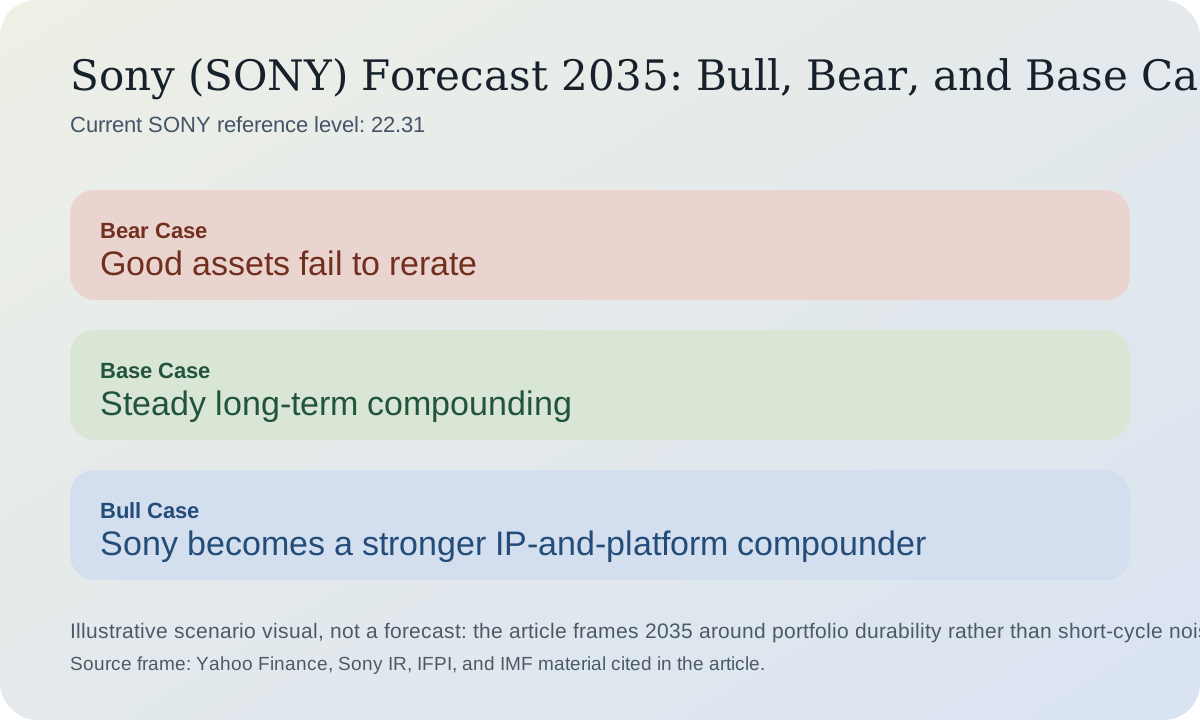
The bull case is $42 to $50 by 2035. This outcome needs Sony to become more clearly recognized as a creator-economy and IP platform with durable sensor leadership, not just as a well-managed conglomerate.
Bearish scenario
The bear case is $20 to $26. That path would likely require multiple businesses to remain fundamentally healthy but not strong enough to justify a better long-run valuation framework.
Base-case scenario
The base case is $30 to $38. It assumes Sony continues compounding through portfolio quality, recurring monetization, and selective capital returns, but without becoming a high-multiple pure-play platform story.
Risks to watch
Watch content costs, PlayStation engagement quality, anime monetization, image-sensor competitiveness, AI implementation, and whether capital allocation remains shareholder-friendly.
What could invalidate the forecast
The base range would be too low if Sony's content and platform assets reinforce each other more powerfully than the market expects. It would be too high if the company remains operationally good but never becomes structurally less cyclical in investors' eyes.
Conclusion
The 2035 SONY story is ultimately about business quality and strategic coherence. Sony has enough premium assets to justify long-run optimism, but not enough certainty to justify a one-number prophecy.
Disclaimer: This article is for research and informational purposes only. Long-range scenario ranges are conditional estimates and should not be treated as guarantees or personalized advice.
| Scenario | Range | Conditions | Probability |
|---|---|---|---|
| Bull | $42-$50 | Higher-quality IP, platform, and sensor compounding | 25% |
| Base | $30-$38 | Disciplined long-term execution | 50% |
| Bear | $20-$26 | Portfolio stays good but not reratable | 25% |
| Path | Estimated probability | Why |
|---|---|---|
| Rising from current levels by 2035 | 60% | Sony still has enough quality assets to support a constructive long-run bias. |
| Falling below current levels by 2035 | 15% | A lower level after nine years likely needs strategic drift or persistent de-rating. |
| Moving broadly sideways | 25% | Plausible if good execution is offset by limited multiple expansion. |
06. Investor Positioning
Positioning for 2035 should separate conviction from impatience
| Investor type | Cautious approach | What to watch |
|---|---|---|
| Investor already in profit | Hold core exposure, but trim if the position size now assumes the bull case. | Watch whether long-run business quality is still strengthening. |
| Investor currently at a loss | Reassess whether the thesis is long duration or just cyclical rebound hope. | The 2035 thesis only works if patience and business quality still align. |
| Investor with no position | Build gradually over time rather than treating Sony as an all-at-once bet. | Long-duration stories rarely require chasing. |
| Trader | Do not confuse a 2035 thesis with a short-term setup. | Trading signals and structural value are different categories. |
| Long-term investor | Dollar-cost averaging and periodic re-underwriting make more sense than prediction theater. | Check whether recurring monetization keeps improving. |
| Risk-hedging investor | Pair the position with awareness of global macro and consumer-cycle risk. | Even premium portfolios still feel slowdowns. |
07. FAQ
Frequently asked questions about Sony's 2035 outlook
What would make Sony more reratable by 2035?
A clearer shift toward durable recurring economics from music, anime, platform services, and high-value sensors would help most.
What is the biggest risk to the long-run bull case?
The main risk is that Sony stays good across many businesses but never becomes exceptional enough in aggregate to sustain a meaningfully higher valuation framework.
Why is the base case not more aggressive?
Because Sony still operates in cyclical end markets and because long-run excellence does not always translate into rapid multiple expansion.
References
Sources
- Yahoo Finance chart API for SONY, 10-year monthly history
- Yahoo Finance chart API for SONY, recent daily closes
- Sony FY2025 consolidated financial summary
- Sony FY2025 earnings presentation
- Sony Group Corporate Strategy 2026 press release
- Sony Business Segment Presentation and Fireside Chat 2025
- Sony Corporate Report 2025
- Sony Form 20-F for FY2024
- Sony Corporate Strategy Meeting 2024 speech transcript
- IFPI Global Music Report 2026
- IMF Japan 2026 Article IV mission statement