01. Quick Answer
The next Seoul rally needs both earnings power and a lower structural discount
The KOSPI closed at 7,493.18 on 2026-05-15 after starting the current 10-year Yahoo Finance series at 1,970.35 on 2016-05-31, implying a price-only CAGR of roughly 14.36% (Yahoo Finance chart API for ^KS11, 10-year monthly history; Yahoo Finance chart API for ^KS11, recent daily closes). That is an extraordinary run for a market long associated with the so-called Korea discount. It also means the easy part of the rerating is probably over. Any serious forecast now has to weigh a real semiconductor and AI earnings engine against Korea's cyclical exposure to trade, oil, geopolitics, and currency shocks. The bullish interpretation is that Korea is finally combining top-tier technology exposure with a more shareholder-aware market structure. MSCI saw Korean equities outperform while still appearing cheaper than broader emerging markets, and Reuters reported renewed foreign buying as AI memory strength and reform momentum improved sentiment.
| Point | Why it matters |
|---|---|
| The bull case is more than semiconductors | Chips matter most, but autos, industrials, financials, and shareholder returns must participate. |
| Governance is a real catalyst | The market can sustain higher multiples if value-up reform keeps improving capital discipline. |
| Foreign access and credibility matter | WGBI inclusion and better market plumbing can improve country perception. |
| A disciplined bull case still needs counterarguments | Any serious upside thesis must explain what could stop the rally. |
02. Historical Context
The current bull case is stronger because it sits on both earnings strength and policy reform
The KOSPI closed at 7,493.18 on 2026-05-15 after starting the current 10-year Yahoo Finance series at 1,970.35 on 2016-05-31, implying a price-only CAGR of roughly 14.36% (Yahoo Finance chart API for ^KS11, 10-year monthly history; Yahoo Finance chart API for ^KS11, recent daily closes). That is an extraordinary run for a market long associated with the so-called Korea discount. It also means the easy part of the rerating is probably over. Any serious forecast now has to weigh a real semiconductor and AI earnings engine against Korea's cyclical exposure to trade, oil, geopolitics, and currency shocks.
That combination is unusual. Past Korea rallies often depended mainly on a cyclical export rebound or a valuation bounce from distressed levels. The present setup looks more structurally interesting because semiconductor earnings are very strong while policy and market-access reforms are also visible.
| Metric | Latest reading | Why it matters |
|---|---|---|
| Recent close | 7,493.18 | Every forecast in this article starts from the latest available close, not an old cyclical trough. |
| 10-year starting point | 1,970.35 | Helps frame how much rerating has already happened. |
| 10-year price CAGR | 14.36% | Useful for calibrating whether a future range is conservative or aggressive. |
| 10-year observed range | 1,754.64 to 7,493.18 | Shows how cyclical KOSPI outcomes can be even across a strong decade. |
| Recent 1-month range | 6,091.39 to 7,981.41 | Confirms that the market is still moving in large swings, not a calm trend. |
| Signal | Evidence | Forecast implication |
|---|---|---|
| AI export engine | Reuters says exports have been rising for 11 months, with semiconductors offsetting broader jitters. | Gives the bull case a fundamental earnings foundation. |
| Corporate value-up reform | FSC seminars and guidelines aim to raise valuation quality and shareholder returns. | Supports the idea of a higher, stickier multiple floor. |
| Foreign market relevance | WGBI inclusion improves Korea's benchmark status and market visibility. | Can help sustain interest from global allocators. |
| Rate backdrop | BOK easing offers support without yet signaling panic. | Constructive for risk assets if inflation and FX stay manageable. |
03. Main Drivers
Five forces could drive the next KOSPI rally
1. AI memory leadership. Samsung described record quarterly results tied to AI innovation and higher-value memory sales. Its AMD collaboration and SK hynix guidance both point to the durability of AI-related memory demand. That remains the clearest direct bull catalyst.
2. Governance rerating. The value-up framework gives investors a concrete reason to believe Korea can deserve a higher valuation over time.
3. Broader industrial participation. Hyundai is still investing heavily and guides to major 2026 capex and R&D. If autos and industrials participate, the rally becomes healthier.
4. Easier policy without losing credibility. The May BOK cut is supportive because it eases financial conditions while still sounding cautious enough to preserve confidence.
5. Better country positioning with foreign capital. Reuters says capital markets are luring investors back, and that matters because Korea can rerate quickly when foreign investors decide the market is both profitable and accessible.
| Catalyst | What would confirm it | Why it matters |
|---|---|---|
| AI-led earnings | Repeated strong results and guidance from Samsung and SK hynix | Supports the market's profit engine. |
| Broadening participation | Autos, industrials, financials, and internet names join the advance | Reduces concentration risk. |
| Reform credibility | Higher payouts, more buybacks, cleaner disclosures | Supports multiple expansion. |
| Foreign flows | Sustained inflows beyond tactical momentum | Helps keep the rally liquid and benchmark-relevant. |
04. Institutional Forecasts and Analyst Views
Institutions mostly publish shorter-horizon inputs, so long-range KOSPI estimates need explicit translation
There is a practical problem with very long-range KOSPI forecasting: major institutions rarely publish exact 2030 or 2035 KOSPI targets with enough methodological detail to treat them as hard forecasts. What they do publish are the ingredients. J.P. Morgan Global Research sees emerging markets supported by lower local rates, earnings growth, attractive valuations, and governance improvements. J.P. Morgan Private Bank says global AI tailwinds should continue to support exporters such as South Korea. Invesco says Korea is accelerating governance reforms to strengthen shareholder value, while UBS keeps a favorable lens on Asia tech and a neutral to constructive view on Korea within Asia. MSCI adds that South Korean equities had still been trading around 10 times forward earnings in mid-2025, below the broader MSCI EM multiple near 13, even after strong performance.
Those inputs do not give a clean 2030 number. They do justify a scenario framework. In these articles, the range logic uses five building blocks: the current index level; the 10-year price CAGR; public macro forecasts from OECD, IMF, the BOK, and KDI; public evidence on earnings engines from Samsung, SK hynix, and Hyundai; and the probability that governance reform and foreign-access improvements keep narrowing the Korea discount through the decade.
| Source | What it says | How it influences the scenario work |
|---|---|---|
| IMF, OECD, BOK, KDI | Growth is recovering, but risks remain tilted to trade, energy, and domestic leverage. | Supports moderate earnings growth, not blind extrapolation. |
| J.P. Morgan and UBS | Asia tech and exporters such as Korea still benefit from AI and easing-cycle support. | Strengthens the bull and base cases for semiconductors. |
| Invesco and MSCI | Governance reforms and still-reasonable valuation remain important. | Supports the case for a lower structural discount versus history. |
| Company disclosures | Samsung, SK hynix, and Hyundai all provide evidence on capex, demand, and export sensitivity. | Grounds the index view in the earnings power of major constituents. |
The institutional tone is not wildly euphoric, but it is constructive enough to support a bull case. That matters because the strongest upside frameworks usually start with public research that is positive yet still disciplined.
05. Bull, Bear, and Base Cases
Scenario ranges are more defensible than a single-number prediction
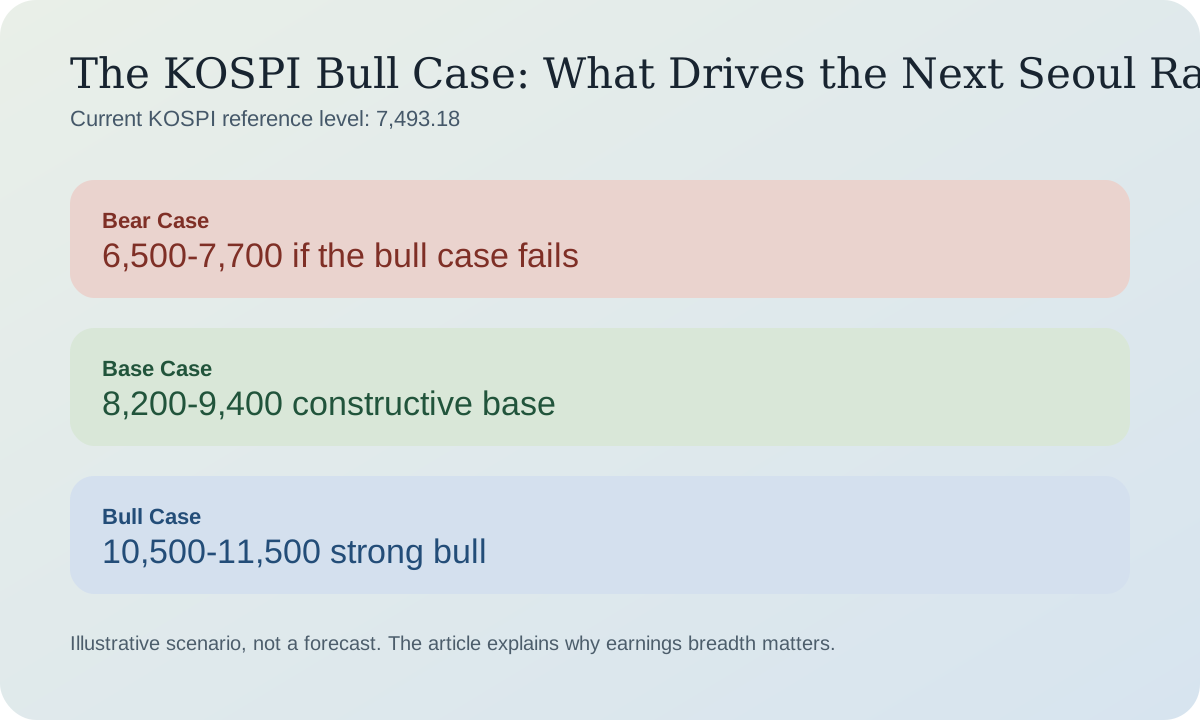
The bull-case range in this article is 9,500 to 11,500 over the next major rally phase. It assumes AI earnings remain strong, governance reform keeps narrowing the discount, and participation broadens enough that the move is not just one more concentrated hardware spike.
| Scenario | Range | Conditions | Probability |
|---|---|---|---|
| Strong bull | 10,500-11,500 | AI demand accelerates again and reform credibility improves materially. | 25% |
| Constructive base | 8,200-9,400 | Rally continues but at a slower pace with normal volatility. | 50% |
| Failed bull thesis | 6,500-7,700 | Leadership stays narrow or valuations outrun reality. | 25% |
| Path | Estimated probability | Comment |
|---|---|---|
| Rising | 60% | The bull case has enough earnings and reform support to remain the leading scenario. |
| Falling | 15% | A failed rally is possible, but not the most likely outcome unless external stress rises materially. |
| Sideways | 25% | Sideways movement would likely reflect digestion after a sharp prior surge. |
Bullish scenario
The strongest upside path is one where Korea's valuation discount keeps narrowing while AI-memory profits stay high and sector participation broadens.
Bearish counterargument
The main rebuttal is that too much of the rally still depends on a narrow group of exporters and one unusually powerful semiconductor cycle.
Base-case scenario
The base path assumes the rally continues, but in a more normal and less spectacular fashion than the recent sprint higher.
Risks to watch
Watch whether earnings breadth improves, whether oil or the dollar reverse risk appetite, and whether value-up reform produces measurable behavior change.
What could invalidate the forecast
This bull case would weaken if AI demand slows sharply, if Korea's discount stops narrowing, or if foreign inflows prove purely tactical. It would strengthen if capital return policies improve more quickly across the index.
Conclusion
The KOSPI bull case is real, but it is strongest when framed as earnings plus reform plus breadth. If only one of those pillars holds, the rally becomes more fragile.
Disclaimer: This article is for research and informational purposes only. A bullish scenario is not a guarantee and should not be read as a personalized recommendation to buy Korean equities.
06. Investor Positioning
Different investor profiles should react differently to the same KOSPI outlook
| Investor profile | Cautious approach | What to watch |
|---|---|---|
| Investor already in profit | Consider holding a core stake but trimming if one semiconductor or ETF has become too dominant. | Watch whether the upside-rerating thesis keeps broadening or becomes a narrow momentum trade. |
| Investor currently at a loss | Separate thesis from timing. Reassess balance between semiconductors, cyclicals, and Korea-specific governance catalysts before averaging down. | Monitor earnings revisions, FX moves, and whether the Korea discount is genuinely narrowing. |
| Investor with no position | Prefer staged entry or dollar-cost averaging rather than chasing a vertical rally. | Pullbacks linked to oil, rates, or trade headlines may offer cleaner entry points. |
| Trader | Use stop-loss discipline and respect event risk around chip earnings, BOK decisions, and export releases. | Short-term KOSPI moves can be amplified by foreign flows and KRW volatility. |
| Long-term investor | Focus on scenario ranges, governance progress, and the durability of AI and industrial policy support. | The long-run case improves only if earnings growth spreads beyond a handful of names. |
| Risk-hedging investor | Consider partial hedges or rebalancing if portfolio risk is already highly correlated with semiconductors and energy-import shocks. | Korea remains sensitive to oil, geopolitics, and the US dollar. |
07. FAQ
Frequently asked questions about this KOSPI outlook
What is the strongest factual support for the KOSPI bull case right now?
The combination of AI-led semiconductor profits, visible governance reform, and improving foreign market access is the strongest current support.
Does a bullish KOSPI article mean the Korea discount has disappeared?
No. The discount may be narrowing, but structural risks tied to geopolitics, currency, and cyclicality still matter.
What would make the bull case healthier?
Broader participation from autos, industrials, financials, and platform companies alongside better payout and disclosure behavior.
References
Sources
- Yahoo Finance chart API for ^KS11, 10-year monthly history
- Yahoo Finance chart API for ^KS11, recent daily closes
- Bank of Korea Economic Outlook, February 2026
- Bank of Korea base-rate decision, February 26, 2026
- Bank of Korea base-rate decision, May 2026
- Bank of Korea Q1 2026 GDP release
- IMF 2025 Article IV consultation with the Republic of Korea
- IMF blog: Asia's economic resilience is being tested by the energy shock
- OECD Economic Outlook, Korea chapter, Volume 2025 Issue 2
- KDI Economic Outlook Update, February 2026
- FSC first seminar on the Corporate Value-up Program
- FSC guidelines on Corporate Value-up Plans
- FTSE Russell reminder on South Korea's inclusion in the WGBI
- MSCI: 'Hallyu' Moment - how investors rode the Korean Wave
- MSCI Korea Index overview