01. Quick Answer
A useful 2035 TTE forecast has to be scenario-based, not falsely precise
A 2035 forecast for TotalEnergies has to start from a structural question: will the market still see the company mainly as a commodity producer, or will it increasingly price it as a differentiated multi-energy platform with durable cash flows from LNG and electricity as well as oil? The answer determines whether the long-term upside is modest, meaningful, or surprisingly strong.
| Point | Why it matters |
|---|---|
| 2035 requires scenario thinking | A nine-year energy forecast is too exposed to geopolitics and policy change for false precision. |
| TTE's transition optionality matters more over 2035 than 2027 | Integrated power and electricity targets have more time to influence the valuation. |
| Hydrocarbon cash flow still funds the thesis | The long-run bull case still needs oil and LNG to keep earning their cost of capital. |
| The bear case is about weaker compounding, not necessarily a broken company | A slower stock outcome can come from lower commodity and transition returns without franchise collapse. |
02. Historical Context
The last decade proves TTE can recover strongly, but not without commodity volatility
TTE's last 10 years already show why the 2035 range has to be wide. The stock moved from €43.38 in May 2016 to €25.82 in the 2020 energy collapse, then up to €80.91 in February 2026 before settling at €78.68 in May 2026 (Yahoo Finance history). That is not the profile of a stable utility. It is the profile of a capital-returning energy company whose valuation still swings with macro energy conditions.
| Dimension | Short-horizon focus | Long-horizon focus |
|---|---|---|
| Oil prices | Near-term Brent and macro shocks | Whether the oil business stays structurally cash-generative over the decade. |
| LNG | Quarterly realizations and trading | Whether LNG remains a long-duration strategic moat. |
| Power | Execution milestones and capex | Whether integrated power earns a valuation premium by the mid-2030s. |
| Returns to shareholders | Current buybacks and dividend tone | Whether TTE can compound cash returns through multiple cycles. |
The strategic materials matter here. TotalEnergies says it plans to grow energy production 4% per year through 2030 and electricity above 100 TWh, with significant investment into Integrated Power (company strategy; energy transition page). By 2035, investors should be able to judge much more clearly whether that model deserves a better multiple than a traditional European oil major.
03. Main Drivers
Five structural forces are most likely to shape the 2035 outcome
1. Long-run oil economics still anchor the valuation
Even in a 2035 forecast, hydrocarbons remain fundamental. If oil remains structurally profitable enough to fund capex and shareholder returns, the base and bull cases stay credible. If not, the whole model gets harder to defend.
2. LNG could become the strongest bridge business in the model
TotalEnergies has been explicit that LNG is central to its oil-and-gas pillar. The IEA's gas work reinforces that this market still has strategic relevance well beyond the next quarter (IEA Gas Market Report).
3. Integrated power execution is the biggest long-range differentiator
If TotalEnergies proves it can earn attractive returns in electricity and flexible power, the market may eventually award a better long-term multiple than it gives to a plain upstream producer.
4. Policy and climate credibility can alter the discount rate
A company operating in Europe cannot ignore climate scrutiny. TotalEnergies' Sustainability & Climate 2026 Progress Report is part of why the market sees the story as more nuanced than simple fossil-fuel extraction (Sustainability & Climate 2026 report).
5. AI and digital tools may matter more by 2035 than by 2027
AI in energy can influence field performance, renewables optimization, predictive maintenance, grid balancing, and trading workflows. Those are gradual but potentially material compounding levers over a decade (Mistral AI collaboration; AI accelerates the energy transition).
04. Institutional Forecasts and Analyst Views
Company strategy and official energy outlooks matter more than scarce 2035 point targets
Public long-dated institutional point forecasts for TotalEnergies are scarce, so a rigorous 2035 framework should extend what is observable today: strategic targets, capital discipline, and the changing economics of oil, gas, and power. The company's own strategy documents give a clearer baseline than trying to reverse-engineer precise 2035 sell-side targets that are rarely published openly.
| Source | Signal | Long-run implication |
|---|---|---|
| TotalEnergies strategy statements | 4% energy growth and >100 TWh electricity by 2030 | Creates a credible case that 2035 could look structurally different from 2025. |
| IEA oil outlooks | Oil balances remain uncertain and highly geopolitical | Keeps the long-run range wide. |
| IEA gas outlooks | LNG supply and gas demand both remain strategic | Supports the LNG pillar as a long-duration bridge. |
| Sustainability and climate reporting | Transition strategy is becoming more measurable | Could affect the valuation multiple if returns are proven. |
Available data suggests the cleanest 2035 base case is moderate compounding. The bull case requires proof that the integrated model earns a premium. The bear case requires weak hydrocarbon economics or disappointing transition returns, not necessarily both at once.
That is why the long-run debate is less about whether TotalEnergies can survive the transition and more about whether it can keep earning attractive returns while navigating it. That is a much harder, and more useful, question.
05. Bull, Bear, and Base Cases
Long-range energy forecasting should be conditional and range-based
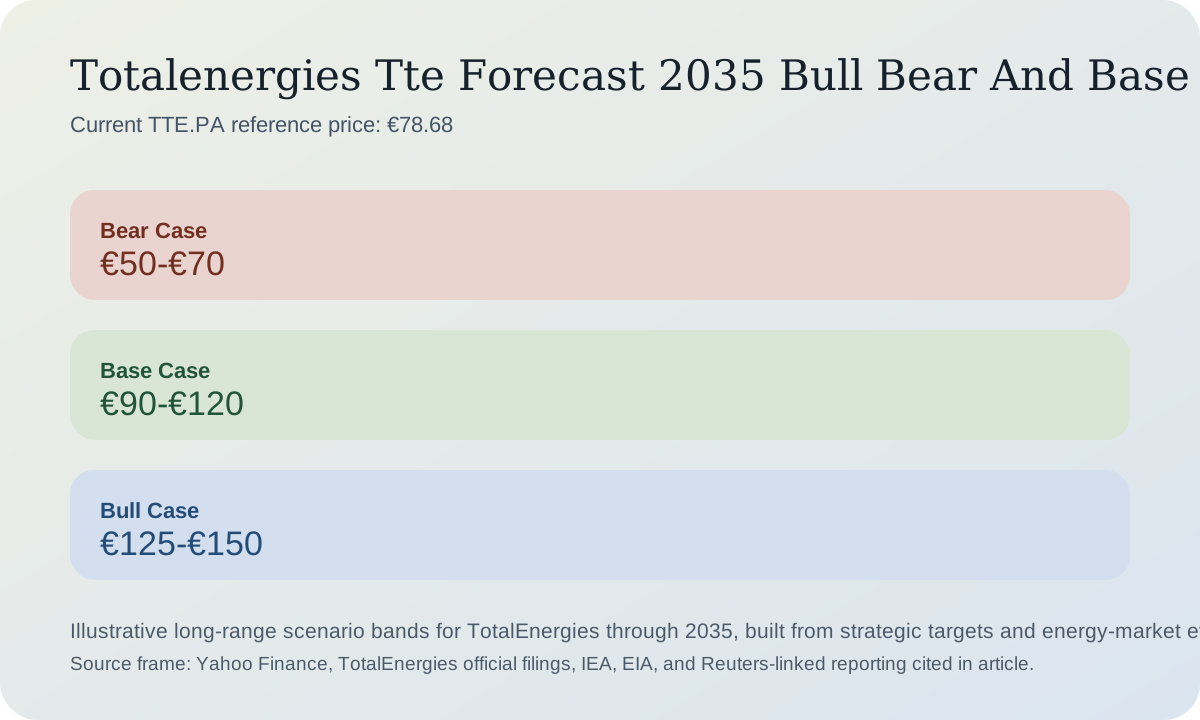
Bull case for 2035
The bull range is €125 to €150. That would likely require a supportive long-run oil and LNG environment, successful integrated-power scaling, and a market increasingly convinced that TotalEnergies deserves a hybrid energy-transition multiple.
Base case for 2035
The base case is €90 to €120. This assumes decent hydrocarbon cash flow, useful but not spectacular power returns, and continued shareholder distributions without a major balance-sheet problem.
Bear case for 2035
The bear range is €50 to €70. This path would likely reflect structurally weaker hydrocarbon returns, lower investor confidence in power economics, or a slower global energy system than transition bulls expect.
| Scenario | Range | Core assumptions | Probability |
|---|---|---|---|
| Bull | €125-€150 | Hydrocarbons stay profitable and power earns a higher-quality valuation. | 20% |
| Base | €90-€120 | Balanced cash returns plus gradual strategic broadening. | 55% |
| Bear | €50-€70 | Energy cash flows weaken and the transition premium never arrives. | 25% |
| Direction | Estimated probability | Interpretation |
|---|---|---|
| Higher by 2035 | 60% | The integrated model still supports a positive long-run bias from current levels. |
| Lower by 2035 | 15% | A durable decline likely needs weaker oil, gas, and power outcomes together. |
| Mostly sideways over a long span | 25% | Energy stocks can stay range-bound if distributions offset lower valuation multiples. |
Risks to watch
Long-run commodity supply economics, LNG competition, power-market regulation, political hostility to hydrocarbons, and capital discipline inside the transition build-out are the biggest variables.
What could invalidate the framework
This framework would be too cautious if integrated power becomes a bigger value creator than skeptics expect. It would be too bullish if hydrocarbon returns normalize lower and the company cannot replace them with high-return electricity and gas assets.
Conclusion
The 2035 TotalEnergies outlook is better framed as a debate about quality of compounding than a debate about short-term oil. The company's hybrid model gives it a credible path to better long-run outcomes, but that path is not automatic.
Investors should therefore focus less on any heroic target and more on whether management keeps proving that hydrocarbons, LNG, and power can coexist inside a disciplined return framework.
If that proof accumulates over the next several years, the stock's 2035 ceiling could rise materially from today's market assumptions.
Disclaimer: These scenarios are for research only and are not guarantees or personal investment recommendations.
06. Investor Positioning
Position sizing and patience matter even more over a nine-year horizon
| Investor profile | Prudent stance | Scenario-based note |
|---|---|---|
| Investor already in profit | Let winners run if the thesis is multi-cycle cash compounding, but rebalance if energy dominates the portfolio. | The major risk is overestimating how much of the transition premium is already earned. |
| Investor currently at a loss | Recheck whether the original thesis depended only on oil prices. | Averaging should still be gradual because the stock remains cyclical. |
| Investor with no position | Prefer staged entries over narrative chasing. | Long-range upside does not remove commodity-driven drawdown risk. |
| Trader | Keep horizon discipline and use stop-losses. | 2035 stories do not neutralize quarterly oil and gas volatility. |
| Long-term investor | Dollar-cost averaging still fits best for a capital-returning energy major. | Total return matters as much as the share price. |
| Risk-hedging investor | Treat TTE as cyclical energy exposure, not as a clean hedge substitute. | Pair with explicit hedges if macro risk is the main concern. |
07. FAQ
Frequently asked questions about a 2035 TotalEnergies forecast
Could TotalEnergies deserve a higher multiple by 2035?
Yes, if integrated power and LNG prove durable enough to convince the market that the company is more than a conventional oil major.
Why is the 2035 range so wide?
Because commodity prices, policy, LNG economics, and transition returns can all shift meaningfully over a nine-year horizon.
Does the 2035 thesis depend mainly on oil?
Oil still anchors the model, but the long-run difference between bull and bear cases also depends heavily on LNG and integrated power execution.
References
Sources
- Yahoo Finance chart API for TTE.PA, 10-year monthly history
- Yahoo Finance chart API for TTE.PA, recent daily closes
- TotalEnergies annual financial reports page
- TotalEnergies 2025 Universal Registration Document
- TotalEnergies results page
- TotalEnergies Q1 2026 results press release
- Board statement on TotalEnergies strategy and 2026 buyback framework
- TotalEnergies two-pillar multi-energy strategy
- TotalEnergies energy-transition page
- TotalEnergies gas-to-power integration strategy in Europe
- IEA Oil Market Report, May 2026
- IEA Gas Market Report, Q1 2026
- EIA Short-Term Energy Outlook, April 2026
- Reuters-linked coverage of TotalEnergies cutting buybacks in February 2026
- Reuters-linked coverage of TotalEnergies Q1 2026 trading and earnings outlook
- TotalEnergies Sustainability & Climate 2026 Progress Report
- Mistral AI collaboration
- AI and digital acceleration at TotalEnergies