01. Quick Answer
The cleanest bear case for SMSN is not that Samsung is a bad company. It is that the stock has moved far enough, fast enough, that any sign of peak-cycle earnings or strategic slippage could trigger a derating
Samsung's current fundamentals are strong, but strong fundamentals do not eliminate drawdown risk in cyclical technology stocks. SMSN.L has rerated from 621 to 4,534 over the last decade, and the underlying Korean line has moved from KRW 28,500 to KRW 270,500 SMSN 10-year history 005930.KS 10-year history.
The first-quarter 2026 numbers were spectacular, yet that can itself increase downside risk if the market starts asking how much of the profit surge came from unusually tight memory conditions rather than from a permanently improved business model Q1 2026 results 1Q 2026 presentation.
Available data suggests the most credible bear thesis is a combination of profit normalization, smartphone-market fatigue, foundry underdelivery, and macro stress. None of those risks needs to destroy Samsung. They only need to make investors less willing to capitalize current earnings at today's optimism level.
| Point | Why it matters |
|---|---|
| A bear case is not a bankruptcy case | Samsung can remain financially strong while the stock still corrects materially. |
| Peak earnings create their own risk | The market often derates cyclicals before reported profits weaken. |
| Correction, bear market, and crash are different | Investors should separate normal volatility from a deeper thesis break. |
| Invalidation matters | A serious bear case must still explain what would prove it wrong. |
02. Historical Context
Samsung's long-term rerating has been real, but the path has never been smooth
Official Samsung investor-relations materials identify SMSN as the London Stock Exchange code for the company's common-share GDR, while the operating business is still reported against the Seoul-listed common stock 005930.KS Samsung listing information. That distinction matters because the GDR price is the right market reference for the title keyword, but the Korean line remains the cleaner anchor for operating history, dividends, and buybacks.
Yahoo Finance shows SMSN.L at 4,534 on 2026-05-15 versus 621 on 2016-05-31, implying a 10-year price CAGR of about 22.11% SMSN 10-year history recent SMSN closes. The underlying common stock closed at KRW 270,500 on the same day, versus KRW 28,500 at the start of the 10-year series, for a price-only CAGR of roughly 25.37% 005930.KS 10-year history recent 005930.KS closes. Available data suggests Samsung has already rerated materially, which means future returns are more likely to depend on margins and mix than on a simple multiple reset.
| Metric | Latest reading | Why it matters |
|---|---|---|
| SMSN.L recent close | 4,534 | The London GDR line is the direct price reference for the topic. |
| SMSN.L 10-year range | 621 to 4,534 | Shows how much cyclicality investors have already absorbed. |
| 005930.KS recent close | KRW 270,500 | Useful cross-check because company disclosures and dividends are reported in KRW. |
| FY 2025 revenue / operating profit | KRW 333.6T / KRW 43.6T | The operating baseline comes from the latest audited full year. |
| Q1 2026 revenue / operating profit | KRW 133.9T / KRW 57.2T | Signals how violently the AI-memory upcycle has changed near-term earnings power. |
| Date | Approximate level | Interpretation |
|---|---|---|
| 2016-05-31 | SMSN 621 | Samsung was still largely valued as a cyclical hardware champion. |
| 2021-05-31 | SMSN 1,783.5 | Semiconductor strength and platform confidence lifted sentiment sharply. |
| 2022-05-31 | SMSN 1,091 | Memory downcycle and macro tightening proved how quickly the stock can derate. |
| 2024-05-31 | SMSN 1,480 | The market started pricing in AI memory optionality, but not the full surge. |
| 2026-05-15 | SMSN 4,534 | Today's price already embeds much stronger HBM and DRAM expectations. |
The historical lesson is straightforward. Samsung is neither a stable consumer staple nor an early-stage software compounder. It is a capital-intensive technology leader whose upside usually arrives when the memory cycle, product mix, and investor confidence all strengthen at the same time. The evidence is mixed rather than one-directional, which is exactly why scenario ranges are more defensible than single-number targets.
03. Main Drivers of Potential Weakness
Five downside channels could pressure SMSN even if Samsung remains operationally important
1. Memory-cycle mean reversion. WSTS is still positive on 2026, but markets usually anticipate the next margin rollover before company presentations do WSTS forecast.
2. Smartphone-market softness. IDC said Q1 2026 global smartphone shipments fell 2.9% year over year, and rising memory costs could keep pressure on the broader device market even if Samsung holds share IDC Q1 2026 data.
3. Foundry remains an execution question. If investors keep seeing foundry as a capital sink rather than a moat builder, the stock can lose some of its strategic premium even while memory stays solid 4Q 2025 presentation.
4. Korea and trade risk can compress multiples quickly. The IMF and OECD still highlight external uncertainty, while the BOK explicitly flags semiconductors, trade conditions, and geopolitics as key variables in the outlook IMF OECD BOK.
5. Competitive catch-up in AI memory. Samsung's leadership claims are meaningful, but the AI ecosystem is too important for customers to rely indefinitely on a narrow supplier set. If competitors close the gap, margins can compress without volumes collapsing.
| Term | Approximate meaning | What it could look like for SMSN |
|---|---|---|
| Correction | Roughly a 10% to 20% decline | Can happen even if the long-term thesis remains intact and only expectations cool. |
| Bear market | Roughly a 20%+ sustained decline | Usually requires either a clear profit downcycle or a major macro derating. |
| Crash | A disorderly and fast decline | Would usually need a broader market or geopolitical shock, not only Samsung-specific issues. |
| Period | Approximate move | Lesson |
|---|---|---|
| 2021 to 2022 | 1,783.5 to 1,091 (-38.8%) | Even dominant franchises can derate hard during a semiconductor downcycle. |
| 2024 to early 2025 | 1,480 to 1,101 (-25.6%) | Narrative support can fade quickly when the market reassesses timing and pricing. |
| Peak-cycle risk today | Depends on whether 2026 earnings are treated as sustainable | A stock can fall before fundamentals visibly weaken. |
04. Institutional Forecasts and Analyst Views
The public institutional evidence base is constructive, but not clean enough for a single deterministic target
Samsung itself provides the most concrete near-term evidence. The company reported FY 2025 revenue of KRW 333.6 trillion and operating profit of KRW 43.6 trillion, then followed with a record Q1 2026 at KRW 133.9 trillion of revenue and KRW 57.2 trillion of operating profit FY 2025 results Q1 2026 results 1Q 2026 presentation. That scale change is large enough that any forecast ignoring the AI-memory cycle would be obsolete on arrival.
Industry institutions remain supportive but not euphoric. WSTS said the global semiconductor market could approach USD 975 billion in 2026, with memory and logic again leading growth, while IDC said the smartphone market contracted 2.9% year over year in Q1 2026 even as Samsung and Apple held premium share WSTS 2026 forecast IDC smartphone market data. Inference: Samsung's best business is in one of the strongest parts of tech, but one of its largest product categories is still structurally mature.
Visible public institutional commentary points in the same direction. A JPMorgan emerging-markets fund report said it added to Samsung because valuation still looked attractive and earnings outlook was improving, and Morningstar's public analyst note after Q1 2026 said fair value was raised materially after the earnings beat JPMorgan EM fund report Morningstar public note. Those are not blanket buy signals. They do, however, support the view that the company is being rerated for real operating reasons rather than only for narrative heat.
| Source | Main message | What it means for SMSN |
|---|---|---|
| Samsung management | Record profits are now tied to AI memory, HBM, and mix improvement. | Validates a constructive near-term backdrop. |
| WSTS | Memory and logic should lead 2026 semiconductor growth again. | Supports the semiconductor leg of the thesis. |
| IDC | Samsung remains the top smartphone vendor by Q1 2026 shipments, but the market is under memory-cost pressure. | Explains why phones help but do not remove cyclicality. |
| JPMorgan Asset Management | Added to Samsung on attractive valuation and improved earnings outlook. | Public institutional sentiment has turned more constructive. |
| Morningstar | Raised fair value after strong results and tighter memory markets. | Public analyst commentary recognizes better earnings power. |
The scenario ranges in these articles are built from five ingredients rather than one valuation shortcut: today's GDR price, the adjusted 10-year CAGR, the gap between cyclical and structural profits, Samsung's public HBM and AI roadmaps, and Korea's macro backdrop. Probabilities are not statistical certainties. They are decision weights assigned to how likely the business appears to sustain today's earnings power.
05. Bear Scenario, Counterpoints, and Invalidation
The bear case is credible, but it is not the only credible case
Bullish scenario
The bullish rebuttal is that Samsung now has a stronger strategic position than it did in earlier downcycles: HBM4 is commercial, AI demand is broad, the balance sheet is strong, and shareholder returns are explicit. If those factors prove durable, any drawdown could stay in correction territory rather than turning into a full bear market.
Bearish scenario
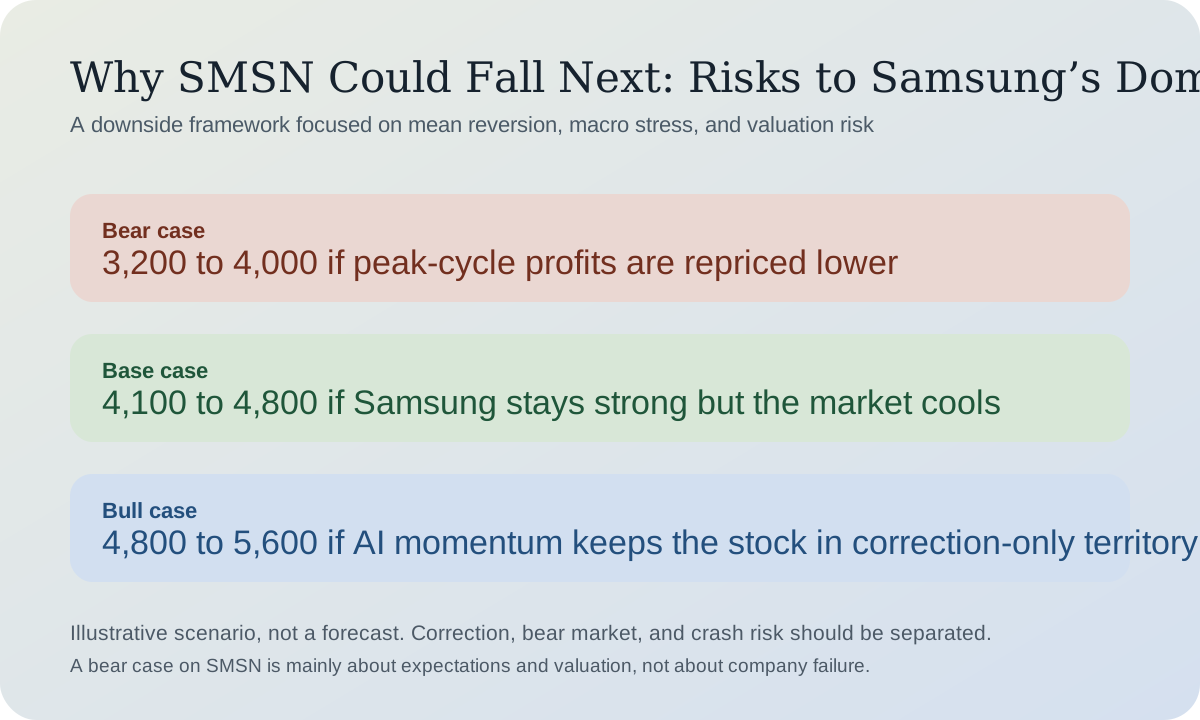
The bearish scenario is 3,200 to 4,000. This range assumes the market concludes that 2026 represents a local earnings high, not a new normal. It also assumes that smartphone softness, foundry skepticism, or macro stress reduce the willingness to pay for Samsung's future optionality.
Base-case scenario
The base case is 4,100 to 4,800. That would fit a market that acknowledges Samsung's quality but still prices in some normalization after an exceptional quarter and an exceptionally strong AI-memory backdrop.
Risks to watch
Track AI-memory customer qualification, inventory behavior, smartphone demand elasticity under higher component costs, Korea export momentum, and whether foundry updates start improving confidence or not.
What could invalidate the forecast
This bear framework would be invalidated if Samsung keeps converting AI demand into broader platform economics instead of only into peak memory profits. Stronger-than-expected foundry traction or a more durable Galaxy AI monetization story would also weaken the downside thesis.
Conclusion
A serious bear case on SMSN does not require a collapse in the company. It only requires the market to decide that current profits are too cyclical, too narrow, or too fully priced. That is a meaningful risk after a sharp rerating, even for a world-class operator.
Disclaimer: This article is for research and informational purposes only. The scenario ranges and probabilities discussed here are conditional estimates, not personalized investment advice.
| Scenario | Illustrative range | Key conditions | Probability |
|---|---|---|---|
| Bull rebuttal | 4,800 to 5,600 | AI leadership broadens and drawdowns stay shallow | 30% |
| Base risk case | 4,100 to 4,800 | Some normalization arrives without a thesis break | 40% |
| Bear | 3,200 to 4,000 | Peak-cycle derating and macro pressure hit at the same time | 30% |
| Path | Estimated probability | Why |
|---|---|---|
| Rising from current levels over the next major leg | 35% | Possible, but less likely if the market focuses on peak-cycle risk. |
| Falling below current levels | 40% | This is a risk-focused article because the setup now contains real derating risk. |
| Moving broadly sideways | 25% | Sideways is plausible if strong fundamentals and valuation caution offset each other. |
06. Investor Positioning
Risk management around SMSN matters most when the market starts debating peak-cycle earnings
| Investor type | Cautious approach | What to watch |
|---|---|---|
| Investor already in profit | Consider trimming into strength or hedging rather than assuming every pullback will be brief. | Watch whether your thesis depends on permanently elevated memory margins. |
| Investor currently at a loss | Avoid emotional averaging down. Recheck whether the original thesis still holds under a lower-multiple scenario. | If the position was tactical, discipline matters more than attachment. |
| Investor with no position | Waiting for pullbacks is reasonable in a risk-heavy setup. | Do not confuse strategic admiration for Samsung with an attractive short-term entry point. |
| Trader | Use stop-losses and plan for gap risk around earnings and macro headlines. | A cyclical leader can still move violently when expectations change. |
| Long-term investor | Keep size moderate and reserve capital for volatility if the long-run thesis remains intact. | Long-term conviction should still allow for cyclical risk management. |
| Risk-hedging investor | Hedges or rebalancing make sense if semiconductor exposure is already large elsewhere in the portfolio. | Correlation across AI names can rise sharply in risk-off periods. |
07. FAQ
Frequently asked questions about the SMSN bear case
Why can Samsung fall if earnings are strong?
Because markets discount future normalization. A stock can decline when investors believe profits are near a peak, even if trailing numbers still look excellent.
Would a pullback automatically break the long-term thesis?
Not necessarily. A correction can simply mean valuation and expectations cooled, while a deeper bear move would imply stronger evidence that normalized earnings were overstated.
What would make the bear case wrong quickly?
Faster-than-expected HBM follow-through, stronger foundry traction, or more durable Galaxy AI monetization could all make the downside case less convincing.
References
Sources
- Yahoo Finance chart API for SMSN.L, 10-year monthly history
- Yahoo Finance chart API for SMSN.L, recent daily closes
- Yahoo Finance chart API for 005930.KS, 10-year monthly history
- Yahoo Finance chart API for 005930.KS, recent daily closes
- Samsung listing information showing SMSN as the London GDR code
- Samsung Electronics announces first quarter 2026 results
- Samsung Electronics 1Q 2026 earnings presentation
- Samsung Electronics announces fourth quarter and FY 2025 results
- Samsung Electronics 4Q 2025 earnings presentation
- Samsung shareholder return policy
- Samsung FY 2025 year-end dividend disclosure
- Samsung ships commercial HBM4 for AI computing
- Samsung unveils HBM4E and AI infrastructure roadmap at NVIDIA GTC 2026
- Samsung and AMD expand AI memory collaboration
- Samsung and NVIDIA AI Megafactory announcement
- Samsung advances Galaxy AI and its connected ecosystem at MWC 2026
- Samsung unveils Galaxy S26 series
- IDC smartphone market insights, Q1 2026
- WSTS autumn 2025 semiconductor forecast for 2026
- Bank of Korea Economic Outlook, February 2026
- IMF 2025 Article IV consultation with the Republic of Korea
- OECD Interim Economic Outlook, March 2026
- Korean MSIT AI computing and AI semiconductor support plan
- JPMorgan Emerging Markets Dividend Income 2026 half-year report
- J.P. Morgan Outlook 2026
- Morningstar note on Samsung Electronics after Q1 2026 results
- Morningstar note on Samsung Electronics after FY 2025 results