01. Quick Answer
The strongest Tesla bear case is not that EV adoption ends; it is that premium expectations can compress if demand and autonomy both disappoint at the same time
Tesla could crater without the underlying company collapsing. That distinction matters. A pullback may simply reflect a correction after enthusiasm about autonomy or AI. A bear market in the stock would imply a more durable reset in expectations around deliveries, pricing, software monetization, or robotaxi timing. A crash would require a sharper combination: weaker demand, faster competitive pressure, and evidence that large infrastructure and robotics bets are taking far longer to produce credible economics than the market assumed. The bearish case today is strongest when those risks reinforce one another rather than appearing in isolation.
| Category | Evidence-based read | Implication |
|---|---|---|
| Historical data | TSLA moved from about $14.15 to about $443.30 over 10 years | Long-run upside is credible, but future ranges should reflect scale and execution complexity |
| Current market conditions | Margins improved in Q1 2026, but deliveries and capex remain active points of debate | Forecasts should stay scenario-based, not blindly narrative-driven |
| Institutional signals | Official reporting, Reuters, and S&P all show real strategic upside with equally real execution risk | Analysts remain divided rather than uniformly bullish or bearish |
| Most important watchpoints | Deliveries, robotaxi scaling, lower-cost EVs, FSD subscriptions, China competition, and capex ROI | These variables will likely shape the stock range more than generic EV enthusiasm |
02. Historical Context
Tesla is no longer just an EV maker, but the vehicle business still sets the floor for the thesis
Tesla stock moved from roughly $14.15 to about $443.30 over the last 10 years based on Yahoo Finance monthly data, implying a 10-year CAGR of about 41.12%. That kind of compounding explains why Tesla still attracts extreme bull and bear narratives. But it also creates the main forecasting challenge: the past decade captured the company moving from a niche EV manufacturer into a global industrial-tech platform. The next decade will be judged less on whether Tesla can sell electric vehicles at all and more on whether it can turn autonomy, software, energy, robotics, and manufacturing scale into a more resilient earnings mix.
| Metric | Latest official reading | Why it matters |
|---|---|---|
| Q1 2026 revenue | `$22.39 billion, up 16% | Shows the company is still growing even amid delivery and pricing debates |
| Total deliveries | 358,023 in Q1 2026 | Vehicle demand and mix remain the most visible sentiment driver |
| Active FSD subscriptions | 1.28 million, up 51% | Software monetization is becoming more material to the valuation story |
| Cash and short-term investments | `$44.74 billion | Supports capex, autonomy, robotaxi, and factory expansion while reducing near-term balance-sheet stress |
03. Main Drivers
Five forces are most likely to shape Tesla stock over the next several years
1. Vehicle demand and pricing still determine how much valuation flexibility Tesla gets
Tesla can talk about autonomy, robots, and AI chips all day, but deliveries still shape the market's near-term confidence. S&P Global and Reuters both highlighted that Q1 volumes disappointed relative to expectations and that Wall Street is increasingly sensitive to whether Tesla can restore durable delivery growth without sacrificing too much pricing or margin quality.
2. Robotaxi is the biggest upside lever and the biggest credibility test
Official Tesla materials say unsupervised robotaxi rides expanded in Austin, Dallas, and Houston in April, while Reuters reported that rides without in-car safety monitors had already begun in Austin. If this scales safely and economically, Tesla's earnings profile changes materially. If progress stalls, a large part of the premium narrative weakens.
3. A lower-cost vehicle could help volume, but may pressure margins
Reuters reported in April 2026 that Tesla is developing a smaller cheaper SUV. That could broaden addressable demand and help defend share against Chinese and other low-cost EV rivals. It could also increase pressure on gross margin if the product succeeds mostly through price rather than superior software or manufacturing economics.
4. Energy, charging, and infrastructure matter more than they used to
Tesla's energy, charging, and services footprint now provides a second layer of growth and reduces dependence on the car cycle. But the Q1 2026 update also showed energy revenue was down year over year, reminding investors that these businesses are helpful diversifiers, not an automatic offset in every quarter.
5. AI, robotics, and vertical integration can justify the multiple only if returns become visible
Tesla is building AI compute, custom silicon, battery material capacity, robotaxi systems, and Optimus production lines at the same time. That breadth is unusual and can support a very large bull case. It also raises the burden of proof because investors need to see that capex is creating durable future cash flows rather than simply widening the scope of execution risk.
04. Institutional Forecasts and Analyst Views
The market still pays for Tesla's optionality, but it is asking harder questions about timing and payoff
Current evidence keeps that downside case alive without proving it. Reuters directly highlighted the possibility of a third straight year of delivery pressure and investor fear around cash burn, while S&P Global stressed that demand softness and heavy capex remain central debates even after a Q1 profit beat. Those points do not disprove the bull case. They simply mean the stock can be more fragile than the strategic vision.
| Source | Message | Interpretation |
|---|---|---|
| Tesla official reporting | Q1 2026 profit and free cash flow were positive despite delivery debates | Operational resilience remains real |
| Reuters | Wall Street is more worried about deliveries, cash burn, and capex than in prior Tesla cycles | Supports a constructive but volatility-aware base case |
| S&P Global | Margin strength beat expectations, but demand softness and heavy capex stayed in focus | Keeps both upside and execution risk visible |
| Tesla Q1 update | Robotaxi, FSD subscriptions, Optimus, and AI compute are advancing in parallel | Strengthens the strategic quality of the thesis, but also its complexity |
05. Bull, Bear, and Base Case
How the forecast range and probability table are built
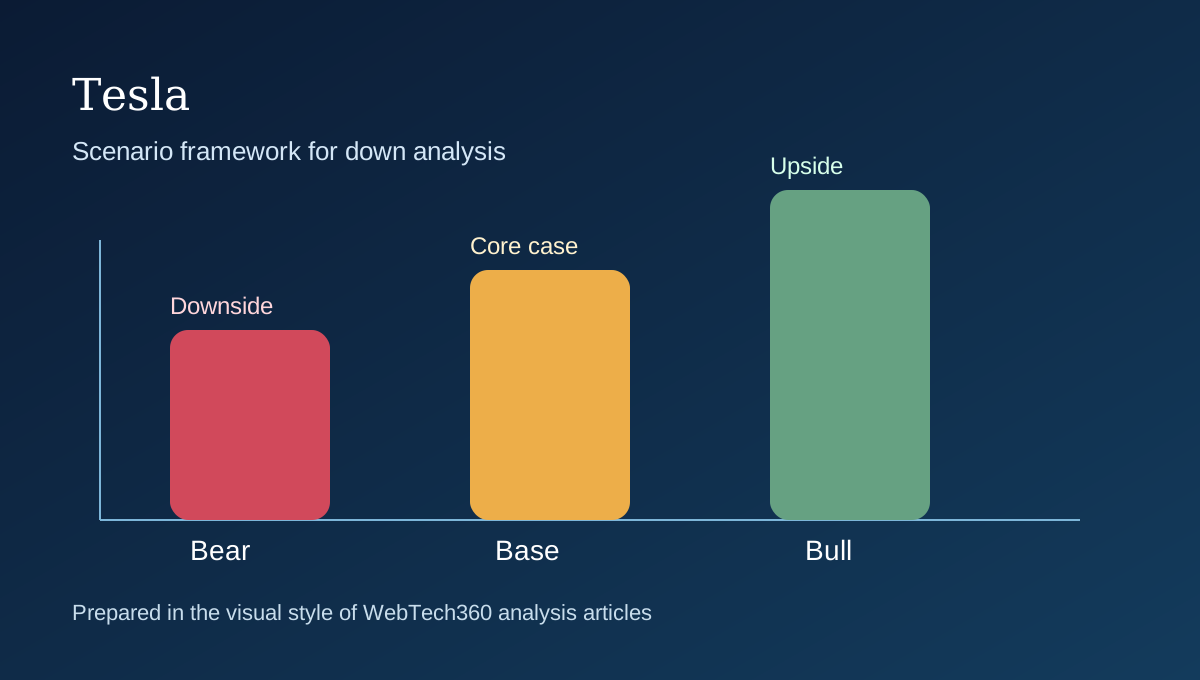
The ranges in this article are not institutional point targets. They are editorial scenario matrices built from current price, 10-year compounding history, vehicle-demand durability, robotaxi and software optionality, energy and services contribution, competition, and the pace at which capex begins to translate into higher-quality earnings.
| Scenario | Likely outcome | Conditions | Probability |
|---|---|---|---|
| Bear | Meaningful pullback or bear market | Demand, pricing, and autonomy expectations all weaken enough to compress the premium multiple | 30% |
| Base | Choppy but supported range | Operational strengths offset part of the narrative pressure | 45% |
| Bull invalidation | New highs resume | Robotaxi, software, and lower-cost vehicles all begin to validate the long-duration thesis faster than expected | 25% |
| Direction | Probability | Comment |
|---|---|---|
| Lower | 35% | Most credible if demand softness combines with slower robotaxi or software monetization |
| Higher | 20% | Would require investors to keep rewarding Tesla's long-duration spending despite skepticism |
| Sideways | 45% | Plausible because Tesla's real strategic optionality can coexist with long periods of stock consolidation |
| Investor type | Prudent approach | Main watchpoints |
|---|---|---|
| Investor already in profit | Hold a core stake, but trim if the position now assumes very fast robotaxi or Optimus monetization | Portfolio concentration, robotaxi milestones, and valuation sensitivity |
| Investor currently at a loss | Reassess whether the thesis is EV demand recovery, autonomy, or long-run robotics rather than averaging down automatically | Deliveries, margins, and the clarity of future monetization |
| Investor with no position | Stage entries or wait for pullbacks instead of chasing momentum around autonomy headlines | Delivery updates, China data, and capex commentary |
| Trader | Use stop-loss discipline and trade around deliveries, earnings, robotaxi news, and macro rate swings | Volatility, options pricing, and sentiment reversals |
| Long-term investor | Dollar-cost average only if convinced software, autonomy, and energy can gradually reduce dependence on pure vehicle economics | Earnings mix, software take rate, and return on invested capital |
| Risk-hedging investor | Rebalance if Tesla has become an oversized bet on one high-beta autonomy and AI narrative | Correlation with other AI names and macro drawdown risk |
Conclusion: Tesla could crater if the market decides demand pressure, autonomy timing, and capital intensity deserve a far larger discount, but the downside thesis still needs several concerns to align rather than one isolated miss. Disclaimer: This article is for informational and research purposes only and does not constitute personalized financial advice.
06. FAQ
Frequently asked questions
Is Tesla still mainly a car company?
Operationally, vehicles still dominate the revenue mix. But the valuation debate increasingly depends on autonomy, software, energy, robotics, and infrastructure.
What matters most for the next forecast revision?
Deliveries, pricing, robotaxi progress, FSD subscription growth, lower-cost EV timing, and cash flow quality are the most important inputs.
Is the biggest risk demand or execution?
Right now, the evidence suggests both matter. Demand softness can hit near-term results, while autonomy and robotics execution shape the long-duration premium.
What would invalidate the bullish case?
Persistent delivery weakness, pricing pressure, slow robotaxi scaling, or capex rising faster than monetization would all weaken the bullish case.
Methodology and Invalidation
How to interpret this Tesla framework and what would change it
Tesla should not be analyzed like a normal automaker, but it also should not be valued as if every long-duration project is already commercially proven. The company sits at the intersection of electric vehicles, charging, energy storage, manufacturing automation, robotics, autonomy, and AI infrastructure. That is why point targets can be misleading. A single narrative rarely captures both the upside and the risk. Tesla can look expensive on near-term auto metrics and still look rational on a platform view. It can also look visionary in strategy while remaining vulnerable to demand softness, competitive pricing, and delayed monetization.
These articles therefore use a range-based approach anchored to three things: current price, 10-year growth history, and present operating evidence. Yahoo Finance chart data place TSLA around `$443.30` in mid-May 2026, versus roughly `$14.15` at the start of the 10-year comparison window. That implies a 10-year CAGR of about 41.12%. That historical rate is extremely strong, but it is not a forecast by itself. A company of Tesla's current size and complexity is unlikely to repeat that exact pace indefinitely unless autonomy, software, robotics, or energy become much larger contributors to earnings than they are today.
Primary documents matter most. Tesla's Q1 2026 update showed revenue of `$22.39 billion`, GAAP operating income of `$0.94 billion`, GAAP net income attributable to common stockholders of `$0.48 billion`, free cash flow of `$1.44 billion`, deliveries of 358,023 vehicles, active FSD subscriptions of 1.28 million, and cash plus short-term investments of `$44.74 billion`. The 2025 Form 10-K adds context around delivery concentration, commodity and battery supply, regulatory and legal exposure, autonomy claims, and the role of capital expenditure in expanding factories and software capabilities.
External reporting frames the active market debate. S&P Global argued that Tesla's Q1 2026 profit beat was offset by demand softness and heavy capex, while Reuters highlighted both the risk of a third straight year of delivery pressure and the strategic upside from a smaller cheaper EV. Reuters also reported early robotaxi progress in Austin and Tesla's stronger China-made EV sales in April, which matters because the China market remains central to both growth and competitive pressure. Available data suggests Tesla is still simultaneously an execution story, a narrative story, and a capital allocation story. That combination is why range-based scenario analysis is more useful than a single linear target.
Investor positioning should match horizon. A trader may care most about deliveries, gross margin, China data, robotaxi headlines, and earnings revisions. A long-term allocator should care more about whether autonomy, software, energy, and robotics can eventually reduce Tesla's dependence on cyclical vehicle economics. Someone already in profit may trim if the position size assumes a very fast robotaxi or Optimus payoff. Someone with no position may prefer staged entries after volatility rather than chasing momentum around AI-themed narratives. What would invalidate a constructive Tesla view? Persistent delivery weakness, stronger pricing pressure, slower robotaxi scaling, or capex expanding faster than monetization would all matter. What would invalidate a bearish Tesla view? Evidence that robotaxi economics work, FSD subscriptions keep scaling, lower-cost EVs restore volume growth, and energy plus services contribute more visibly to profit would weaken it.
Inline evidence anchors the framework (Yahoo TSLA chart API; Tesla Q1 2026 update; Tesla 2025 Form 10-K; S&P Global post-quarter snapshot; Reuters on deliveries; Reuters on robotaxi). That is why the ranges here are scenario tools rather than certainty theater.
References
Sources
- Yahoo Finance chart API, TSLA 10-year monthly history and current price
- Tesla investor relations quarterly disclosure page
- Tesla, Q1 2026 update deck
- Tesla, Form 10-K for fiscal year ended December 31, 2025
- S&P Global, Tesla post-quarter snapshot, April 2026
- S&P Global, Tesla faces challenging Q1 as deliveries miss estimates
- Reuters, Tesla delivery slide may stretch to third year, March 11, 2026
- Reuters, Tesla is developing a smaller cheaper EV, April 9, 2026
- Reuters, Tesla starts robotaxi rides without safety monitors in Austin, January 22, 2026
- Reuters, Tesla China-made EV sales rise 36% in April, May 7, 2026
- Reuters, AI spending boom remains intact, April 16, 2026
- Reuters, investors gauge AI payoff across large tech and AI spenders, April 28, 2026
- Reuters, BYD doubles down on fast charging in China, April 24, 2026
- Axios, Tesla earnings rise but AI expenses add up, April 22, 2026