Home
» News
»
Fat Bear Week 2026: How It Works and Why the Bears Matter
Fat Bear Week 2026: How It Works and Why the Bears Matter
Updated September 21, 2026: Fat Bear Week 2026 runs from September 22 through September 29. The official bracket was revealed on September 18, and the champion will be announced on September 29.
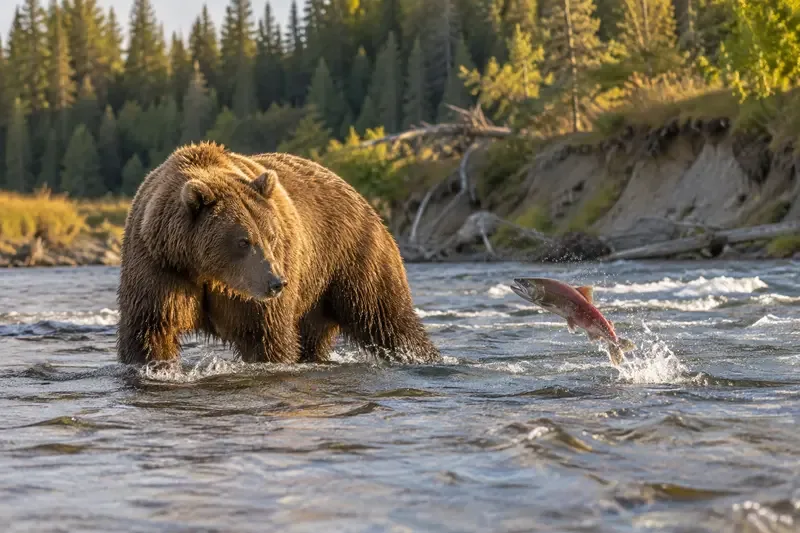
A coastal brown bear fishes in a river similar to Brooks River in Katmai National Park, where summer salmon help bears build the fat reserves they need for winter.
What is Fat Bear Week?
Fat Bear Week is an annual public tournament centered on the brown bears of Brooks River in Katmai National Park and Preserve, Alaska. People around the world compare the participating bears and vote for the one they believe best represents fatness, survival, and success after a demanding summer.
The event began in 2014. It is playful in tone, but the biological story behind it is serious. Katmai's bears spend the summer finding calorie-rich food, especially sockeye salmon, and storing energy before winter. In a single-elimination tournament, a bear advances when it receives more votes than its opponent. The last bear standing becomes the Fat Bear Week champion.
That description matters because this is not a laboratory contest with a scale, a weigh-in, or one official measurement of “the fattest” bear. The organizers describe it as a subjective competition. Voters can consider a bear's visible size, its progress through the season, fishing ability, age, family responsibilities, resilience, and the challenges it overcame.
When is Fat Bear Week 2026?
For 2026, the tournament runs from September 22 through September 29. The National Park Service says the bracket was revealed on September 18. The published schedule lists matchups on September 22–25, no voting on September 26–27, semifinal voting on September 28, and the championship match on September 29.
The official voting page lists voting hours as 12–9 p.m. Eastern, 9 a.m.–6 p.m. Pacific, and 8 a.m.–5 p.m. Alaska time. Because event pages can change during a live tournament, check the current schedule before planning around a particular matchup.
Start with the official Meet the Bears page. It groups the 2026 candidates by life stage and family situation, including mothers with cubs, subadult bears, single adult females, and adult males. Examples include 132, 284, 610, 806, 901, 428 Studious, 909, 910, 32 Chunk, 151 Walker, and other bears identified by park researchers and observers.
The number used for a bear is an identification number, not a ranking. A bear with a lower number is not automatically older, larger, or more likely to win. Read the biography and look at the before-and-after images when available. They give useful context that a single late-summer photograph cannot show.
2. Study the bracket
The bracket pairs contestants in head-to-head matchups. A bracket is simply a tournament chart showing who faces whom and how winners move toward the final. Before voting, note the date of each matchup and the bear's situation. Comparing a large adult male with a growing subadult or a mother caring for cubs requires more thought than comparing two nearly identical photographs.
3. Vote through the official page
During an open matchup, choose the bear you think best demonstrates success in the wild. On the voting page, click or tap that bear's photo, enter your email when prompted, and submit. The official instructions say the poll registers one vote per email. If the updated results do not appear, refresh the page; if a poll does not load, the page advises checking blockers and trying again.
A practical newcomer routine is to open the official tournament page, read both biographies, make one choice based on evidence, and save the next matchup date. Do not assume a result is final simply because one bear appears ahead early in the day. Online totals can change while voting remains open.
4. Follow the live educational programming
Voting is only one part of the event. Explore.org and Katmai rangers also schedule live chats and explainers about fishing behavior, body fat, salmon, and the park ecosystem. The 2026 schedule includes ranger commentary from Brooks River, a program about how bears achieve their winter goal, semifinal coverage, and a finale discussion about the two remaining bears.
If you want to observe rather than vote, the National Park Service's Bears of Katmai resource links to bear webcams and background information. Watching for a few minutes can help you notice fishing styles, competition for productive spots, and the difference between an adult bear and a subadult bear.
Why do bears need to get so fat?
Brown bears enter a period of winter dormancy in a den. In the Fat Bear Week explanation, Katmai's organizers describe the winter period as one in which bears do not eat or drink and can lose about one-third of their body weight. Fat reserves supply energy for that interval.
Late summer is therefore a time of intense feeding. At Brooks River, salmon provide an unusually concentrated and accessible source of energy. Bears may fish in different parts of the river, wait for an opportunity at the falls, or use other foods when competition is high. The most successful strategy is not identical for every bear. Age, size, experience, family responsibilities, injury, and the location of fish all affect the outcome.
This is also why “fat” should not be read as a judgment about human body size. For these wild bears, adequate body fat is an adaptation that supports winter survival and, for females, the energy demands of giving birth and nursing cubs in the den before they emerge in spring.
Why the bears matter beyond the contest
Katmai's brown bears are part of a connected system rather than isolated internet celebrities. The National Park Service describes salmon as a keystone species in the ecosystem: a species whose influence is especially important to the wider community of organisms. Salmon feed bears and other wildlife, while the health of the rivers and spawning habitat affects the fish themselves.
Katmai's legal conservation purpose includes protecting concentrations of brown bears and their denning areas, as well as watersheds and water habitat vital to red salmon spawning. That connection makes the tournament a simple entry point into larger questions: Are salmon runs healthy? Can bears find safe places to feed and den? How do visitors and online audiences affect wildlife? What happens when water conditions, food availability, or climate patterns change?
The public attention can also support education. The park's classroom materials use Fat Bear Week to teach food webs, salmon life cycles, observation, ecosystems, critical thinking, and human impacts. A family or classroom can watch a bear cam, record what the bear does, and discuss what cannot be seen from the camera, such as the larger watershed and the many species connected to the river.
Common mistakes first-time viewers should avoid
Assuming the biggest-looking photo proves the bear is the heaviest. Camera angle, wet fur, lighting, posture, and distance can change appearance. Use the official biography and seasonal context.
Treating the vote as a scientific measurement. The tournament is a public, subjective celebration, not a standardized population survey or a complete assessment of bear health.
Ignoring age and family role. A subadult's growth and a mother's work raising cubs are different kinds of success. The official bear profiles explain those differences.
Using an unofficial poll or copied schedule. Event times and matchup information can change. Start with FatBearWeek.org, which routes to the official Explore.org event page, or the NPS announcement.
Expecting every bear to behave like a cartoon character. Wild brown bears can be affectionate with cubs, competitive, cautious, or dangerous depending on circumstances. Watch from a respectful distance in person and avoid treating a live camera as an invitation to interfere.
Forgetting that salmon are part of the story. A bear's success depends on a broader habitat. Learning about the river and fish makes the event more meaningful than choosing a favorite face.
A simple way to follow Fat Bear Week 2026
Check the official schedule and note the next open voting window.
Read the two contestants' official biographies before voting.
Compare the evidence: body condition, age, fishing skill, family duties, and obstacles faced.
Submit one vote through the official poll and confirm that the page acknowledges it.
Use a bear cam or ranger program to observe behavior rather than relying only on still photos.
After the final, look at what the event revealed about salmon, habitat, and the conservation work at Katmai.
Fat Bear Week 2026 is easy to enter because the first action is simple: learn about two bears and make a choice. Its lasting value comes from what follows that choice. The tournament turns a seasonal wildlife spectacle into a practical lesson about adaptation, energy, parenting, competition, and the healthy rivers that make life at Brooks River possible.