Home
» News
»
Opus 5.5: What to Know About the Claude AI Model Name—and the Official Opus 5
Opus 5.5: What to Know About the Claude AI Model Name—and the Official Opus 5
If you are seeing searches for “Opus 5.5,” the first thing to know is that Anthropic’s official model catalog does not currently list a Claude model with that name. As of September 23, 2026, the company’s current documentation identifies Claude Opus 5 as the active Opus-generation model, alongside Claude Sonnet 5, Claude Fable 5.1, and older Opus releases that remain available. Anthropic announced Opus 5 on July 24, 2026.
That distinction matters because model names affect API identifiers, pricing, migration decisions, benchmarks, and expectations. Treating “Opus 5.5” as an official release before Anthropic documents it could lead developers to code against a nonexistent model ID or readers to compare specifications that have never been published.
This article therefore uses “Opus 5.5” as the search term people are encountering, while grounding the comparison in the currently documented Claude lineup.
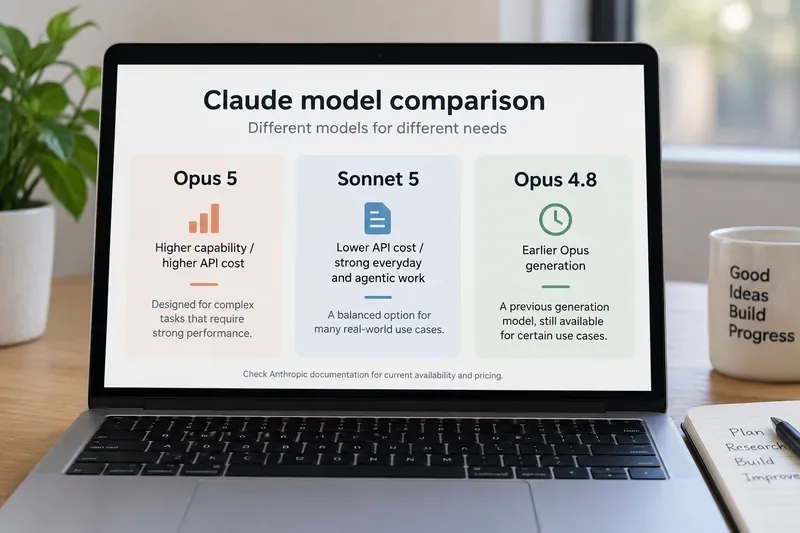
Anthropic’s current lineup gives users several trade-offs between capability, latency, and price; the official documentation currently lists Opus 5 rather than an Opus 5.5 model.
Is Claude Opus 5.5 an official model?
Not according to Anthropic’s current public documentation. The company’s Claude models overview lists Claude Fable 5.1, Claude Opus 5, Claude Sonnet 5, and Claude Haiku 4.5 among the current models. Its model lifecycle documentation also lists claude-opus-5 as active, but does not list a claude-opus-5-5 model.
Anthropic’s official announcement, Introducing Claude Opus 5, is dated July 24, 2026. If Anthropic later announces an Opus 5.5 release, the relevant facts should be checked again against the company’s newsroom and developer documentation rather than inferred from search trends, social posts, or third-party model menus.
What is Claude Opus 5 actually designed for?
Anthropic positions Claude Opus 5 for complex agentic coding and enterprise work. The official developer documentation highlights its gains over Opus 4.8 in deep reasoning, long-horizon tasks, code review, vision, large-context work, document creation, and multi-agent coordination.
The model has a 1 million-token context window and a maximum standard output of 128,000 tokens. Its API model ID is claude-opus-5. Anthropic lists API pricing at $5 per million input tokens and $25 per million output tokens.
Those numbers make Opus 5 a serious option for difficult workloads, but not automatically the right choice for every request. The more useful question is what you gain for the additional cost and latency compared with lighter models.
What changed from Opus 4.8 to Opus 5?
According to Anthropic’s Opus 5 technical overview, the largest improvements are in deep reasoning, agentic coding, long-running tasks, test-time compute scaling, code review, vision, long-context work, and multi-agent coordination.
There are also behavior and API differences that matter during migration. Thinking is enabled by default on Opus 5, and Anthropic exposes multiple effort levels—low, medium, high, xhigh, and max. Higher effort can improve results on demanding tasks, but it can also increase token use and latency. That makes effort tuning one of the central trade-offs with Opus 5.
For teams already using Opus 4.8, this means migration should be evaluated on real workloads rather than based only on benchmark headlines. A higher-capability model may complete a task in fewer retries or tool calls, but those savings depend heavily on the task and prompt design.
Opus 5 vs. Sonnet 5: which trade-off makes sense?
Claude Sonnet 5 is the more cost-oriented option in Anthropic’s current generation. Anthropic prices it at $2 per million input tokens and $10 per million output tokens, compared with $5 and $25 for Opus 5. The company describes Sonnet 5 as a strong combination of speed and intelligence for everyday coding, agent, and enterprise workloads.
Criteria
Claude Opus 5
Claude Sonnet 5
Primary positioning
Complex agentic coding and enterprise work
Speed and capability for everyday coding and agent workloads
Input price
$5 per million tokens
$2 per million tokens
Output price
$25 per million tokens
$10 per million tokens
Context window
1 million tokens
1 million tokens
Relative latency
Moderate
Fast
Best fit
Hard reasoning, large refactors, autonomous multi-step work
High-volume coding, content, analysis, and tool use where cost matters more
For a developer processing thousands of routine requests, Sonnet 5 may offer the more practical cost profile. For a smaller number of difficult tasks where failure is expensive—such as complex debugging, large codebase changes, or long agent loops—Opus 5 may justify the higher per-token rate.
Anthropic’s Sonnet 5 announcement also notes that higher-effort Sonnet settings can approach earlier Opus-class performance on some tasks. That reinforces an important point: model selection is not only about model family. Effort settings, prompt quality, tool access, and evaluation criteria can materially change the result.
When would Fable 5.1 make more sense than Opus 5?
Anthropic’s current model-selection guidance places Claude Fable 5.1 above Opus 5 for the most demanding reasoning and long-horizon agentic work. Fable 5.1 costs more—$10 per million input tokens and $50 per million output tokens—and has higher latency, so the additional capability comes with a clear operational trade-off.
If a workflow consistently fails on Opus 5 even after prompt optimization and higher effort settings, Anthropic recommends considering Fable 5.1. That makes Fable a candidate for tasks where accuracy and long-horizon execution matter more than cost, not a default replacement for Opus or Sonnet.
Should developers migrate from Opus 4.8 immediately?
Not necessarily. Opus 4.8 remains active in Anthropic’s current lifecycle documentation, so existing applications do not have to switch solely because Opus 5 exists. The better decision depends on measurable benefits.
A practical migration test should compare at least four things: task success rate, total tokens consumed, wall-clock latency, and how often a human has to intervene. If Opus 5 solves more tasks on the first attempt or needs fewer tool calls, its higher reasoning capability may reduce the total cost of the workflow even when the per-token price is unchanged from Opus 4.8. If the workload is already stable, the migration benefit may be smaller.
What should API users check before changing models?
First, use the exact documented model ID. For Opus 5, Anthropic lists claude-opus-5. Do not assume that a search phrase such as “Opus 5.5” maps to a valid API name.
Second, review effort settings. Opus 5 supports low, medium, high, xhigh, and max effort. Higher settings are intended for harder problems but can consume more output tokens and take longer. A production system should measure quality against cost at multiple effort levels rather than simply selecting max.
Third, retest prompts and tool workflows. Anthropic says Opus 5 generally works well with prompts written for Opus 4.8, but model behavior changes can still affect output length, tool usage, and how long an agent continues working before returning control.
Which Claude model should you choose right now?
There is no single best answer for every workload. The useful choice depends on what you are optimizing:
Choose Opus 5 when difficult reasoning, large codebase work, long tool-use loops, or complex enterprise tasks justify a higher cost than Sonnet.
Choose Sonnet 5 when you need strong coding and agentic performance at lower cost and higher speed, especially for high-volume workloads.
Consider Fable 5.1 when your most demanding tasks still fall short on Opus 5 and the extra cost is acceptable.
Keep Opus 4.8 temporarily when an existing production system is stable and you have not yet measured enough benefit from migration.
For developers, the safest approach is to build a small evaluation set from real production tasks and test models under the same conditions. Anthropic’s own model selection guide recommends choosing based on capabilities, speed, cost, and effort rather than on a model name alone.
What should readers watch for next?
The current evidence supports Claude Opus 5, not an officially released “Opus 5.5.” If Anthropic introduces a 5.5 revision later, the most important details to verify will be the announcement date, API model ID, context and output limits, pricing, effort controls, migration notes, benchmark methodology, and availability across Claude, the API, Amazon Bedrock, Google Cloud, and Microsoft Foundry.
Until those details appear in Anthropic’s own documentation, claims about “Opus 5.5” specifications should be treated as unconfirmed. For anyone making a buying, migration, or architecture decision today, the documented comparison is between the models Anthropic actually lists: especially Opus 5, Sonnet 5, Fable 5.1, and the still-supported Opus 4.8.