Home
» News
»
What Martha’s Rule Means for A&E Patients in England
What Martha’s Rule Means for A&E Patients in England
You are in an A&E waiting area in England when a relative becomes much more confused, short of breath, unusually drowsy, or clearly worse than when you arrived. You have already spoken to a member of staff, but you still feel that the change is not being recognized. What can you do?
Martha’s Rule is designed for that kind of patient-safety concern. It gives patients, families, carers, advocates, and hospital staff a structured way to ask for an urgent review by another clinical team when a patient may be deteriorating and their concerns are not being addressed. The review is not a guaranteed second diagnosis, admission, scan, medication, or intensive-care transfer. It is a route to make sure a serious concern is heard and assessed promptly.
There is an important update for A&E patients. As of September 22, 2026, NHS England is expanding Martha’s Rule into emergency departments, but local availability and the exact process may still differ while the rollout continues. NHS England’s patient information says the service is not available everywhere yet and that implementation in the newer settings is expected during 2026/27. Before relying on a phone number, ask the A&E team whether Martha’s Rule is active there and how to use it.
The first practical step is to tell the A&E triage or clinical team clearly when a patient’s condition changes.
What is Martha’s Rule?
Martha’s Rule is an NHS patient-safety initiative named after Martha Mills, a 13-year-old who died in hospital in 2021 after developing sepsis. Her family had raised concerns about her worsening condition, and a coroner later concluded that she probably would have survived if she had been moved to intensive care sooner. The policy grew from the need to listen to patients and families who may notice a change before it is obvious in routine clinical observations.
In this article, deterioration means a patient’s health appears to be getting worse. Escalation means taking a concern to a more senior or different clinical team because the first response has not resolved the worry. A rapid review is an urgent assessment by a team that is separate from the clinicians initially caring for the patient. A critical care outreach team is a hospital team with expertise in recognizing and managing seriously unwell patients.
The policy should not be confused with a routine second opinion. A second opinion usually means asking another professional to consider a diagnosis or treatment plan. Martha’s Rule is an escalation route for a concern about a patient becoming more unwell, especially when the concern has already been raised but still feels unresolved.
What changes for someone in A&E?
A&E means accident and emergency, also called an emergency department. It is the hospital service for serious injuries and life-threatening emergencies. Patients may be in a waiting room, triage area, assessment area, treatment cubicle, or short-stay space. The new A&E focus matters because people can become more unwell while waiting, moving between areas, or awaiting tests and treatment.
Under the expansion, patients, relatives, carers, and A&E staff will have another route to request an urgent review when the patient’s condition is worsening and they believe the concern is not being acted on. In practice, this normally means a local hospital phone number, poster, or staff-led process. There is not one universal national Martha’s Rule number that every A&E patient should call.
The rollout is intended to include emergency-department spaces such as waiting areas, but local implementation remains the deciding factor. Some hospitals may already display the process prominently; others may still be preparing their local service. The safest first action is always to tell the nurse, doctor, healthcare assistant, or reception and triage staff immediately if the patient is becoming worse.
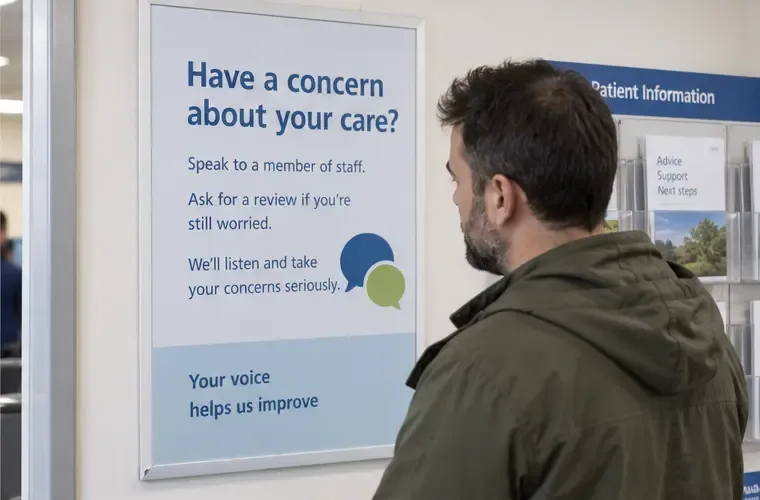
A local poster or information board may explain whether Martha’s Rule is available and how patients and families can request a review.
How the three parts of Martha’s Rule work
NHS England describes three core components. They are easier to understand when separated into what the patient hears, what people can request, and what the hospital must provide.
Component
What it means
What an A&E patient should know
Patient wellness question
A structured question asks the patient, at least daily in inpatient care, whether they feel better or worse.
A short A&E visit may not follow the same daily-question routine. Still, you should report any new or worsening symptom immediately.
Access to escalation
Patients, families, carers, advocates, and staff can raise an unresolved deterioration concern through a clearly advertised local route.
Ask staff for the local Martha’s Rule or patient-and-family escalation process. Do not guess a number from an online post.
Rapid clinical review
A different or specialist clinical team reviews the concern and decides what action is needed.
The result may be reassurance, more observations, tests, treatment changes, a senior review, or transfer to a higher level of care.
The first component was developed mainly for inpatient care, where a person may be asked about their progress every day. The A&E expansion is about adapting the voice and escalation elements to a fast-moving emergency setting. That is why a patient should not wait for a routine question. If you see a change, speak up at once.
How to use Martha’s Rule in A&E: a beginner’s route
1. Notice and describe the change
Start with what is different from earlier. Useful details include when the change began, what you noticed, and whether it is getting worse. For example: “Since 20 minutes ago, she is much harder to wake and is not answering normally,” or “His breathing is faster and he looks paler than when we arrived.” You do not need to name the diagnosis.
Recording when a symptom changed and what you observed can help you give the clinical team a precise account.
2. Tell the current A&E team immediately
Tell the nurse, doctor, healthcare assistant, or triage desk. If the patient is in a cubicle, use the call bell if one is available. If the patient is in a waiting area, go to the reception or clinical desk and explain that the condition has changed. Do not assume staff have seen the change just because observations were taken earlier.
Tell the current nurse or doctor what has changed, and ask for help promptly if the patient appears more unwell.
3. Explain that you remain worried
If the response does not address the concern, say so respectfully and specifically: “I understand you are assessing him, but I am still worried because he is now confused and difficult to wake. Can you explain what will happen next?” Clear information helps the team decide whether an immediate clinical response is needed.
4. Ask whether Martha’s Rule is available there
If you still believe the patient is deteriorating and the concern has not been addressed, ask: “Is Martha’s Rule available in this A&E, and how do I request the rapid review?” Ask a staff member to show you the poster, phone instructions, or local process. The number and response arrangement can be specific to the hospital.
If the local process directs you to a hospital helpline, give the patient’s location and describe the unresolved change in condition.The hospital’s current patient-safety information may explain how to request an escalation review at that location.
5. Give the information the reviewing team needs
Be ready to provide the patient’s name, date of birth if requested, current location, your relationship to the patient, and a callback number. Explain what changed, when it changed, who you already spoke to, and why you remain concerned. If English is not your first language or communication is difficult, ask the hospital for an interpreter or another communication support.
6. Stay available and follow the instructions
The reviewing team may speak with you, examine the patient, check observations, look at the notes, and contact the A&E team. The review may lead to a change in monitoring or treatment, further tests, a senior decision, transfer to another area, or a clear explanation that no change is needed at that moment. A review is an assessment, not a promise of a particular outcome.
A rapid review is a clinical conversation and assessment by a different or specialist team, followed by a decision about the safest next step.After the review, ask which team is responsible, what will happen next, and which changes should be reported immediately.
When should you not wait to use Martha’s Rule?
Martha’s Rule must not delay emergency action. If someone is unconscious, not breathing normally, having severe difficulty breathing, suffering severe bleeding, or showing another immediate threat to life, call 999 when outside hospital. If you are already in A&E, alert the nearest member of staff loudly and directly and follow their instructions. The NHS says 999 is for life-threatening emergencies, while NHS 111 can help when you need urgent advice but are unsure what service is appropriate.
Similarly, do not wait to find a poster or phone number if a patient suddenly collapses or becomes critically unwell. Martha’s Rule is an additional safety route for an unresolved concern; it is not a replacement for the emergency response already available in A&E.
Common mistakes to avoid
Waiting quietly because the department is busy: A busy A&E is not a reason to hide a new or worsening symptom. Tell staff again if the condition changes.
Calling it a complaint: Martha’s Rule is for a safety concern about deterioration, not a routine complaint about parking, waiting times, food, or billing.
Assuming the service has one national phone number: The contact route is local. Ask the hospital team for the current instructions.
Demanding a particular treatment: Describe the change and the risk you are worried about. The reviewing clinicians decide what assessment or treatment is appropriate.
Leaving the department to seek help elsewhere: Tell staff before moving or leaving, especially if the patient is unstable. Follow clinical advice about where the patient should remain.
Using an old leaflet or social-media number: Hospital procedures can change during the rollout. Use the current poster, patient information, or staff instructions at that hospital.
What if the A&E says Martha’s Rule is not live yet?
Ask the nurse or doctor to record and respond to your concern through the normal clinical escalation process. You can also ask for the nurse in charge, senior clinician, or hospital patient-experience team, depending on the urgency. If the patient is getting worse, keep describing the change to staff rather than treating the absence of a local Martha’s Rule phone line as the end of the conversation.
NHS England’s national guidance is moving toward wider implementation, but the local launch date, phone route, and team responsible for reviews may not be identical between hospitals. The official patient information page is therefore more useful for understanding the policy than for finding a universal telephone number. For local instructions, check the hospital’s current website or ask staff at the A&E desk.
What Martha’s Rule does—and does not—guarantee
It does provide
It does not guarantee
A recognized route to raise a serious unresolved concern
A diagnosis that agrees with the patient or family
Access to a review process where the local service is active
Immediate treatment, admission, or an intensive-care bed
A way for families, carers, advocates, and staff to contribute information
That every concern will lead to a change in treatment
A patient-safety check when deterioration may be missed
A substitute for calling 999 or alerting staff in a life-threatening emergency
How to check the result before you leave
Can you explain what change in the patient’s condition was assessed?
Do you know which team is now responsible for monitoring the patient?
Have staff explained what symptoms or changes should be reported immediately?
Do you know whether the patient is waiting for a test, treatment, transfer, or another review?
If you remain worried, have you clearly said so and asked who to speak to next?
If the patient has been discharged, follow the written safety-netting instructions and seek urgent help if the condition worsens. For life-threatening symptoms, use 999. If you need urgent medical advice but it is not a life-threatening emergency, use NHS 111 or 111 online. If you are still in the hospital and the patient is deteriorating, tell the clinical team immediately rather than waiting for a follow-up call.
The practical meaning of Martha’s Rule for A&E patients is simple: your observation of a worsening condition is useful clinical information, and you should have a clear way to make sure it is heard. The rule strengthens that route as A&E departments adopt it, but the safest behavior remains the same during every stage of the rollout—speak up early, describe the change precisely, ask what will happen next, and escalate again if the concern is not addressed.